Convert atmospheres to psi
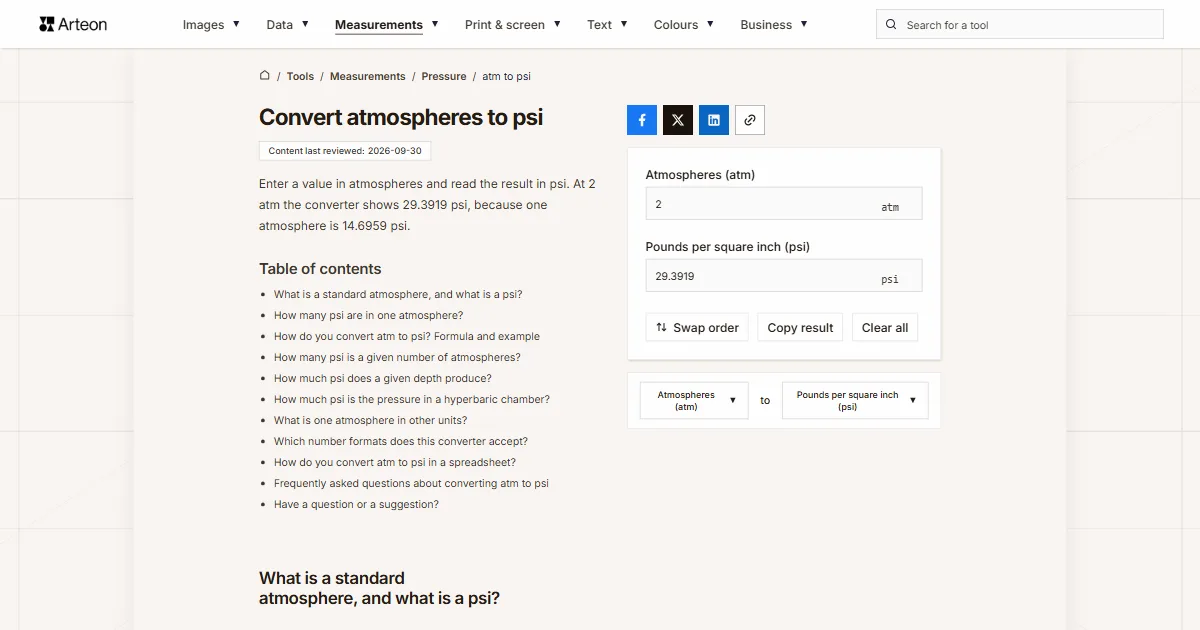
Enter a value in atmospheres and read the result in psi. At 2 atm the converter shows 29.3919 psi, because one atmosphere is 14.6959 psi.
What is a standard atmosphere, and what is a psi?
The standard atmosphere describes the pressure air exerts at sea level. Its value is fixed at exactly 101,325 pascals[1], and it is sometimes used as a reference pressure[2].
The symbol of the unit is atm. A separate unit called the technical atmosphere carries the symbol at and equals 98,066.5 pascals[1], which comes to 14.2233 psi. This page works with the standard atmosphere.
A psi is one pound-force spread over one square inch[3]. It equals 6,894.757 pascals[1], so it is a far smaller unit than the atmosphere. That size difference is why a single atmosphere already gives a two-digit figure in psi.
How many psi are in one atmosphere?
One atmosphere is 14.6959 psi. You multiply the number of atmospheres by that value, so the formula reads psi = atm × 14.6959.
The figure comes from dividing two definitions by each other. An atmosphere is exactly 101,325 pascals and a psi is 6,894.757 pascals[1]. That psi figure is rounded, and dividing the full definitions gives 14.695 948 8. The IUPAC pressure conversion table prints the same number[4].
Technical texts also use the rounded 14.7 psi per atmosphere. Rounding shifts the result by 0.004 psi for every atmosphere. At two hundred atmospheres that adds up to 0.81 psi. The converter on this page uses the full factor, so its result matches the table to the fourth decimal place.
The same factor works across the whole range. One tenth of an atmosphere gives 1.4696 psi, and a thousand atmospheres give 14,695.9488 psi.
How do you convert atm to psi? Formula and example
The arithmetic takes one step: multiply the number of atmospheres by 14.6959. Three worked examples follow.
Two and a half atmospheres give 36.7399 psi. Five atmospheres come to 73.4797 psi. A hundred atmospheres reach 1,469.5949 psi. The same multiplication produces all three, because the relation between the units is linear.
The psi to atm converter runs the calculation the other way. If your reading is in bar or in kilopascals, the bar to psi converter and the kPa to psi converter handle those.
How many psi is a given number of atmospheres?
| Atmospheres | Psi | Kilopascals |
|---|---|---|
| 0.1 atm | 1.4696 psi | 10.1325 kPa |
| 0.2 atm | 2.9392 psi | 20.265 kPa |
| 0.3 atm | 4.4088 psi | 30.3975 kPa |
| 0.5 atm | 7.348 psi | 50.6625 kPa |
| 0.8 atm | 11.7568 psi | 81.06 kPa |
| 1 atm | 14.6959 psi | 101.325 kPa |
| 1.2 atm | 17.6351 psi | 121.59 kPa |
| 1.3 atm | 19.1047 psi | 131.7225 kPa |
| 1.5 atm | 22.0439 psi | 151.9875 kPa |
| 1.8 atm | 26.4527 psi | 182.385 kPa |
| 2 atm | 29.3919 psi | 202.65 kPa |
| 2.2 atm | 32.3311 psi | 222.915 kPa |
| 2.5 atm | 36.7399 psi | 253.3125 kPa |
| 2.8 atm | 41.1487 psi | 283.71 kPa |
| 3 atm | 44.0878 psi | 303.975 kPa |
| 3.5 atm | 51.4358 psi | 354.6375 kPa |
| 4 atm | 58.7838 psi | 405.3 kPa |
| 4.5 atm | 66.1318 psi | 455.9625 kPa |
| 5 atm | 73.4797 psi | 506.625 kPa |
| 6 atm | 88.1757 psi | 607.95 kPa |
| 7 atm | 102.8716 psi | 709.275 kPa |
| 8 atm | 117.5676 psi | 810.6 kPa |
| 9 atm | 132.2635 psi | 911.925 kPa |
| 10 atm | 146.9595 psi | 1,013.25 kPa |
| 12 atm | 176.3514 psi | 1,215.9 kPa |
| 14 atm | 205.7433 psi | 1,418.55 kPa |
| 16 atm | 235.1352 psi | 1,621.2 kPa |
| 18 atm | 264.5271 psi | 1,823.85 kPa |
| 20 atm | 293.919 psi | 2,026.5 kPa |
| 25 atm | 367.3987 psi | 2,533.125 kPa |
| 29 atm | 426.1825 psi | 2,938.425 kPa |
| 30 atm | 440.8785 psi | 3,039.75 kPa |
| 35 atm | 514.3582 psi | 3,546.375 kPa |
| 40 atm | 587.838 psi | 4,053 kPa |
| 45 atm | 661.3177 psi | 4,559.625 kPa |
| 50 atm | 734.7974 psi | 5,066.25 kPa |
| 60 atm | 881.7569 psi | 6,079.5 kPa |
| 70 atm | 1,028.7164 psi | 7,092.75 kPa |
| 71 atm | 1,043.4124 psi | 7,194.075 kPa |
| 80 atm | 1,175.6759 psi | 8,106 kPa |
| 90 atm | 1,322.6354 psi | 9,119.25 kPa |
| 100 atm | 1,469.5949 psi | 10,132.5 kPa |
| 150 atm | 2,204.3923 psi | 15,198.75 kPa |
| 200 atm | 2,939.1898 psi | 20,265 kPa |
| 250 atm | 3,673.9872 psi | 25,331.25 kPa |
| 300 atm | 4,408.7846 psi | 30,397.5 kPa |
| 380 atm | 5,584.4605 psi | 38,503.5 kPa |
| 400 atm | 5,878.3795 psi | 40,530 kPa |
| 500 atm | 7,347.9744 psi | 50,662.5 kPa |
| 700 atm | 10,287.1641 psi | 70,927.5 kPa |
| 1,000 atm | 14,695.9488 psi | 101,325 kPa |
How much psi does a given depth produce?
| Absolute pressure | Depth in sea water | Depth in fresh water | Psi |
|---|---|---|---|
| 1 ATA | 0 ft | 0 ft | 14.6959 psi |
| 2 ATA | 33 ft | 34 ft | 29.3919 psi |
| 3 ATA | 66 ft | 68 ft | 44.0878 psi |
| 4 ATA | 99 ft | 102 ft | 58.7838 psi |
| 5 ATA | 132 ft | 136 ft | 73.4797 psi |
| 6 ATA | 165 ft | 170 ft | 88.1757 psi |
| 10 ATA | 297 ft | 306 ft | 146.9595 psi |
| 40 ATA | 1,287 ft | 1,326 ft | 587.838 psi |
How much psi is the pressure in a hyperbaric chamber?
A hyperbaric chamber is a sealed room where staff raise the air pressure while the patient breathes pure oxygen through a mask. The chamber run by Hyperbaric Treatment & Training Services in Birkenhead is pressurised to 2.4 atmospheres absolute, the equivalent of 14 metres of seawater, and each session lasts 90 minutes at that depth[6]. Absolute means the figure includes the air pressure around us, so the count starts at one atmosphere.
Converted, 2.4 atmospheres absolute is 35.2703 psi. A gauge that reads zero at room pressure shows 1.4 atmospheres over that, which is 20.5743 psi. In psi the absolute figure is written psia and the gauge figure psig, so the same chamber runs at 35.2703 psia or 20.5743 psig.
What is one atmosphere in other units?
| Unit | Value of one atmosphere |
|---|---|
| Pascal (Pa) | 101,325 Pa |
| Kilopascal (kPa) | 101.325 kPa |
| Bar | 1.01325 bar |
| Torr | 760 Torr |
| Millimetre of mercury (mmHg) | 760 mmHg |
| Technical atmosphere (at) | 1.033227 at |
| Pound per square inch (psi) | 14.6959 psi |
Which number formats does this converter accept?
| What you type | What the converter shows | Note |
|---|---|---|
| 2 | 29.3919 psi | A plain number is read as atmospheres, because that’s what the field is labeled. |
| 2 atm | 29.3919 psi | The atm symbol pasted along with the number is skipped, so only the number counts. |
| 2 atmospheres | 29.3919 psi | The whole word is skipped the same way, so a phrase copied from a text needs no tidying. |
| 2 ATA | 29.3919 psi | The ATA suffix from dive tables and hyperbaric chamber notes is skipped, and the number counts as absolute atmospheres. |
| 2.5 | 36.7399 psi | The period is your decimal point, and that’s exactly how we read it. |
| 2,5 | 36.7399 psi | A comma with fewer than three digits after it is a decimal comma from a European document, so we read two and a half atmospheres. |
| 1.500 | 22.0439 psi | A single period is always read as a decimal point, so the field takes one and a half atmospheres. A note under the field says: Read as 1.5. If you meant 1500, type 1500. |
| 1,500 | 22043.9232 psi | A comma followed by three digits groups thousands, so the field reads fifteen hundred atmospheres. A note under the field says: Read as 1500. If you meant 1.5, type 1.5. |
| 1/2 | 7.348 psi | A fraction with a slash is worked out for you, so half an atmosphere doesn’t need to become 0.5 first. |
| 2½ | 36.7399 psi | The ½ character copied from a text is added to the number in front of it. |
| -0.5 | -7.348 psi | A minus sign is accepted, so a vacuum gauge reading below the surrounding air pressure converts too. |
| -80 kPa | -11.603 psi | A pressure in another unit is converted by the field itself, minus sign included, as long as the minus sits right against the number. |
| - 80 kPa | The result field stays empty. | A minus separated by a space isn’t joined to the number, so nothing is calculated. Type the minus right before the digit. |
How do you convert atm to psi in a spreadsheet?
Excel carries a built-in function for pressure units, and the unit codes atm and psi are all it needs.
Type the pressure in atmospheres
Put the number of atmospheres in a cell, for example 2.5 in cell A2.Call the CONVERT function
In the next cell type =CONVERT(A2,"atm","psi"). The function takes number, from_unit and to_unit[7].Keep the quotation marks on the codes
The codes "atm" and "psi" stay inside quotation marks and in lower case, because Excel reads them as pressure unit codes.Drag the formula down
Grab the bottom right corner of the result cell and drag it along the column to convert a whole list of pressures at once.
Convert other units to Pounds per square inch (psi)
Sources
- NIST Guide to the SI, Appendix B.9: Factors for Units Listed by Kind of Quantity or Field of Science — National Institute of Standards and Technology
- Standard atmosphere (unit) — Wikipedia
- Pound per square inch — Wikipedia
- Quantities, Units and Symbols in Physical Chemistry (Green Book), 3rd edition, p. 233 — International Union of Pure and Applied Chemistry
- Atmospheric and Hydrostatic Pressure — NOAA Diving Center
- Our patients — Hyperbaric Treatment & Training Services
- CONVERT function — Microsoft
Every figure in the tables was computed from the unit definitions and checked arithmetically before publication. Historical values and the names of local units come from the sources listed above.
Content last reviewed: · written and checked by the Arteon team
Frequently asked questions about converting atm to psi
Is 14.7 psi exactly one atmosphere?
One atmosphere is 14.6959 psi. A reading of 14.7 psi works out to 1.000276 atmospheres, so the gap stays under three ten-thousandths of an atmosphere and workshop arithmetic lands on the same answer.
How many psi are 2 atm?
Two atmospheres come to 29.3919 psi, or 202.65 kilopascals. That is the absolute pressure 33 feet below the surface of the sea.
How many psi is 2.5 atm?
Two and a half atmospheres give 36.7399 psi. In bar the same pressure reads 2.5331, because a bar is a slightly smaller unit than an atmosphere.
How many psi are 10 atm?
Ten atmospheres come to 146.9595 psi and 1,013.25 kilopascals. Absolute pressure reaches that level 297 feet below the surface of the sea.
How many psi are 100 atm?
A hundred atmospheres come to 1,469.5949 psi. In kilopascals that is 10,132.5, exactly one hundred times the value of a single atmosphere.
Is 1 bar 14.5 or 14.7 psi?
One bar is 14.5038 psi and one atmosphere is 14.6959 psi. A bar is exactly 100,000 pascals and an atmosphere is 101,325, so both figures are right, each for its own unit. The bar to psi converter handles bar readings.
What is the difference between the standard and the technical atmosphere?
The standard atmosphere is 101,325 pascals and 14.6959 psi, while the technical atmosphere is 98,066.5 pascals and 14.2233 psi. The second one matches one kilogram-force per square centimetre and carries its own symbol, at.
Is air pressure always one atmosphere?
The standard atmosphere is an agreed value, while real air pressure moves with the weather and with altitude. The records for sea-level air pressure are listed in a table on the psi to atm converter page.
How many atmospheres are 33 feet under water?
Thirty-three feet of sea water add one atmosphere of gauge pressure, so together with the air above the surface that makes two atmospheres absolute. In fresh water the same atmosphere arrives at 34 feet.
Is the atmosphere an SI unit?
The SI unit of pressure is the pascal. The atmosphere is outside the SI, and chemistry has used 100 kilopascals, one bar, as its standard pressure since 1982.
Have a question or a suggestion?
Write to us if you need another pressure unit converted, or if you spot a value in the tables worth correcting.