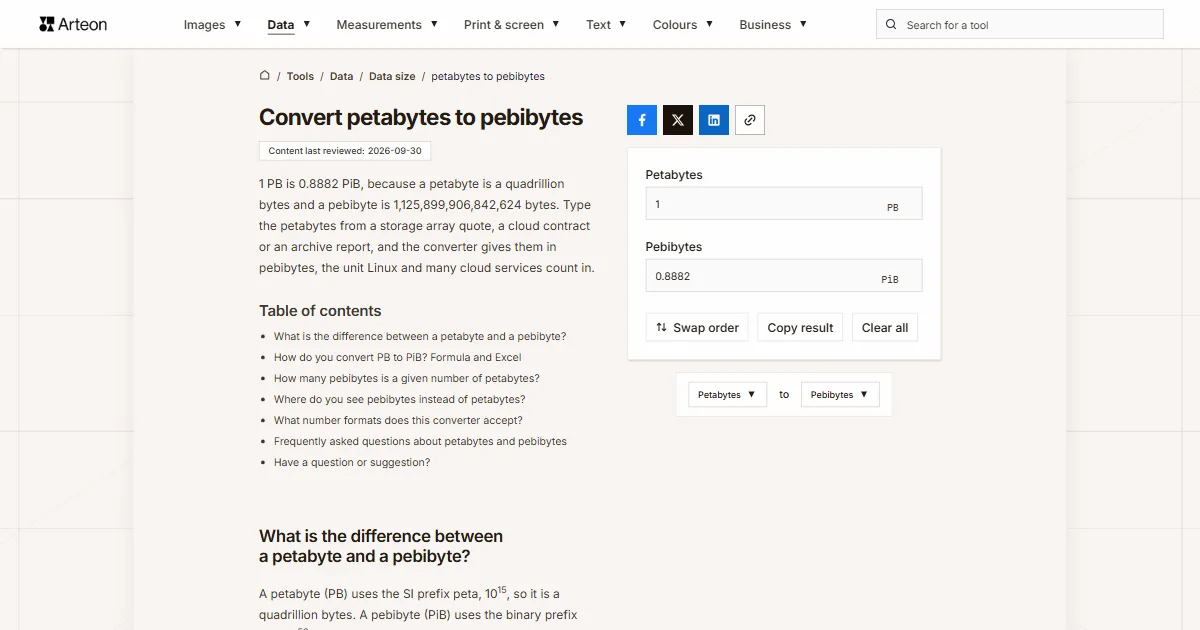
Convert petabytes to pebibytes
1 PB is 0.8882 PiB, because a petabyte is a quadrillion bytes and a pebibyte is 1,125,899,906,842,624 bytes. Type the petabytes from a storage array quote, a cloud contract or an archive report, and the converter gives them in pebibytes, the unit Linux and many cloud services count in.
What is the difference between a petabyte and a pebibyte?
A petabyte (PB) uses the SI prefix peta, 1015, so it is a quadrillion bytes. A pebibyte (PiB) uses the binary prefix pebi, 250, which is 1,125,899,906,842,624 bytes. The binary prefixes were approved by the International Electrotechnical Commission (IEC) in December 1998 to tell powers of two apart from SI prefixes[1].
The gap grows with every step: a kibibyte is 2.4% larger than a kilobyte, while a pebibyte is already 12.59% larger than a petabyte. Mixing the two up at this scale means an error of more than an eighth of the capacity, which matters when you size storage arrays, archives and cloud budgets.
How do you convert PB to PiB? Formula and Excel
Multiply the petabytes by a quadrillion to get bytes, then divide by 250. As a shortcut, multiply the petabytes by 0.8881784:
- PiB = PB × 1015 ÷ 1,125,899,906,842,624,
- PiB ≈ PB × 0.8881784.
A 4 PB array therefore holds 3.5527 PiB, and a 10 PB archive holds 8.8818 PiB. The factor is the same for every size, so the percentage gap never changes.
In Excel, type =CONVERT(A2,"Pbyte","Pibyte"). Excel reads the prefix “Pi” as pebi, 250, and “P” as a quadrillion[2].
To go back from pebibytes to petabytes, use the PiB to PB converter. Smaller drives are covered by the TB to TiB converter, and petabytes split into terabytes in the PB to TB converter.
How many pebibytes is a given number of petabytes?
| Petabytes | Pebibytes |
|---|---|
| 0.1 PB | 0.08882 PiB |
| 0.25 PB | 0.222 PiB |
| 0.5 PB | 0.4441 PiB |
| 1 PB | 0.8882 PiB |
| 1.5 PB | 1.3323 PiB |
| 2 PB | 1.7764 PiB |
| 4 PB | 3.5527 PiB |
| 5 PB | 4.4409 PiB |
| 8 PB | 7.1054 PiB |
| 10 PB | 8.8818 PiB |
| 20 PB | 17.7636 PiB |
| 50 PB | 44.4089 PiB |
| 100 PB | 88.8178 PiB |
| 1,000 PB | 888.1784 PiB |
Where do you see pebibytes instead of petabytes?
On Linux, df -h prints volume sizes in powers of 1024, and its letters K, M, G, T and P stand for KiB, MiB, GiB, TiB and PiB[3]. A 1 PB volume is about 909.5 TiB in those units, or 0.8882 PiB.
Google Cloud Storage bills stored data in JEDEC binary units, where a gigabyte is 230 and a terabyte 240 bytes[4]. Storage makers, on the other hand, state capacity in decimal units[5], so bring both figures to one unit before you compare a hardware quote with a cloud bill.
Research computing centers use pebibytes as well. In its 2017 annual report, NERSC, the scientific computing center at Lawrence Berkeley National Laboratory, wrote that over ten years the data it stores had grown from 3.5 PiB to 146 PiB, and the report's glossary spells PiB out as pebibyte[6]. Those 146 PiB are about 164.4 PB.
What number formats does this converter accept?
| What you type | What the converter shows | How we read it |
|---|---|---|
| 1.5 | 1.3323 PiB | A dot before the last digit is a decimal point, so the field holds one and a half petabytes |
| 1,5 | 1.3323 PiB | A comma before a single digit is a decimal comma, as in much of Europe, so the result matches 1.5 |
| 1,500 | 1332.2676 PiB | A comma before three digits separates thousands, so we count one thousand five hundred petabytes. A hint under the field shows how to type 1.5 instead. |
| 1.500 | 1.3323 PiB | A single dot is always read as a decimal point, so we count one and a half petabytes. Because many countries write thousands with a dot, a hint under the field shows that one thousand five hundred is typed as 1500. |
| 8 PB | 7.1054 PiB | The PB symbol after the number is ignored, so you can paste a capacity together with its unit |
| 900 TB | 0.7994 PiB | Terabytes pasted into the petabytes field are rewritten as 0.9 PB, with a note under the field |
| 1 PiB | 1 PiB | Pebibytes pasted into the field are rewritten as 1.1259 PB, and the result uses the exact value, so it comes back as 1 PiB |
| 2 EB | 1776.3568 PiB | Exabytes pasted into the petabytes field are rewritten as 2000 PB and then converted to pebibytes |
| 2½ | 2.2204 PiB | A ½ sign copied from text is added to the number in front of it |
| 1e3 | 888.1784 PiB | Scientific notation from a spreadsheet is read directly: 1e3 is a thousand petabytes |
Convert Petabytes to other units
Sources
- Prefixes for binary multiples — NIST
- CONVERT function — Microsoft
- df(1) – Linux manual page — man7.org
- Cloud Storage pricing — Google Cloud
- How storage capacity is measured on Apple devices — Apple
- NERSC 2017 Annual Report — NERSC, Lawrence Berkeley National Laboratory
Every figure in the tables was computed from the unit definitions and checked arithmetically before publication. Historical values and the names of local units come from the sources listed above.
Content last reviewed: · written and checked by the Arteon team
Frequently asked questions about petabytes and pebibytes
According to NIST, what is a pebibyte?
NIST lists pebi (symbol Pi) as the binary prefix for 250, the counterpart of the SI prefix peta, 1015[1]. A pebibyte is therefore 1,125,899,906,842,624 bytes, and the next binary unit up is the exbibyte, 260 bytes, or 1,024 PiB.
How many terabytes are in a pebibyte?
A pebibyte is 1,024 TiB[1], or 1,125.899906842624 TB in decimal terabytes. For smaller capacities, the TiB to TB converter turns tebibytes into terabytes.
Have a question or suggestion?
Write to us if the table is missing a capacity you need or if you spot a mistake in a result.