Convert decigrams to kilograms
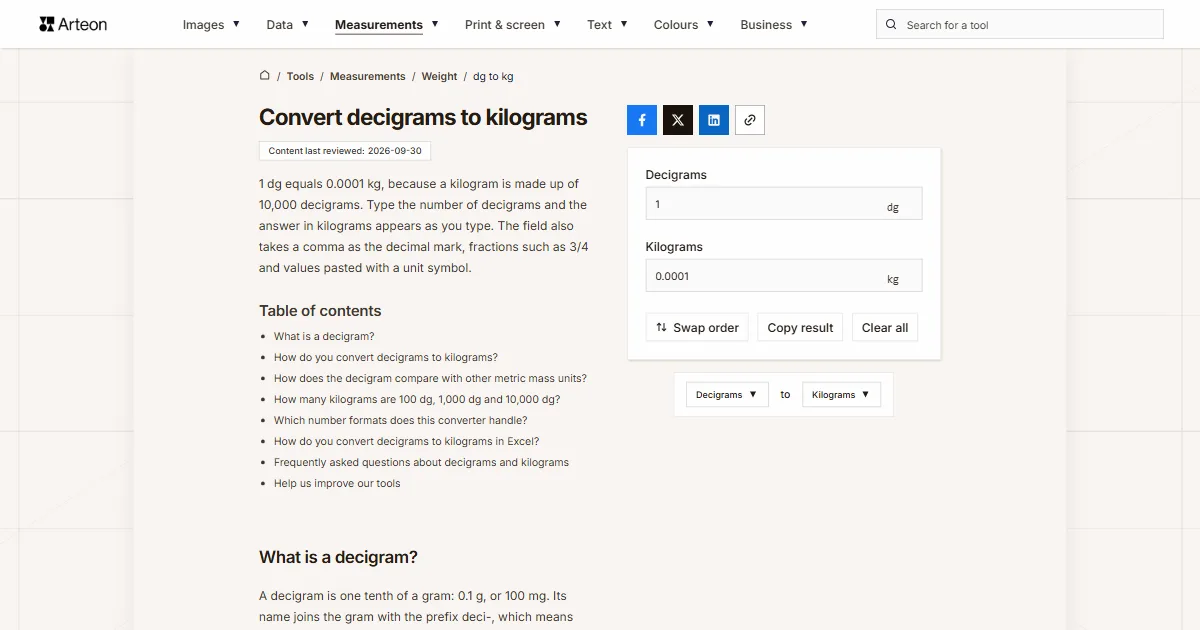
1 dg equals 0.0001 kg, because a kilogram is made up of 10,000 decigrams. Type the number of decigrams and the answer in kilograms appears as you type. The field also takes a comma as the decimal mark, fractions such as 3/4 and values pasted with a unit symbol.
What is a decigram?
A decigram is one tenth of a gram: 0.1 g, or 100 mg. Its name joins the gram with the prefix deci-, which means one-tenth, so its symbol is dg[1]. It is the same deci- you find in the decimeter and the deciliter.
The kilogram is the SI base unit of mass[2], and it is four powers of ten larger than the decigram. That is why one decigram is one ten-thousandth of a kilogram.
You will meet the decigram in science and math classes that teach the metric prefixes in order, from kilo down to milli. In a lab, a balance that reads to 0.1 g is sometimes called a decigram balance, because its last digit counts decigrams.
How do you convert decigrams to kilograms?
Divide the number of decigrams by 10,000. For example, 2,500 dg divided by 10,000 gives 0.25 kg.
Formula: kilograms = decigrams ÷ 10,000
The 10,000 comes from two steps. There are 10 decigrams in a gram and 1,000 grams in a kilogram, and 10 × 1,000 is 10,000.
To do it in your head, move the decimal point four places to the left. 750 dg becomes 0.075 kg, and 99 dg becomes 0.0099 kg. When you run out of digits, fill the gap with zeros, as in the second example.
For the opposite direction, which multiplies by 10,000, use the kg to dg converter.
How does the decigram compare with other metric mass units?
| Unit | Symbol | In grams | In kilograms |
|---|---|---|---|
| Kilogram | kg | 1,000 g | 1 kg |
| Hectogram | hg | 100 g | 0.1 kg |
| Dekagram | dag | 10 g | 0.01 kg |
| Gram | g | 1 g | 0.001 kg |
| Decigram | dg | 0.1 g | 0.0001 kg |
| Centigram | cg | 0.01 g | 0.00001 kg |
| Milligram | mg | 0.001 g | 0.000001 kg |
How many kilograms are 100 dg, 1,000 dg and 10,000 dg?
| Decigrams | Kilograms | Grams | Milligrams |
|---|---|---|---|
| 1 dg | 0.0001 kg | 0.1 g | 100 mg |
| 2 dg | 0.0002 kg | 0.2 g | 200 mg |
| 5 dg | 0.0005 kg | 0.5 g | 500 mg |
| 10 dg | 0.001 kg | 1 g | 1,000 mg |
| 25 dg | 0.0025 kg | 2.5 g | 2,500 mg |
| 50 dg | 0.005 kg | 5 g | 5,000 mg |
| 75 dg | 0.0075 kg | 7.5 g | 7,500 mg |
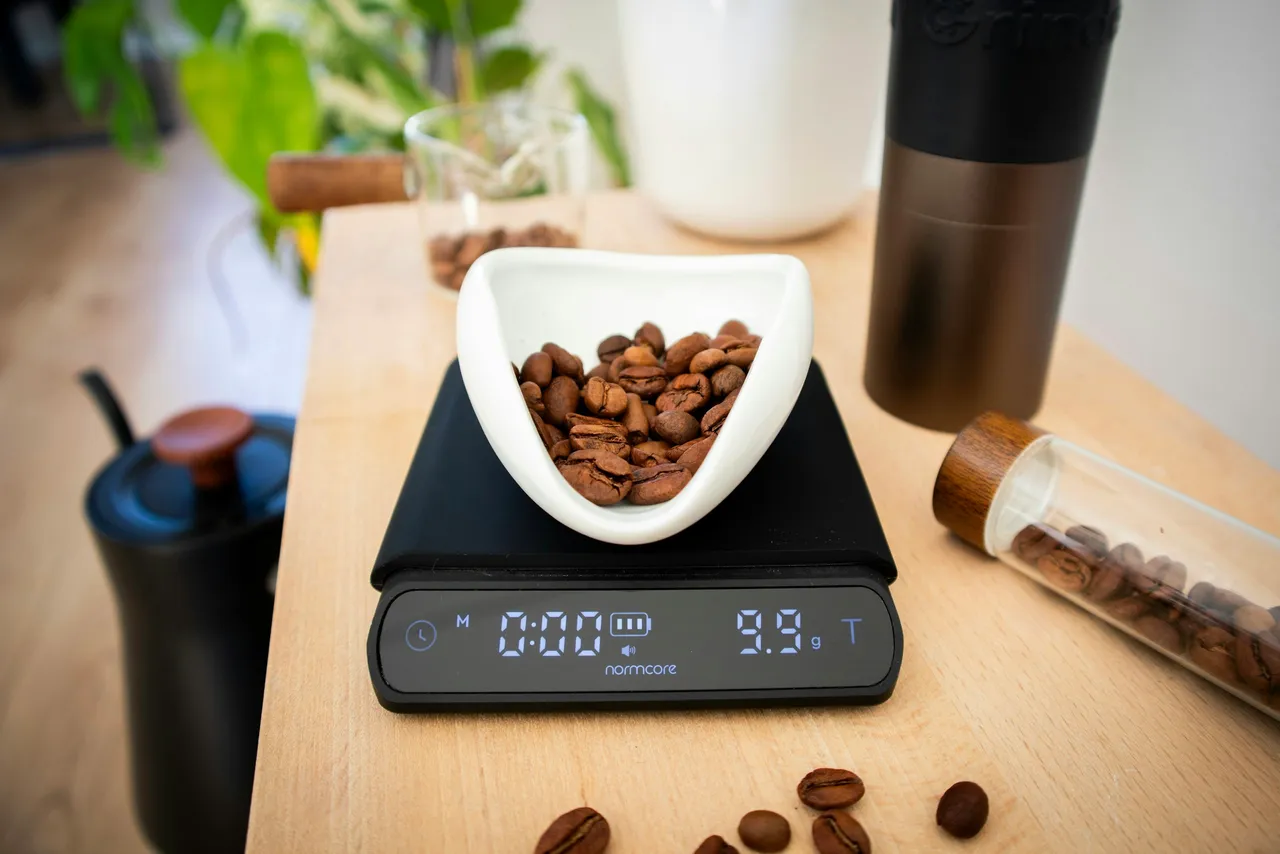
| 99 dg | 0.0099 kg | 9.9 g | 9,900 mg |
| 100 dg | 0.01 kg | 10 g | 10,000 mg |
| 150 dg | 0.015 kg | 15 g | 15,000 mg |
| 250 dg | 0.025 kg | 25 g | 25,000 mg |
| 500 dg | 0.05 kg | 50 g | 50,000 mg |
| 750 dg | 0.075 kg | 75 g | 75,000 mg |
| 1,000 dg | 0.1 kg | 100 g | 100,000 mg |
| 2,500 dg | 0.25 kg | 250 g | 250,000 mg |
| 5,000 dg | 0.5 kg | 500 g | 500,000 mg |
| 7,500 dg | 0.75 kg | 750 g | 750,000 mg |
| 10,000 dg | 1 kg | 1,000 g | 1,000,000 mg |
| 20,000 dg | 2 kg | 2,000 g | 2,000,000 mg |
| 25,000 dg | 2.5 kg | 2,500 g | 2,500,000 mg |
| 50,000 dg | 5 kg | 5,000 g | 5,000,000 mg |
| 100,000 dg | 10 kg | 10,000 g | 10,000,000 mg |
Which number formats does this converter handle?
| What you type | What the converter shows | Note |
|---|---|---|
| 2.5 | 0.00025 kg | A decimal point, written the way English writes decimals. |
| 2,5 | 0.00025 kg | A comma followed by one digit is read as a decimal comma, the way a European worksheet writes it. |
| 1,500 | 0.15 kg | Three digits follow the comma, so we read it as a thousands separator and count one thousand five hundred decigrams. A note under the field shows the other possible reading, 1.5. |
| 3/4 | 0.000075 kg | We work out the fraction ourselves, so there is no need to turn it into 0.75 first. |
| 2½ | 0.00025 kg | The ½ character copied from a worksheet is added to the number in front of it. |
| 25 dg | 0.0025 kg | The dg symbol pasted with the number is the unit of the field, so we keep just the number. |
| 5 g | 0.005 kg | Grams pasted into the field become 50 dg first, and a line under the field tells you so. |
| 250 mg | 0.00025 kg | Milligrams pasted into the field become 2.5 dg first, so the answer is not ten times too big. |
How do you convert decigrams to kilograms in Excel?
A spreadsheet can do it with plain division or with a built-in function that knows the metric prefixes. These steps cover both.
Put the decigrams in a column
Say the first value is in cell A1. Type the rest below it, so you can drag the formula from the next step down the whole list.Divide the cell by 10,000
In the next cell, type=A1/10000. For 99 dg the sheet shows 0.0099, and for 2,500 dg it shows 0.25.Or use the CONVERT function
Its syntax isCONVERT(number, from_unit, to_unit), and it writes the prefix deci as "d"[4]. The whole conversion reads=CONVERT(A1,"dg","kg").
Convert other units to Kilograms
Sources
- Metric (SI) Prefixes — National Institute of Standards and Technology
- SI base unit: kilogram (kg) — International Bureau of Weights and Measures (BIPM)
- List of mnemonics — Wikipedia
- CONVERT function — Microsoft
- Metric prefix — Wikipedia
- NIST Guide to the SI, Appendix B.8: Factors for Units Listed Alphabetically — National Institute of Standards and Technology
Every figure in the tables was computed from the unit definitions and checked arithmetically before publication. Historical values and the names of local units come from the sources listed above.
Content last reviewed: · written and checked by the Arteon team
Frequently asked questions about decigrams and kilograms
Is the decigram actually used?
Yes, but rarely. It is a valid SI unit, yet everyday practice prefers the prefixes that step by a thousand, such as kilo and milli, and keeps deci, deka, centi and hecto mostly for informal use[5]. The centimeter is the big exception.
Is a decigram bigger than a milligram?
Yes. One decigram is 100 milligrams, so it is a hundred times heavier. It is also ten times heavier than a centigram.
How many decigrams are in an ounce?
About 283.5 dg. NIST gives one avoirdupois ounce as 28.34952 g[6], and each gram holds 10 decigrams. In kilograms the same ounce is about 0.02835 kg.
How do you write 1 dg in kilograms with a power of ten?
1 dg is 1 × 10⁻⁴ kg, because dividing by 10,000 moves the number four places. In grams the same decigram is 1 × 10⁻¹ g.
Help us improve our tools
Have an idea for a new feature, spotted a bug, or want to suggest another tool? Write to us.