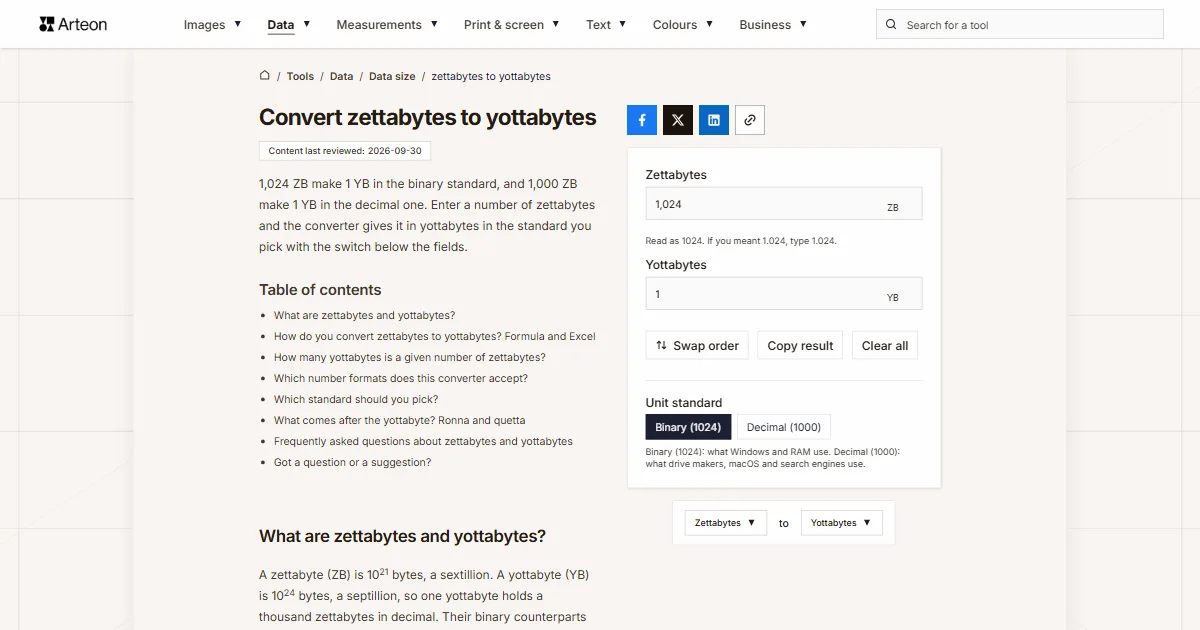
Convert zettabytes to yottabytes
1,024 ZB make 1 YB in the binary standard, and 1,000 ZB make 1 YB in the decimal one. Enter a number of zettabytes and the converter gives it in yottabytes in the standard you pick with the switch below the fields.
What are zettabytes and yottabytes?
A zettabyte (ZB) is 1021 bytes, a sextillion. A yottabyte (YB) is 1024 bytes, a septillion, so one yottabyte holds a thousand zettabytes in decimal. Their binary counterparts are the zebibyte (ZiB) of 270 bytes and the yobibyte (YiB) of 280 bytes[1].
The zetta and yotta prefixes entered the SI together in 1991[2], and for more than three decades yotta was the largest SI prefix there was. The step below is covered by the EB to ZB converter, and every unit from bytes to petabytes by the data unit converter.
How do you convert zettabytes to yottabytes? Formula and Excel
A yottabyte is one step above the zettabyte, so you divide the number of zettabytes by one of two divisors:
- binary: YB = ZB ÷ 1,024,
- decimal: YB = ZB ÷ 1,000.
So 512 ZB is 0.5 YB in binary and 0.512 YB in decimal. A yobibyte holds almost 21% more bytes than a yottabyte, so the standard you pick changes the result more than it does for smaller units.
In Excel, =CONVERT(A2,"Zbyte","Ybyte") gives the decimal result and =CONVERT(A2,"Zibyte","Yibyte") the binary one[3]. The YB to ZB converter works the other way round.
How many yottabytes is a given number of zettabytes?
| Zettabytes | Binary (1024) | Decimal (1000) |
|---|---|---|
| 1 ZB | 0.0009766 YB | 0.001 YB |
| 2 ZB | 0.001953 YB | 0.002 YB |
| 5 ZB | 0.004883 YB | 0.005 YB |
| 10 ZB | 0.009766 YB | 0.01 YB |
| 16 ZB | 0.015625 YB | 0.016 YB |
| 50 ZB | 0.048828 YB | 0.05 YB |
| 100 ZB | 0.097656 YB | 0.1 YB |
| 128 ZB | 0.125 YB | 0.128 YB |
| 250 ZB | 0.244141 YB | 0.25 YB |
| 500 ZB | 0.488281 YB | 0.5 YB |
| 512 ZB | 0.5 YB | 0.512 YB |
| 1,000 ZB | 0.976563 YB | 1 YB |
| 1,024 ZB | 1 YB | 1.024 YB |
| 1,500 ZB | 1.464844 YB | 1.5 YB |
| 2,000 ZB | 1.953125 YB | 2 YB |
| 2,048 ZB | 2 YB | 2.048 YB |
| 5,000 ZB | 4.882813 YB | 5 YB |
| 8,192 ZB | 8 YB | 8.192 YB |
| 10,000 ZB | 9.765625 YB | 10 YB |
Which number formats does this converter accept?
| What you type | What the converter shows | How we read it |
|---|---|---|
| 1.5 | 0.001465 YB | The dot is a decimal point, so the field holds one and a half zettabytes. |
| 1,500 | 1.464844 YB | A comma before three digits separates thousands, so the field holds fifteen hundred zettabytes. A hint under the field shows how to type 1.5 instead. |
| 1.500 | 0.001465 YB | A single dot is always read as a decimal point, so we count one and a half zettabytes. A hint appears below the field, and you can type fifteen hundred zettabytes as 1500 or 1,500. |
| 1024ZB | 1 YB | A unit stuck to the number without a space matches the field's unit, so you don't need to delete it. |
| 2 zettabytes | 0.001953 YB | The full unit name is recognised too, in the singular or the plural. |
| 8 ZiB | 0.007813 YB | A zebibyte is always 2⁷⁰ bytes, so in the Decimal (1000) standard the same entry gives 0.009445 YB. |
| 500 EB | 0.0004768 YB | Exabytes pasted into the zettabytes field are rewritten as 0.488281 ZB, and a note below the field says so. |
| 2 YB | 2 YB | Yottabytes pasted into the zettabytes field are rewritten as 2048 ZB, so the result comes back to the same number. |
| 1e3 | 0.976563 YB | Scientific notation from a spreadsheet is read directly: 1e3 means a thousand zettabytes. |
| 3/4 | 0.0007324 YB | A fraction is divided straight away, so the field holds three quarters of a zettabyte. |
Which standard should you pick?
You set the standard with the Unit standard switch below the fields. The right choice depends on where the zettabyte figure comes from.
A disk or file system limit
Pick Binary (1024). Limits of storage formats come from powers of two, so they are stated in ZiB and YiB.A figure from a report or statistic
Pick Decimal (1000). Totals of data use SI prefixes, where a yottabyte is an even thousand zettabytes.A value given in ZiB
Pick Binary (1024). ZiB stands for zebibyte, a unit counted in powers of two, which is how the converter calculates in this mode.
What comes after the yottabyte? Ronna and quetta
In 2022 the 27th General Conference on Weights and Measures added two new prefixes to the SI: ronna (R) for 1027 and quetta (Q) for 1030. After the yottabyte come the ronnabyte (RB), a thousand yottabytes, and the quettabyte (QB), a million yottabytes[4].
The resolution names two reasons. One is the needs of data science, which will soon have to express quantities of digital information above 1024. The other is to act before unofficial prefix names become established in use[4]. The binary counterparts, robi (Ri) and quebi (Qi), were adopted by the IEC in 2025[1].
Convert Zettabytes to other units
Sources
- Binary prefix — Wikipedia
- Resolution 4 of the 19th CGPM (1991) — BIPM
- CONVERT function — Microsoft
- Resolution 3 of the 27th CGPM (2022) — BIPM
Every figure in the tables was computed from the unit definitions and checked arithmetically before publication. Historical values and the names of local units come from the sources listed above.
Content last reviewed: · written and checked by the Arteon team
Frequently asked questions about zettabytes and yottabytes
How many bytes are in a yottabyte?
A yottabyte holds 1,000,000,000,000,000,000,000,000 bytes. Its binary version, the yobibyte, holds 1,208,925,819,614,629,174,706,176 bytes.
How many bits are in a yottabyte?
A byte has eight bits, so a yottabyte holds 8,000,000,000,000,000,000,000,000 bits and a yobibyte 9,671,406,556,917,033,397,649,408 bits.
Got a question or a suggestion?
If you spot a mistake in a table or the field won't accept a format you copy, let us know.