BMP to AVIF converter
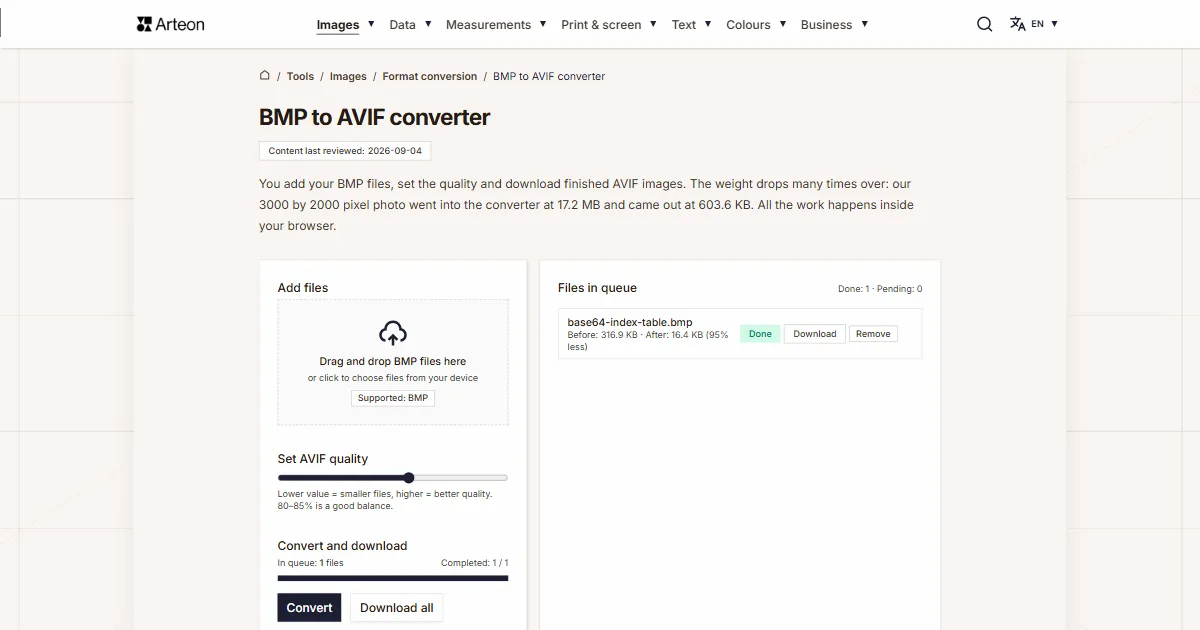
You add your BMP files, set the quality and download finished AVIF images. The weight drops many times over: our 3000 by 2000 pixel photo went into the converter at 17.2 MB and came out at 603.6 KB. All the work happens inside your browser.
Files in queue
What is BMP, and what is AVIF?
BMP stores an image by giving every single pixel its own place in the file. Microsoft defined it as a device-independent bitmap so that the same picture could travel between machines and programs, and the format has carried that job ever since.[1]
Microsoft describes the layout plainly: a header with the file size and the offset where the picture starts, then a second header with the dimensions and the number of bits per pixel, and finally the raw array of points.[2] The flavour you meet most often uses 24 bits per pixel, one byte each for red, green and blue. That layout keeps every pixel value intact, so the file is heavy. A program written decades ago still reads its contents.
AVIF grew out of a completely different idea: it is the compression used by AV1 video, applied to a single frame. The Alliance for Open Media gathered the rules in the AV1 Image File Format specification, whose version 1.2.0 is dated 16 October 2025.[3] The format holds 8 to 12 bits per colour channel, a wide colour gamut, an alpha channel and image sequences, which is how it does animation. It writes the picture either lossily or losslessly, depending on the setting.
How do you turn a BMP into an AVIF?
Drag your BMP files onto the Add files area, or click it and pick the images from your drive. The Set AVIF quality slider accepts values from 60 to 95 per cent and sits at 80 by default. Then press the Convert button.
You can download the finished images one at a time with the Download button on each queue row, or all at once with Download all. Clear all empties the queue, and the Remove label on a row takes a single file out of it.
In the queue on the right, every file shows its weight before and after conversion together with the difference in per cent. The same summary for the whole batch sits under the buttons, on the Saved line.
The writing itself is done by libavif, the encoder from the Alliance for Open Media project, compiled to WebAssembly and run on your own machine. Browsers read AVIF without any add-on, and writing it from a canvas is still beyond them: on 4 September 2026 we checked Chrome 152, Edge 152 and Firefox 153, and each of them handed back a PNG for that request. The MDN documentation states this behaviour outright — ask for a format the browser does not know and you get a PNG with no warning at all.[4]
Our own encoder writes AVIF whatever the browser can do, and the image stays on your device.
Under the converter sits a format switch reading BMP to AVIF. Clicking either of the two formats opens a list, and picking from it takes you to the converter page for that pair. Every pair in this group is also gathered on the Format conversion page.
Why does the AVIF file weigh so much less than the BMP?
You can work out the weight of a BMP file in advance, and the result has nothing to do with what the picture shows. Every pixel takes three bytes, and every row of the image is padded with zeros up to a full four bytes; the Microsoft documentation gives the formula for it.[5] On top of that come 54 bytes of header.
Let us walk through a photo measuring 3000 by 2000 pixels. One row holds 3000 pixels at three bytes each, which is 9,000 bytes. At this width nothing needs padding. There are 2000 such rows, so the pixels alone take 18,000,000 bytes. With the header the file weighs 18,000,054 bytes, which is 17.2 MB in the notation the tool uses in its summary.
AVIF approaches the same picture from another side. The encoder predicts what the next patch of the image looks like from the ones beside it and stores only the difference, and in lossy mode it drops detail that the eye will not catch in ordinary viewing. The MDN guide puts it at around half the weight of a JPEG at comparable quality, and against WebP the median saving runs 50 per cent to 30.[6] Against a BMP, which packs nothing at all, the gap is far wider than that. When the file also has to open in older browsers, the BMP to WebP converter prepares the same image.
Our 3000 by 2000 pixel photo came out of the converter at 603.6 KB with the slider left at its default. A Saved line then appears under the buttons, carrying the number of megabytes and the percentage the file shed.
How much does the same image weigh in BMP and in AVIF?
| Image | Dimensions in pixels | BMP | AVIF at 80% | Times smaller |
|---|---|---|---|---|
| Camera photograph | 3000 × 2000 | 17.2 MB | 603.6 KB | 29.1 |
| Photo for a web page | 1280 × 850 | 3.11 MB | 362.0 KB | 8.8 |
| Scan of a book page | 1200 × 1600 | 5.49 MB | 293.6 KB | 19.2 |
| Screenshot of an interface | 1200 × 630 | 2.16 MB | 41.2 KB | 53.8 |
| Graphic made of flat colour | 800 × 600 | 1.37 MB | 4.71 KB | 298.8 |
What does the quality slider change when writing AVIF?
| Image | Dimensions in pixels | Quality 60% | Quality 80% | Quality 95% |
|---|---|---|---|---|
| Camera photograph | 3000 × 2000 | 313.2 KB | 603.6 KB | 1.34 MB |
| Photo for a web page | 1280 × 850 | 252.6 KB | 362.0 KB | 624.3 KB |
| Scan of a book page | 1200 × 1600 | 190.9 KB | 293.6 KB | 576.7 KB |
| Screenshot of an interface | 1200 × 630 | 28.1 KB | 41.2 KB | 71.0 KB |
| Graphic made of flat colour | 800 × 600 | 3.40 KB | 4.71 KB | 7.80 KB |
How does BMP differ from AVIF?
| Format feature | BMP | AVIF |
|---|---|---|
| Lossy compression | No | Yes |
| Lossless compression | Yes, by RLE on palette images | Yes |
| Colour depth | 1 to 32 bits per pixel | 8, 10 or 12 bits per channel |
| Alpha channel, that is transparency | Yes, in the 32-bit flavour | Yes |
| Animation | No | Yes, as an image sequence |
| ICC colour profile | Yes, from the version 5 header | Yes |
| High dynamic range (HDR) | No | Yes |
| The browser version that reads them | every version of Chrome, Firefox, Safari and Edge | Chrome 85, Firefox 93, Safari 16.1, Edge 121 |
What does the converter do with a BMP file?
Seven things worth knowing before you drop a larger batch of images into the queue.
It reads six flavours of BMP
We checked them one by one: 24-bit with the rows written from the bottom, 24-bit with the rows written from the top, 8-bit with a palette, 32-bit with an alpha channel, RLE-packed, and the old twelve-byte OS/2 header. The tool read every one of those files with the right colours.The pixel count stays the same
A 3000 by 2000 pixel image comes out as an AVIF measuring 3000 by 2000 pixels. Only the way it is stored changes; the framing and the resolution are left alone.Transparency carries over to the result
The alpha channel travels in the 32-bit BMP flavour and AVIF has one too, so a cut-out background stays cut out and a semi-transparent shadow keeps its opacity.Colour is written at eight bits
The browser canvas works with eight bits per channel, so the result gets eight bits each for red, green and blue. A typical monitor shows exactly that many, and a 24-bit BMP carries exactly that many.Writing takes about a second per photo
The encoder runs on your own machine, so the time depends on how fast it is. In our measurement the 3000 by 2000 pixel photo was written in 0.9 seconds. The 800 by 600 pixel graphic was ready in 0.04 seconds. Files in the queue go one after another, and the bar above the buttons shows how many are finished.Single files of up to 100 MB
That is what the converter accepts from one file. Anything larger brings up the message File is too large (max 100 MB). An uncompressed BMP of roughly 5900 by 5900 pixels still fits inside that limit.Very large images are fitted to the canvas
The browser canvas holds 16,384 pixels per side and around 268 million pixels in total. An image beyond that limit is scaled down proportionally so that all of it lands in the result.
When is AVIF the right pick, and when is another format?
The image is going on a web page
Here the weight of the file is what counts, and AVIF comes out lighter than every older format. The WordPress media library has accepted these files since version 6.5 of April 2024, so you can upload them without a plugin.[7]The file still has editing ahead of it
Repeated opening and saving in a lossy format builds up on the picture, so a working file is better kept in a lossless one. The BMP to PNG converter gives you that.The photo is headed for older software
JPG is read today by practically every device and application, from cameras to digital photo frames. The BMP to JPG converter leads to that kind of file.The scan goes out by email
A scanned page travels better as a PDF than as an image. The BMP to PDF converter makes one: each image lands on its own A4 page, with the orientation matched to the proportions of the picture.The way back
A finished AVIF can be written as an uncompressed bitmap with the AVIF to BMP converter. It is the same pair of formats, only turned around.
Convert other files to AVIF
Convert BMP to other formats
Sources
- BMP file format — Wikipedia
- Bitmap Storage — Microsoft Learn
- AV1 Image File Format (AVIF), version 1.2.0 — Alliance for Open Media
- HTMLCanvasElement: toBlob() method — MDN Web Docs
- BITMAPINFOHEADER — Microsoft Learn
- Image file type and format guide — MDN Web Docs
- WordPress 6.5 adds AVIF support — WordPress Core
The file sizes in the tables were measured by running finished images through this converter in a browser, and we report them the way the tool counts them. What the page says about either format rests on the sources listed above.
Content last reviewed: · written and checked by the Arteon team
Common questions about turning BMP into AVIF
Will I lose quality converting BMP to AVIF?
With the slider at its default the output is lossy, meaning the encoder drops some detail to bring the weight down. At 80 per cent the difference only shows up under heavy magnification. If you want more fidelity, push the slider towards 95 per cent — our camera photograph grew from 603.6 KB to 1.34 MB that way.
Do my files go to a server?
No. The page code loads the image in your browser, draws it on a canvas (Canvas API) and hands it from there to the libavif encoder, which also runs locally. The file stays on your device for the whole session and leaves the browser's memory once you close the tab.
What happens to transparency from a 32-bit BMP?
The alpha channel carries over into the AVIF file, so a cut-out background stays cut out and semi-transparent areas keep their opacity. The 24-bit flavour, which is the common one, has no alpha channel at all, and the result is then simply fully opaque.
How many files can I convert at once?
You can add as many files to the queue as you like; the tool works through them one by one and shows the progress above the buttons. A single file may weigh up to 100 MB, and the total number of files depends on your device's memory.
Why does writing AVIF take longer than writing JPG?
JPG is written by the browser itself and comes back instantly. AVIF is written by the libavif encoder running as a WebAssembly module, which computes more in order to bring the file size down. In our measurement the 3000 by 2000 pixel photo took 0.9 seconds. The 1200 by 630 pixel screenshot was ready in 0.1 seconds.
Will an AVIF file open on every device?
AVIF files are read by Chrome from version 85, Firefox from 93, Safari from 16.1 and Edge from 121, which covers every browser in its current release. An older graphics program may not know the format yet, and JPG is the easier choice there — the AVIF to JPG converter makes that file.
I have an AVIF file and I need a bitmap out of it. What now?
Use the converter in the other direction, the AVIF to BMP converter. You get an uncompressed 24-bit file that even a program written for early versions of Windows will open.
Help us improve our tools
Got an idea for a new feature, found a bug or want to suggest another tool? Write to us – we reply within 24 hours.
Try our other useful tools
Online image editor
Resize, crop and convert your image. Ready-made formats for social media, circular avatars, export to JPG/PNG/WebP.

Meta title & description checker
Check title and description length in pixels. Live Google preview and optimization tips.
PNG to JPG
Convert PNG files to JPG in your browser. No file limits, no signup, no server uploads.

Favicon generator
Create a complete favicon.ico set for your website from one image. All required sizes, no login.
Color palette generator
Generate 9 palettes from one color: monochromatic, complementary, triadic and more. HEX codes.
WebP to JPG
Convert WebP files to universally compatible JPG. Works in every app and platform.
Color contrast checker
Check text and background contrast per WCAG 2.1 AA and AAA. Automatic color correction.
Free QR code generator
Create a QR code for a website, vCard business card or print. Export PNG and SVG, no registration.
Word & character counter
Count words, characters, sentences and reading time. Check readability with the Flesch-Kincaid score.