Convert liters to kiloliters
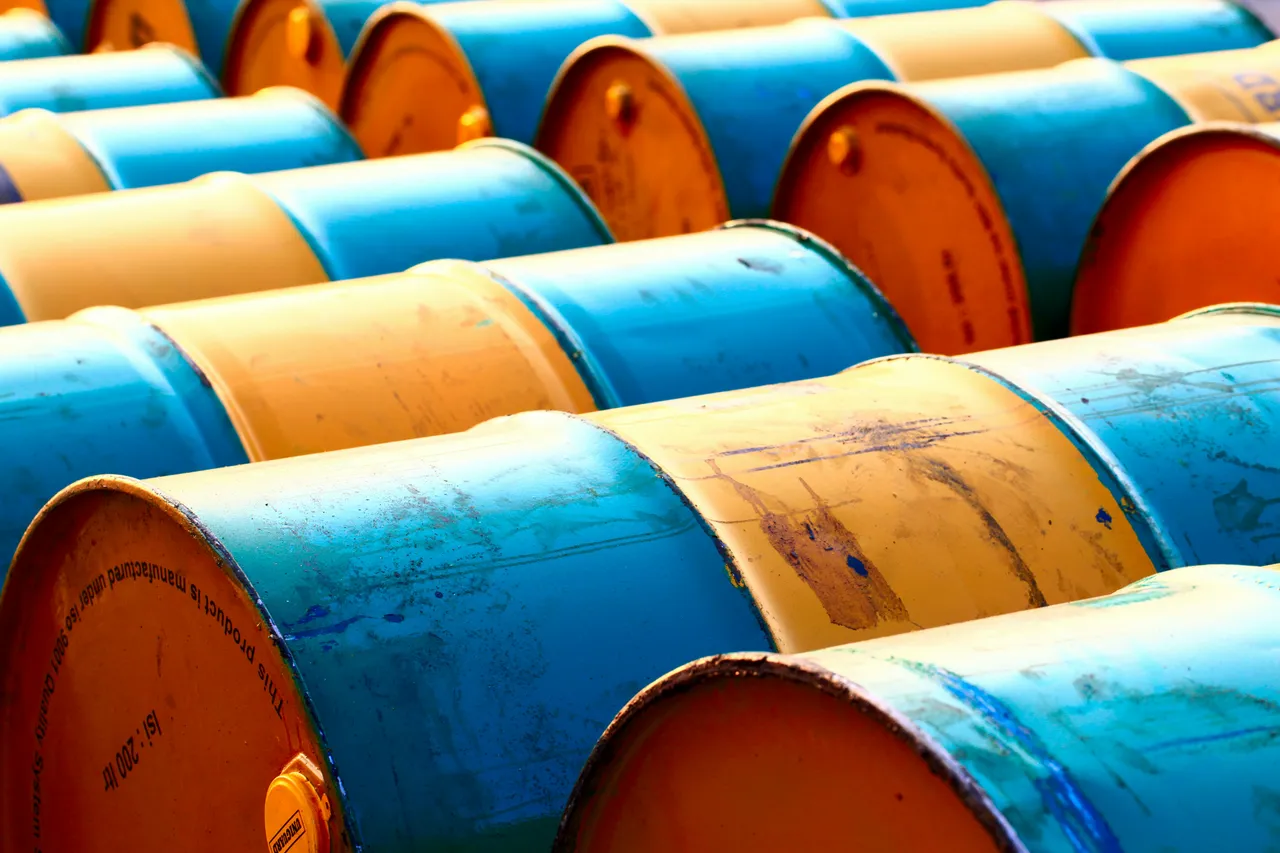
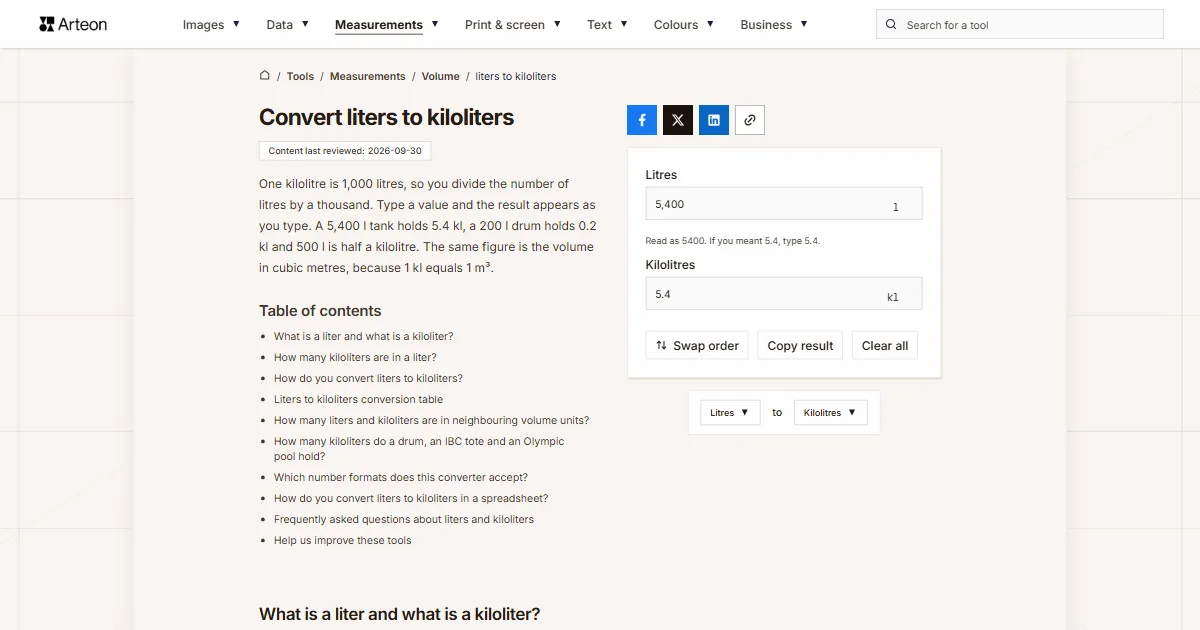
One kilolitre is 1,000 litres, so you divide the number of litres by a thousand. Type a value and the result appears as you type. A 5,400 l tank holds 5.4 kl, a 200 l drum holds 0.2 kl and 500 l is half a kilolitre. The same figure is the volume in cubic metres, because 1 kl equals 1 m³.
What is a liter and what is a kiloliter?
A litre is the volume of a cube ten centimetres on each side, which is one cubic decimetre.[1] The prefix kilo stands for one thousand, and its symbol is the lower-case letter k.[2] A kilolitre is therefore a thousand litres, written kl.
A thousand one-litre cubes placed together form a cube one metre on each side. That makes the kilolitre the same volume as the cubic metre, and the table of litre multiples lists both in a single row.[3]
The symbol has two correct spellings. The litre can be written with a lower-case l or a capital L, so kL is as correct as kl, and NIST names the capital L as the preferred form in the United States.[1]
How many kiloliters are in a liter?
One litre is 0.001 kilolitres, a thousandth of a kilolitre. A full kilolitre is made of a thousand litres, so you divide the number of litres by 1,000. The kilolitre is a thousand times larger than the litre. The ratio is exact and the same in every country, because both units belong to the metric system.
That calculation gives concrete values. Five hundred litres is 0.5 kilolitres. A tank with a capacity of 5,400 litres holds 5.4 kilolitres. A small figure such as 8.55 litres gives 0.00855 kilolitres, because zeros appear between the decimal point and the first digit.
The same number describes cubic metres. A 5.4 kl tank is a 5.4 m³ tank. Half a kilolitre is likewise half a cubic metre. At 12,000 litres the result is 12 kilolitres, which is also 12 cubic metres. A capacity given in litres therefore converts straight to cubic metres, because you copy the result from the field above unchanged.
How do you convert liters to kiloliters?
The formula has one step: kiloliters = liters ÷ 1000. Dividing by a thousand moves the decimal point three places to the left. That turns 2,500 litres into 2.5 kilolitres. In the same way, 750 litres become 0.75 kilolitres.
When the number of litres has fewer than three digits before the decimal point, zeros appear between the point and the first digit of the result. For 42.68 litres the point moves three places to the left, and the result reads 0.04268 kilolitres.
The reverse direction is handled by the kiloliters to liters converter. Smaller units from the same family are covered by the liters to ml converter and the liters to deciliters converter.
Liters to kiloliters conversion table
| Liters | Kiloliters | US gallons |
|---|---|---|
| 1 l | 0.001 kl | 0.264 US gal |
| 5 l | 0.005 kl | 1.321 US gal |
| 10 l | 0.01 kl | 2.642 US gal |
| 20 l | 0.02 kl | 5.283 US gal |
| 50 l | 0.05 kl | 13.21 US gal |
| 100 l | 0.1 kl | 26.42 US gal |
| 200 l | 0.2 kl | 52.83 US gal |
| 250 l | 0.25 kl | 66.04 US gal |
| 500 l | 0.5 kl | 132.09 US gal |
| 750 l | 0.75 kl | 198.13 US gal |
| 800 l | 0.8 kl | 211.34 US gal |
| 1,000 l | 1 kl | 264.17 US gal |
| 1,250 l | 1.25 kl | 330.22 US gal |
| 1,500 l | 1.5 kl | 396.26 US gal |
| 2,000 l | 2 kl | 528.34 US gal |
| 2,500 l | 2.5 kl | 660.43 US gal |
| 3,000 l | 3 kl | 792.52 US gal |
| 3,200 l | 3.2 kl | 845.35 US gal |
| 4,000 l | 4 kl | 1,056.7 US gal |
| 5,000 l | 5 kl | 1,320.9 US gal |
| 5,400 l | 5.4 kl | 1,426.5 US gal |
| 6,000 l | 6 kl | 1,585 US gal |
| 7,000 l | 7 kl | 1,849.2 US gal |
| 7,500 l | 7.5 kl | 1,981.3 US gal |
| 9,000 l | 9 kl | 2,377.5 US gal |
| 10,000 l | 10 kl | 2,641.7 US gal |
| 12,000 l | 12 kl | 3,170.1 US gal |
| 15,000 l | 15 kl | 3,962.6 US gal |
| 25,000 l | 25 kl | 6,604.3 US gal |
| 100,000 l | 100 kl | 26,417.2 US gal |
How many liters and kiloliters are in neighbouring volume units?
| Unit | In liters | In kiloliters |
|---|---|---|
| Milliliter (ml) | 0.001 l | 0.000001 kl |
| Deciliter (dl) | 0.1 l | 0.0001 kl |
| Liter (l) | 1 l | 0.001 kl |
| Hectoliter (hl) | 100 l | 0.1 kl |
| Kiloliter (kl) | 1,000 l | 1 kl |
| Cubic meter (m³) | 1,000 l | 1 kl |
| Megaliter (ML) | 1,000,000 l | 1,000 kl |
How many kiloliters do a drum, an IBC tote and an Olympic pool hold?
| Container | Liters | Kiloliters |
|---|---|---|
| Steel drum | 200 l | 0.2 kl |
| IBC tote | 1,000 l | 1 kl |
| Cube one metre on each side | 1,000 l | 1 kl |
| Larger IBC tote | 1,250 l | 1.25 kl |
| Water one person uses in a year in the Thames Water region | 51,100 l | 51.1 kl |
| Olympic pool 50 × 25 × 2 m | 2,500,000 l | 2,500 kl |
Which number formats does this converter accept?
| What you type | What the converter shows | Note |
|---|---|---|
| 750 | 0.75 kl | A plain number is read as litres, because that’s how the field is labeled. |
| 750 liters | 0.75 kl | The unit word pasted with the number is skipped, and so is the symbol l. |
| 12.5 | 0.0125 kl | The period is your decimal point, and that’s exactly how we read it. |
| 12,5 | 0.0125 kl | A comma with fewer than three digits after it is a decimal comma from a European document, so the result is the same. |
| 1.500 | 0.0015 kl | A single period is a decimal point, so we read one and a half litres. A note under the field says “Read as 1.5. If you meant 1500, type 1500.” |
| 1,500 | 1.5 kl | A comma followed by three digits groups thousands, so the field reads fifteen hundred litres. A note under the field says “Read as 1500. If you meant 1.5, type 1.5.” |
| 1 500 | 1.5 kl | A space between the thousands is skipped, so this is fifteen hundred litres as well. |
| 1500 | 1.5 kl | Thousands written without a separator are read the same way. |
| 3/4 | 0.00075 kl | We work out a slash fraction ourselves, so three quarters of a litre doesn’t need to become 0.75 first. |
| 2½ | 0.0025 kl | A ½ sign copied from a text is added to the number in front of it. |
| 0.5 m³ | 0.5 kl | The field converts cubic metres to litres, puts 500 in the field and says so in a line under it. |
| 250 ml | 0.00025 kl | The field converts millilitres to litres, puts 0.25 in the field and says so in a line under it. |
How do you convert liters to kiloliters in a spreadsheet?
For one number the field above is enough. A list of tank capacities converts in a spreadsheet with one formula dragged down the column.
Excel: the CONVERT function
The formula reads CONVERT(number, from_unit, to_unit). The litre carries the code "l", and the kilo prefix goes in front of it as the letter k, because the documentation allows prefixes in front of any metric unit. For a value in cell A1 you type =CONVERT(A1,"l","kl").[9]Cubic metres with the same function
The cubic metre carries the code "m3", so =CONVERT(A1,"l","m3") returns the same number as the kilolitre formula. Two columns placed side by side then show identical results.[9]Division without the function
The formula =A1/1000 works in every spreadsheet, including Google Sheets and LibreOffice Calc. The whole operation is visible in the cell, so the formula is easy to check by eye.Check the formula on one cell
Before you drag the formula down, type 1000 into cell A1 and confirm that the result is 1. The #N/A error means the function did not recognise a unit. Unit names and prefixes are case-sensitive, so the kilo prefix goes in as a lower-case k.[9]
Convert Litres to other units
Sources
- NIST Special Publication 330, section 4 — non-SI units accepted for use with the SI — National Institute of Standards and Technology
- Metric (SI) prefixes — National Institute of Standards and Technology
- Litre — Wikipedia
- Drum (container) — Wikipedia
- Intermediate bulk container — Wikipedia
- Olympic-size swimming pool — Wikipedia
- Record breaking temperatures – but millions are using more water — Thames Water
- Metered customers — Thames Water
- CONVERT function — Microsoft
Every figure in the tables was computed from the unit definitions and checked arithmetically before publication. Historical values and the names of local units come from the sources listed above.
Content last reviewed: · written and checked by the Arteon team
Frequently asked questions about liters and kiloliters
How many kiloliters are in 1 liter?
One litre is 0.001 kilolitres. The prefix kilo means a thousand, so a litre is one thousandth of a kilolitre.[2]
What is 8.55 liters in kiloliters?
8.55 litres is 0.00855 kilolitres. After the decimal point moves three places to the left, two zeros stand between the point and the digit 8.
How many hectoliters are in a kiloliter?
A kilolitre is 10 hectolitres. A hectolitre holds 100 litres, so a thousand litres divide into ten of them.
Is a kiloliter exactly a cubic meter?
Yes. Since 1964 the litre has been defined as a cubic decimetre, so a kilolitre is exactly one cubic metre. From 1901 to 1964 the litre was defined as the volume of one kilogram of pure water, which made it about 1.000028 cubic decimetres.[3] A kilolitre of that period was therefore about 28 millilitres larger than a cubic metre.
What is the difference between a kiloliter and a kilogram?
A kilolitre is a unit of volume equal to 1,000 litres, while a kilogram is a unit of mass. Both names start with the prefix kilo, which means a thousand: a kilolitre is a thousand litres and a kilogram a thousand grams.[2]
Is the kiloliter an SI unit?
The SI unit of volume is the cubic metre. NIST lists the litre among the units outside the SI that are accepted for use with it,[1] and the kilolitre is formed from the litre by adding the prefix kilo.
What is 0.0005 liters in kiloliters?
0.0005 litres, which is half a millilitre, is 0.0000005 kilolitres. The converter shows results to seven decimal places, so a value this small still appears in the result field.
How many kiloliters are in a million liters?
A million litres is 1,000 kilolitres, which is a thousand cubic metres. The same volume is called a megalitre.
How many kiloliters does a 2 × 1 × 1 m tank hold?
Such a tank has a volume of 2 cubic metres, which is 2 kilolitres or 2,000 litres. The volume of a rectangular tank is the product of its three dimensions given in metres.
Can I type a comma instead of a decimal point?
Yes. Typing 12,5 gives the same result as 12.5, which is 0.0125 kilolitres. Only a comma followed by exactly three digits reads as a thousands separator, so 12,500 means twelve thousand five hundred litres. The field also accepts a fraction, and 3/4 of a litre gives 0.00075 kilolitres.
How many kiloliters is 2 liters?
2 litres is 0.002 kilolitres. After dividing by a thousand, two zeros stand between the decimal point and the digit 2.
Help us improve these tools
Have an idea for a feature, spotted a mistake or want to suggest another tool? Write to us.