Convert carats to grams
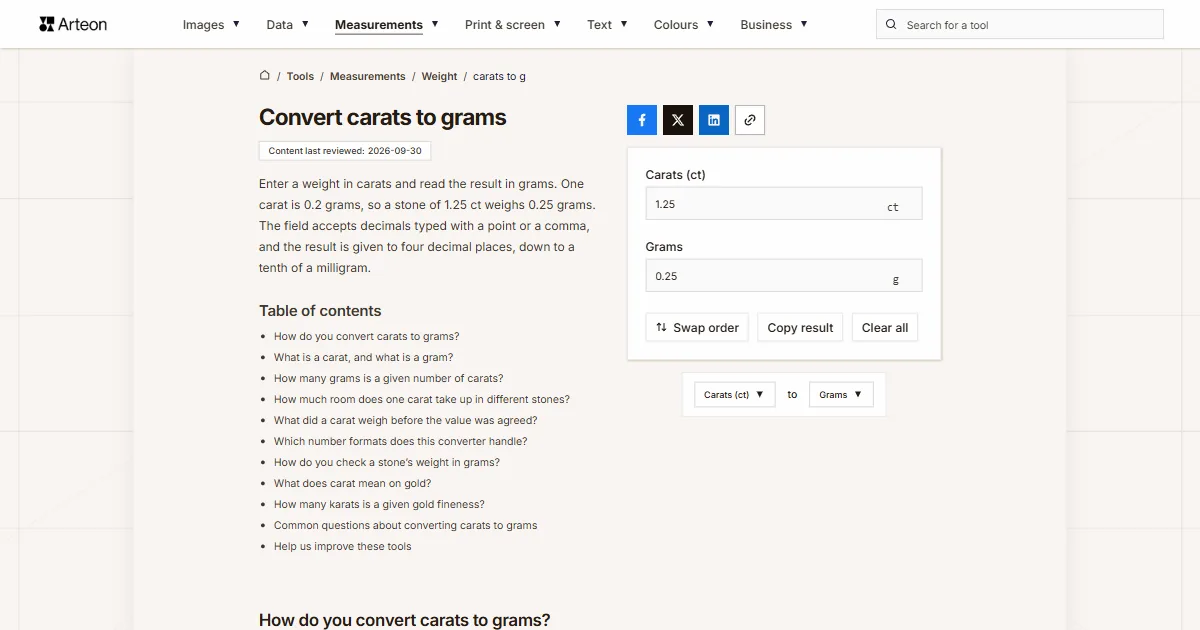
Enter a weight in carats and read the result in grams. One carat is 0.2 grams, so a stone of 1.25 ct weighs 0.25 grams. The field accepts decimals typed with a point or a comma, and the result is given to four decimal places, down to a tenth of a milligram.
How do you convert carats to grams?
Multiply the number of carats by 0.2 and you have the weight in grams. A 2 ct stone weighs 0.4 grams.
Formula: grams = carats × 0.2
The multiplier is exact to the last digit, because the metric carat is fixed in metric terms: the Federal Trade Commission states that a carat is equivalent to 200 milligrams, one fifth of a gram[1].
Three weights show how the arithmetic works on stones you would see in a jeweller’s window. A quarter carat, 0.25 ct, comes to 0.05 grams, that is fifty milligrams. Half a carat gives 0.1 grams. A one-carat stone weighs 0.2 grams.
At those weights the gram figure starts with a zero and a point, which is why the trade describes stones in points instead. One hundred points make up a carat[1], so 0.25 ct is a 25-point stone and 0.7 ct is a 70-point stone.
Going the other way you divide by 0.2. The grams to carats converter does that for you.
What is a carat, and what is a gram?
The metric carat is a unit of mass for gemstones and pearls. One carat weighs 200 milligrams, a fifth of a gram, and its symbol is ct.
The gram is a thousandth of a kilogram and the unit everything else is weighed in: kitchen ingredients, a parcel, scrap gold at a buyer’s counter. A cut gemstone is light enough that grams describe it with zeros after the point, and that is where the separate unit comes from.
In the United States the metric carat became law in 1913. The National Institute of Standards and Technology records that the international metric carat was then defined as 200 milligrams, which ended the use of a number of unofficial and semi-official carats[2], and its tables still list the metric carat of 200 milligrams as the unit used for the sale of precious stones[2].
The value itself was agreed six years earlier, in October 1907. The minutes of the General Conference on Weights and Measures record that the carat then stood close to 200 milligrams but differed from country to country, and nowhere bore a simple relation to metric units. The delegates voted unanimously to recommend the metric carat of 200 mg to their governments[3].
How many grams is a given number of carats?
| Carats | Grams | Milligrams | Points |
|---|---|---|---|
| 0.01 ct | 0.002 g | 2 mg | 1 pts |
| 0.02 ct | 0.004 g | 4 mg | 2 pts |
| 0.03 ct | 0.006 g | 6 mg | 3 pts |
| 0.04 ct | 0.008 g | 8 mg | 4 pts |
| 0.05 ct | 0.01 g | 10 mg | 5 pts |
| 0.06 ct | 0.012 g | 12 mg | 6 pts |
| 0.07 ct | 0.014 g | 14 mg | 7 pts |
| 0.08 ct | 0.016 g | 16 mg | 8 pts |
| 0.09 ct | 0.018 g | 18 mg | 9 pts |
| 0.1 ct | 0.02 g | 20 mg | 10 pts |
| 0.12 ct | 0.024 g | 24 mg | 12 pts |
| 0.15 ct | 0.03 g | 30 mg | 15 pts |
| 0.18 ct | 0.036 g | 36 mg | 18 pts |
| 0.2 ct | 0.04 g | 40 mg | 20 pts |
| 0.25 ct | 0.05 g | 50 mg | 25 pts |
| 0.3 ct | 0.06 g | 60 mg | 30 pts |
| 0.33 ct | 0.066 g | 66 mg | 33 pts |
| 0.35 ct | 0.07 g | 70 mg | 35 pts |
| 0.4 ct | 0.08 g | 80 mg | 40 pts |
| 0.45 ct | 0.09 g | 90 mg | 45 pts |
| 0.5 ct | 0.1 g | 100 mg | 50 pts |
| 0.55 ct | 0.11 g | 110 mg | 55 pts |
| 0.6 ct | 0.12 g | 120 mg | 60 pts |
| 0.65 ct | 0.13 g | 130 mg | 65 pts |
| 0.7 ct | 0.14 g | 140 mg | 70 pts |
| 0.75 ct | 0.15 g | 150 mg | 75 pts |
| 0.8 ct | 0.16 g | 160 mg | 80 pts |
| 0.9 ct | 0.18 g | 180 mg | 90 pts |
| 1 ct | 0.2 g | 200 mg | 100 pts |
| 1.25 ct | 0.25 g | 250 mg | 125 pts |
| 1.5 ct | 0.3 g | 300 mg | 150 pts |
| 1.75 ct | 0.35 g | 350 mg | 175 pts |
| 2 ct | 0.4 g | 400 mg | 200 pts |
| 2.5 ct | 0.5 g | 500 mg | 250 pts |
| 3 ct | 0.6 g | 600 mg | 300 pts |
| 3.5 ct | 0.7 g | 700 mg | 350 pts |
| 4 ct | 0.8 g | 800 mg | 400 pts |
| 4.5 ct | 0.9 g | 900 mg | 450 pts |
| 5 ct | 1 g | 1,000 mg | 500 pts |
| 6 ct | 1.2 g | 1,200 mg | 600 pts |
| 7 ct | 1.4 g | 1,400 mg | 700 pts |
| 8 ct | 1.6 g | 1,600 mg | 800 pts |
| 9 ct | 1.8 g | 1,800 mg | 900 pts |
| 10 ct | 2 g | 2,000 mg | 1,000 pts |
| 15 ct | 3 g | 3,000 mg | 1,500 pts |
| 20 ct | 4 g | 4,000 mg | 2,000 pts |
| 25 ct | 5 g | 5,000 mg | 2,500 pts |
| 30 ct | 6 g | 6,000 mg | 3,000 pts |
| 40 ct | 8 g | 8,000 mg | 4,000 pts |
| 50 ct | 10 g | 10,000 mg | 5,000 pts |
| 60 ct | 12 g | 12,000 mg | 6,000 pts |
| 70 ct | 14 g | 14,000 mg | 7,000 pts |
| 80 ct | 16 g | 16,000 mg | 8,000 pts |
| 100 ct | 20 g | 20,000 mg | 10,000 pts |
| 200 ct | 40 g | 40,000 mg | 20,000 pts |
| 500 ct | 100 g | 100,000 mg | 50,000 pts |
| 1,000 ct | 200 g | 200,000 mg | 100,000 pts |
How much room does one carat take up in different stones?
| Stone | Density (g/cm³) | Volume of 1 ct | 1 cm³ in carats |
|---|---|---|---|
| Diamond | 3.511 | 57.0 mm³ | 17.6 ct |
| Corundum (ruby, sapphire) | 3.98–4.10 | 48.8–50.3 mm³ | 19.9–20.5 ct |
| Almandine (garnet) | 4.318 | 46.3 mm³ | 21.6 ct |
| Topaz | 3.49–3.57 | 56.0–57.3 mm³ | 17.5–17.9 ct |
| Aragonite | 2.95 | 67.8 mm³ | 14.8 ct |
| Quartz (amethyst, citrine) | 2.65 | 75.5 mm³ | 13.3 ct |
| Beryl (emerald, aquamarine) | 2.7 | 74.1 mm³ | 13.5 ct |
What did a carat weigh before the value was agreed?
| Carat | Weight in grams | Weight in milligrams | Difference from today’s carat |
|---|---|---|---|
| Metric carat (since 1907) | 0.2 g | 200 mg | — |
| British carat | 0.2053 g | 205.3 mg | +2.65 % |
| Dutch carat | 0.2057 g | 205.7 mg | +2.85 % |
Which number formats does this converter handle?
| What you type | What the converter shows | How we read it |
|---|---|---|
| 1.25 | 0.25 g | The decimal point from the numeric keypad, written the way English writes it |
| 1,25 | 0.25 g | A comma pasted from a market that writes decimals that way is read as a decimal point, so the result is the same |
| 1,500 | 300 g | Three digits follow the comma, so we read it as a thousands separator: the field holds one thousand five hundred. A note under the field shows the other possible reading, 1.5. |
| 3/4 | 0.15 g | We work the fraction out ourselves, so there is no need to turn it into a decimal first |
| 2½ | 0.5 g | The ½ character copied from a recipe or a label is added to the number in front of it |
| 1.25 ct | 0.25 g | A unit symbol pasted along with the number is no trouble: we take the number and leave the symbol out |
How do you check a stone’s weight in grams?
Four situations where a weight in carats is needed in grams.
The weight on a grading report
A grading report gives the weight in carats to two decimal places, 1.04 ct for example. Typed into the Carats (ct) field that comes to 0.208 grams — the figure to enter wherever a form asks for grams.A reading from a gram scale
A scale that steps in thousandths of a gram reads 0.204 grams for a 1.02 ct stone, and 1.000 grams for exactly 5 carats. For that direction use the grams to carats converter.Comparing two listings
One seller quotes the weight in carats and the other in grams. With both figures in grams the comparison takes a second: 0.9 ct is 0.18 grams and 0.95 ct is 0.19 grams.Customs declaration
The CN 23 customs declaration used for international post asks for the net weight of each article in kilograms[6]. A parcel of stones totalling 12 carats weighs 2.4 grams, or 0.0024 kilograms, and one hundred carats comes to exactly 20 grams. Grams become kilograms in the grams to kilograms converter.
What does carat mean on gold?
On gold the word describes the alloy. One karat is one twenty-fourth of the metal by weight, so 24 karat gold is pure and 14K gold is fourteen parts gold in twenty-four. United States federal rules keep the two words apart, with karat for purity and carat for gemstone weight[1], so a search for carats in gold mixes two different questions.
The Federal Trade Commission treats the word Gold on its own as a claim of fine, 24 karat metal, and requires the karat designation to appear immediately before the word for any alloy[1]. That is the 14K or 18K stamp inside a ring.
British hallmarks work in thousandths instead. The Hallmarking Act 1973 lists six standards of fineness for gold — 375, 585, 750, 916.6, 990 and 999 — and the mark itself is a figure, 916 in the case of 916.6, not a carat number[7]. A 9 carat ring made in Birmingham therefore carries 375, and the same metal sold in the United States would be stamped 9K.
To turn fineness into karats, divide it by 1,000 and multiply by 24: 750 gives 18 karats. The weight of the piece is a separate measurement in grams, and if you want to compare it with the metal price, the grams to ounces converter handles troy ounces once you pick Troy (oz t) under Ounce type.
How many karats is a given gold fineness?
| Fineness | Gold content | Karat equivalent |
|---|---|---|
| 999 | 99.90 % | 23.98 |
| 990 | 99.00 % | 23.76 |
| 986 | 98.60 % | 23.66 |
| 960 | 96.00 % | 23.04 |
| 916.6 | 91.66 % | 22.00 |
| 916 | 91.60 % | 21.98 |
| 900 | 90.00 % | 21.60 |
| 800 | 80.00 % | 19.20 |
| 750 | 75.00 % | 18.00 |
| 585 | 58.50 % | 14.04 |
| 500 | 50.00 % | 12.00 |
| 375 | 37.50 % | 9.00 |
| 333 | 33.30 % | 7.99 |
Convert other units to Grams
Sources
- 16 CFR Part 23, Guides for the Jewelry, Precious Metals, and Pewter Industries, §§ 23.3 and 23.18 — Federal Trade Commission
- Weights and Measures Standards of the United States: A Brief History (NBS Special Publication 447) — National Institute of Standards and Technology
- Comptes rendus des séances de la quatrième Conférence générale des poids et mesures (1907), pp. 89–91 — Bureau international des poids et mesures
- Handbook of Mineralogy: Diamond, Corundum, Almandine, Topaz, Aragonite, Quartz, Beryl — Mineralogical Society of America
- The Cullinan Diamond Centennial: A History and Gemological Analysis of Cullinans I and II, Gems & Gemology, Summer 2006 — Gemological Institute of America
- WCO–UPU Postal Customs Guide (Final edition of 2024), CN 23 Customs declaration — World Customs Organization and Universal Postal Union
- Hallmarking Act 1973, Schedule 2, Part 1 — UK Government, legislation.gov.uk
Every figure in the tables was computed from the unit definitions and checked arithmetically before publication. Historical values and the names of local units come from the sources listed above.
Content last reviewed: · written and checked by the Arteon team
Common questions about converting carats to grams
How many grams are in one carat?
One carat is 0.2 grams, or 200 milligrams. The value is fixed in metric terms, so the conversion is exact to the last digit. Going the other way, one gram holds 5 carats.
How much does a 2 carat diamond weigh?
Two carats come to 0.4 grams, or 400 milligrams. Any other stone of 2 ct weighs the same, because a carat measures mass whatever the mineral. Size is a different matter: at equal weight an emerald takes about 30 percent more room than a diamond.
What does 0.75 ct on a tag mean?
Three quarters of a carat, which is 0.15 grams. The same stone is described in the trade as a 75-point stone, because one hundred points make up a carat.
Can gold karats be converted to grams?
Karats on gold describe the alloy: 14K means fourteen parts gold in twenty-four, a fineness of 585. The weight of the piece is measured separately, in grams, and that is what the scale shows. The carat as a unit of mass applies to gemstones and pearls.
How exact is a weight quoted as half a carat?
The Federal Trade Commission treats a weight stated to one decimal place as accurate to the second decimal place, so “.5 carat” covers anything from .495 to .504 carats. In grams that is a range from 0.099 to 0.1008, a spread of nearly two milligrams.
Why are gemstones weighed in carats rather than grams?
Cut gemstones weigh hundredths of a gram, so grams would describe them with two zeros after the point. The carat moves those figures into a comfortable range: instead of 0.04 grams a seller quotes 0.2 carats. The shared value of 200 milligrams was recommended to governments in 1907.
Has the same stone always weighed the same number of carats?
Before 1907 the carat varied by country: 0.2053 grams in Britain, 0.2057 grams in the Netherlands. The Cullinan was weighed in London at 3,025.75 British carats and its weight is quoted today as 3,106 metric carats. Both figures describe the same 621 grams.
Help us improve these tools
Have an idea for a feature, spotted a bug or want to suggest another tool? Write to us.