Convert stones to pounds
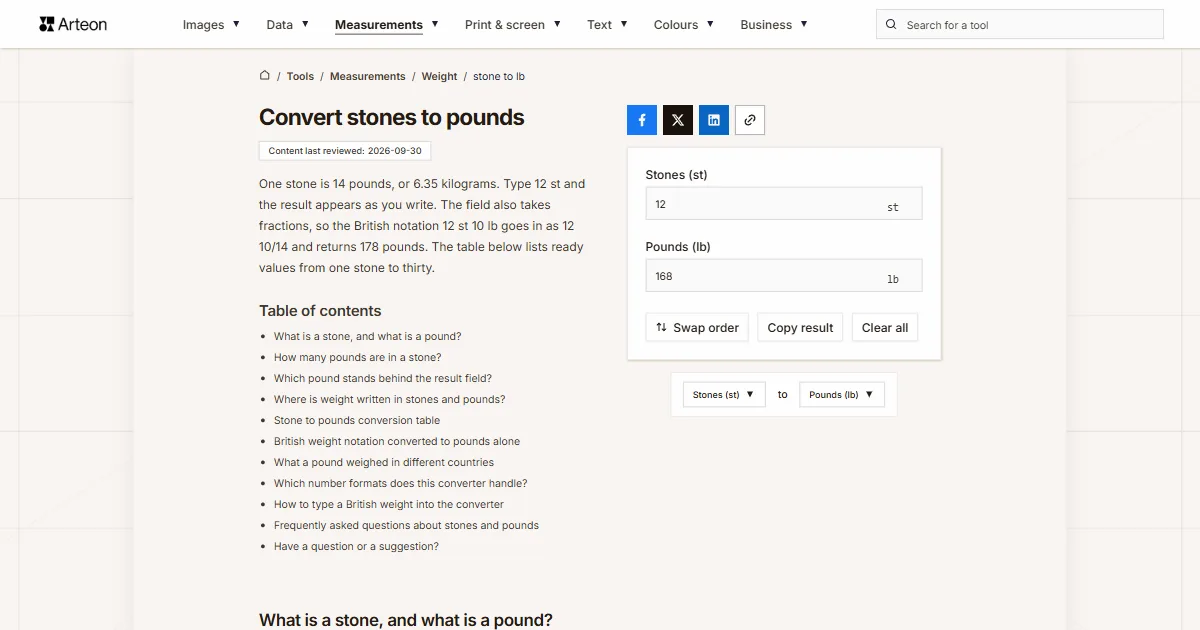
One stone is 14 pounds, or 6.35 kilograms. Type 12 st and the result appears as you write. The field also takes fractions, so the British notation 12 st 10 lb goes in as 12 10/14 and returns 178 pounds. The table below lists ready values from one stone to thirty.
What is a stone, and what is a pound?
The stone and the pound are two imperial units of mass held together by a fixed ratio: one stone equals fourteen pounds.[1]
The pound carries the hard definition. It weighs exactly 0.45359237 kilograms, and the same figure applies in the United Kingdom and in the United States.[2] The stone takes its value from there: fourteen of those pounds come to 6.35029318 kilograms.
In Britain and Ireland the two units describe one thing together: body weight. A British speaker gives it as whole stones plus the remaining pounds, an American gives the same weight in pounds alone. Converting stones to pounds is therefore a move from the British notation to the American one.
How many pounds are in a stone?
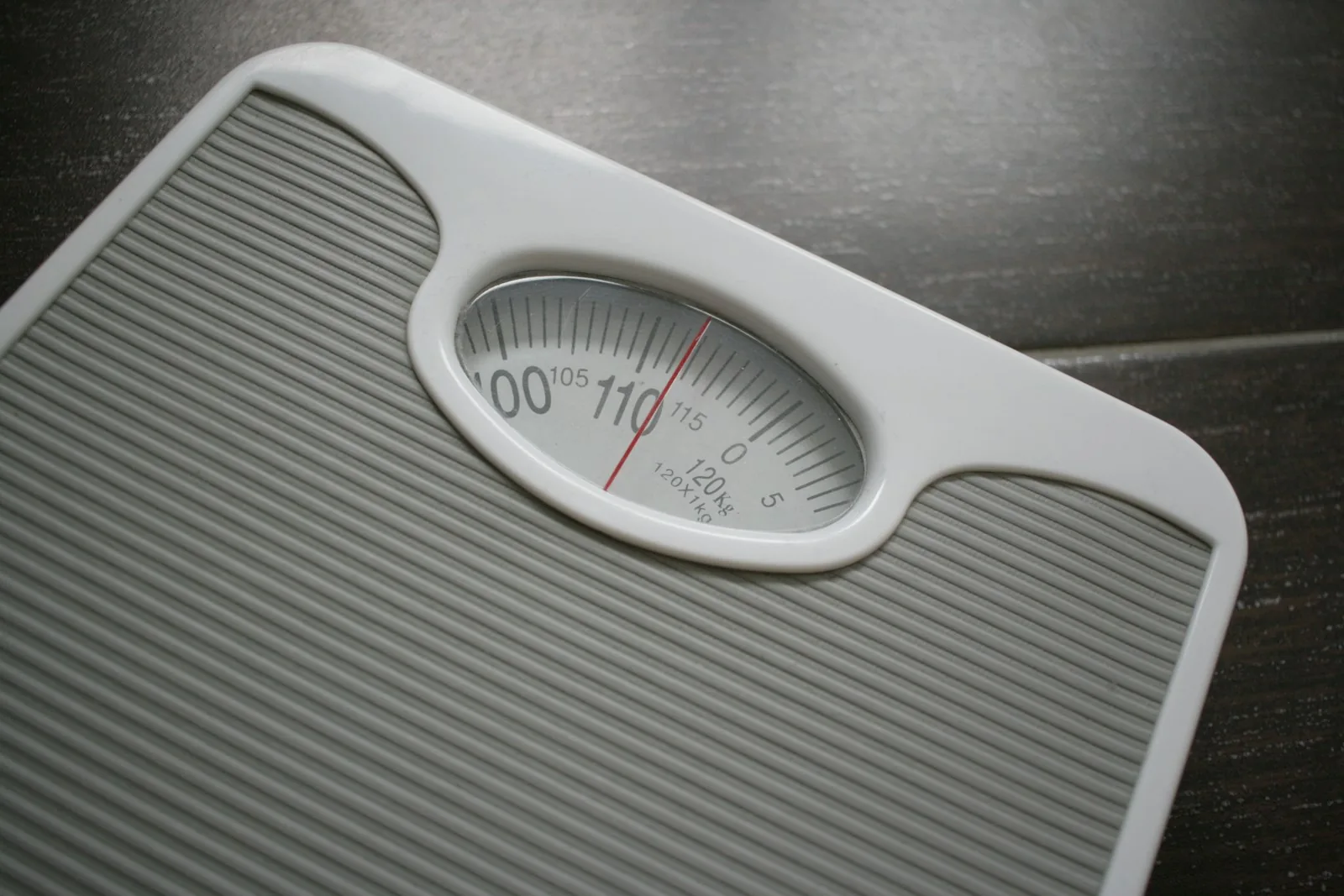
One stone is 14 pounds. The formula has a single step: pounds = stones × 14.
The multiplier is a whole number, so whole stones give a result with no decimal part. Twelve stone comes to 168 pounds. Twenty stone comes to 280 pounds. Seven stone is exactly 98 pounds.
The same sum works in your head in two steps. Multiply the stones by ten, then add four times the same figure. Thirteen stone gives 130 plus 52, which is 182 pounds.
The same rule covers the values in between. Half a stone is 7 pounds, because half of fourteen falls on a whole number. A quarter stone comes to 3.5 pounds.
The opposite direction is handled by the pounds to stones converter, and the move into metric by the stone to kilograms converter.
Which pound stands behind the result field?
English keeps two pounds in circulation. The converter works with the avoirdupois pound of 453.59237 grams, the one behind every weight on this page.[2] The field label says so directly: it reads “Pounds (lb)”.
The other one is the troy pound of 373.24172 grams, which holds twelve troy ounces. The ounce inside it is the unit gold, silver and platinum are priced in.[3] Body weight and stones stay entirely on the avoirdupois side.
The gap shows up quickly on real numbers. Twelve stone is 168 avoirdupois pounds, which comes to 76.2 kilograms. The same count in troy pounds would come to 62.7 kilograms, some thirteen and a half kilograms lower. The pound table below sets the values side by side.
Where is weight written in stones and pounds?
Beyond body weight the stone stays in use across British and Irish sport: professional boxing, wrestling and horse racing.[1]
In the Grand National, the best known British steeplechase, the top weight a horse carries is 11 st 12 lb.[4] In pounds alone that is 166. Eleven stone accounts for 154 pounds, and the remainder adds another twelve.
Boxing sets its division limits in pounds, and British commentary reads them back in stones. Several of them land on a round figure there. The flyweight limit stops at 112 pounds, exactly eight stone. The featherweight limit stops at 126 pounds, exactly nine.[5]
Two more divisions land on half stones. The welterweight limit is 147 pounds, ten and a half stone. The light heavyweight limit is 175 pounds, twelve and a half. Read in stones, the whole set falls on whole and half values.
Stone to pounds conversion table
| Stones | Pounds | Kilograms |
|---|---|---|
| 1 st | 14 lb | 6.35 kg |
| 2 st | 28 lb | 12.7 kg |
| 3 st | 42 lb | 19.05 kg |
| 4 st | 56 lb | 25.4 kg |
| 5 st | 70 lb | 31.75 kg |
| 6 st | 84 lb | 38.1 kg |
| 7 st | 98 lb | 44.45 kg |
| 8 st | 112 lb | 50.8 kg |
| 9 st | 126 lb | 57.15 kg |
| 10 st | 140 lb | 63.5 kg |
| 11 st | 154 lb | 69.85 kg |
| 12 st | 168 lb | 76.2 kg |
| 13 st | 182 lb | 82.55 kg |
| 14 st | 196 lb | 88.9 kg |
| 15 st | 210 lb | 95.25 kg |
| 16 st | 224 lb | 101.6 kg |
| 17 st | 238 lb | 107.95 kg |
| 18 st | 252 lb | 114.31 kg |
| 19 st | 266 lb | 120.66 kg |
| 20 st | 280 lb | 127.01 kg |
| 22 st | 308 lb | 139.71 kg |
| 24 st | 336 lb | 152.41 kg |
| 30 st | 420 lb | 190.51 kg |
British weight notation converted to pounds alone
| British notation | Pounds |
|---|---|
| 8 st 0 lb | 112 lb |
| 8 st 4 lb | 116 lb |
| 8 st 7 lb | 119 lb |
| 8 st 10 lb | 122 lb |
| 9 st 0 lb | 126 lb |
| 9 st 4 lb | 130 lb |
| 9 st 7 lb | 133 lb |
| 9 st 10 lb | 136 lb |
| 10 st 0 lb | 140 lb |
| 10 st 4 lb | 144 lb |
| 10 st 7 lb | 147 lb |
| 10 st 10 lb | 150 lb |
| 11 st 0 lb | 154 lb |
| 11 st 4 lb | 158 lb |
| 11 st 7 lb | 161 lb |
| 11 st 10 lb | 164 lb |
| 12 st 0 lb | 168 lb |
| 12 st 4 lb | 172 lb |
| 12 st 7 lb | 175 lb |
| 12 st 10 lb | 178 lb |
| 13 st 0 lb | 182 lb |
| 13 st 4 lb | 186 lb |
| 13 st 7 lb | 189 lb |
| 13 st 10 lb | 192 lb |
| 14 st 0 lb | 196 lb |
| 14 st 4 lb | 200 lb |
| 14 st 7 lb | 203 lb |
| 14 st 10 lb | 206 lb |
| 15 st 0 lb | 210 lb |
| 15 st 4 lb | 214 lb |
| 15 st 7 lb | 217 lb |
| 15 st 10 lb | 220 lb |
| 16 st 0 lb | 224 lb |
| 16 st 4 lb | 228 lb |
| 16 st 7 lb | 231 lb |
| 16 st 10 lb | 234 lb |
What a pound weighed in different countries
| Name of the pound | Mass | Where it is used |
|---|---|---|
| Avoirdupois pound (lb) | 453.59237 g | United Kingdom, Ireland and the United States — the one this converter uses |
| Troy pound (lb t) | 373.24172 g | the troy system, twelve troy ounces |
| Polish funt zwyczajny | 500 g | Poland, everyday speech and old recipes |
| German Pfund | 500 g | Germany, set by the Customs Union |
| French livre | 500 g | France, everyday speech |
| Libra castellana | 460.093 g | Spain, until the metric system |
| Portuguese arrátel | 459 g | Portugal and Brazil, until the 19th century |
| Bohemian libra | 513 g | Bohemia, until the metric system |
| Roman libbra | 327.168 g | ancient Rome |
Which number formats does this converter handle?
| What you type | What the converter shows | How we read it |
|---|---|---|
| 12.5 | 175 lb | The decimal point from the numeric keypad, written the way English writes it |
| 12,5 | 175 lb | A comma pasted from a market that writes decimals that way is read as a decimal point, so the result is the same |
| 1,500 | 21000 lb | Three digits follow the comma, so we read it as a thousands separator: the field holds one thousand five hundred. A note under the field shows the other possible reading, 1.5. |
| 3/4 | 10.5 lb | We work the fraction out ourselves, so there is no need to turn it into a decimal first |
| 11½ | 161 lb | The ½ character copied from a recipe or a label is added to the number in front of it |
| 12.5 st | 175 lb | A unit symbol pasted along with the number is no trouble: we take the number and leave the symbol out |
How to type a British weight into the converter
The notation 12 st 10 lb carries two units at once, and the field takes one number. A fraction joins them.
Write the remainder as a fraction over 14
Pounds are fourteenths of a stone, so ten pounds is 10/14 of a stone. The whole notation 12 st 10 lb goes into the field as 12 10/14.Read the result in pounds
The result field shows 178 lb. The arithmetic behind it: twelve stone makes 168 pounds, and the remainder adds ten.Take the number further
The Copy result button puts the value on your clipboard. The Clear all button empties both fields for the next conversion.Turn the conversion around
The Swap order button takes you to the pounds to stones converter, where the same weight starts from the pound figure.
Convert other units to Pounds (lb)
Convert Stones (st) to other units
Sources
- Stone (unit) — Wikipedia
- NIST Guide to the SI, Appendix B.9: Factors for Units — National Institute of Standards and Technology
- Troy weight — Wikipedia
- Grand National — Wikipedia
- Boxing weight classes — Wikipedia
Every figure in the tables was computed from the unit definitions and checked arithmetically before publication. Historical values and the names of local units come from the sources listed above.
Content last reviewed: · written and checked by the Arteon team
Frequently asked questions about stones and pounds
Does a stone have 14 pounds in both the United Kingdom and Ireland?
A stone holds exactly 14 avoirdupois pounds, which comes to 6.35029318 kilograms. That value applies to every body weight written in the United Kingdom and Ireland.
How many pounds is 12 stone?
Twelve stone is 168 pounds, or 76.2 kilograms. Thirteen stone comes to 182 pounds and fourteen stone to 196.
How many pounds is 20 stone?
Twenty stone is 280 pounds, or 127.01 kilograms. Twenty-two stone comes to 308 pounds and twenty-four to 336 pounds.
How many pounds is half a stone?
Half a stone is 7 pounds, or 3.18 kilograms. A quarter stone comes to 3.5 pounds.
How do I type 12 st 10 lb into the converter?
Enter it as a mixed fraction over fourteen, so 12 10/14. The result is 178 pounds. In the same way 10 st 7 lb goes in as 10 7/14.
What is the formula for stones to pounds?
The formula is: pounds = stones × 14. The other way round: stones = pounds ÷ 14.
Why does a stone hold fourteen pounds?
The figure comes from medieval trade, where every commodity had its own standard weight stone. The history of the unit is covered on the kilograms to stone converter.
How heavy is the pound this converter uses?
453.59237 grams. That is the avoirdupois pound, the one a stone is built from. The troy pound of 373.24172 grams belongs to the separate system used for precious metals.
What unit does the United States use for body weight?
Pounds alone. A weight written in Britain as 12 st 10 lb is quoted there as 178 pounds.
What is the top weight in the Grand National?
The top weight in that race is 11 st 12 lb, which is 166 pounds. British racing still writes handicap weights in stones and pounds.
What is the welterweight limit in pounds?
The welterweight limit is 147 pounds, exactly ten and a half stone. The flyweight limit stops at 112 pounds and the featherweight limit at 126, which are eight and nine stone even.
How many kilograms is 12 stone?
Twelve stone is 76.2 kilograms. The full conversion in that direction is handled by the stone to kilograms converter.
Have a question or a suggestion?
If you spot an error in the tables or have an idea for the converter, write to us.