Convert liters to cubic meters
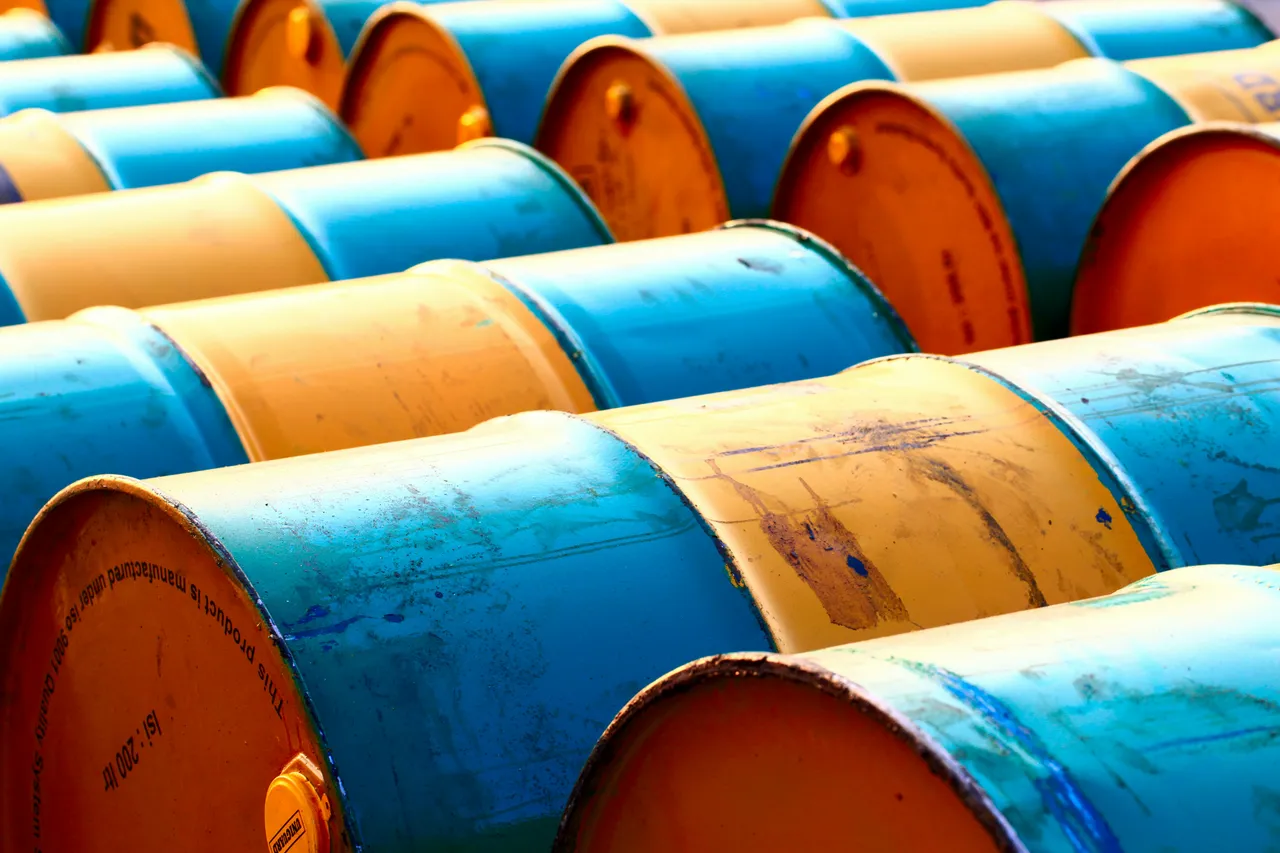
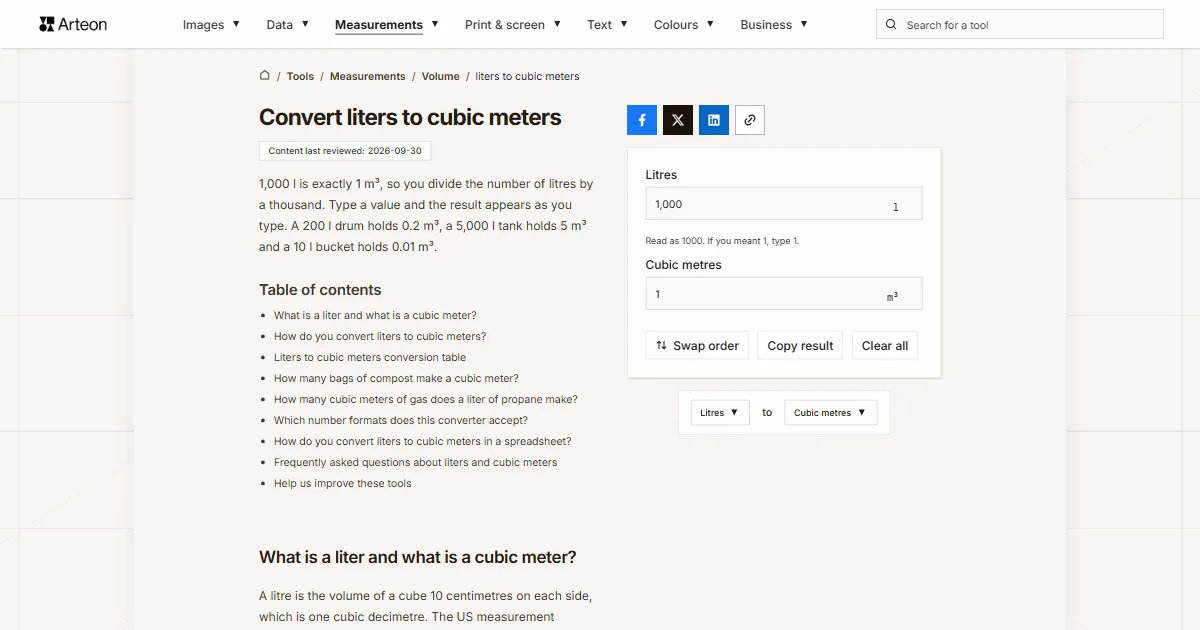
1,000 l is exactly 1 m³, so you divide the number of litres by a thousand. Type a value and the result appears as you type. A 200 l drum holds 0.2 m³, a 5,000 l tank holds 5 m³ and a 10 l bucket holds 0.01 m³.
What is a liter and what is a cubic meter?
A litre is the volume of a cube 10 centimetres on each side, which is one cubic decimetre. The US measurement institute NIST writes the relationship as 1 L = 1 dm³ = 0.001 m³.[1] The symbol can be a lower-case l or a capital L. The capital was added in 1979 so that the letter l would not be mistaken for the number 1, and it is the preferred form in the United States.[1]
A cubic metre (m³) is the volume of a cube one metre on each side and the unit of volume in the International System of Units. British and international usage spells it cubic metre, while American English writes cubic meter.[2] A metre holds 10 decimetres, so the cube fits 10 × 10 × 10 litre boxes, or 1,000 litres.
The same thousand litres is also called a kilolitre, which the liters to kiloliters converter handles. For small amounts, such as a dose of medicine or a splash of oil, the liters to ml converter gives a more readable number.
How do you convert liters to cubic meters?
The formula has one step: cubic metres = litres ÷ 1,000. Dividing by a thousand moves the decimal point three places to the left, so 2,500 l is 2.5 m³, 750 l is 0.75 m³ and 30 l is 0.03 m³.
Small amounts pick up zeros after the point. A half-litre bottle is 0.0005 m³ and 11 litres are 0.011 m³. The converter shows up to seven decimal places, so even a single millilitre (0.000001 m³) stays visible in the result field.
To go the other way, from a water meter reading or a concrete quote back to litres, use the cubic meters to liters converter. If your figure starts in US gallons, the gallons to liters converter turns it into litres first.
Liters to cubic meters conversion table
| Litres | Cubic metres |
|---|---|
| 1 l | 0.001 m³ |
| 5 l | 0.005 m³ |
| 10 l | 0.01 m³ |
| 20 l | 0.02 m³ |
| 50 l | 0.05 m³ |
| 100 l | 0.1 m³ |
| 200 l | 0.2 m³ |
| 250 l | 0.25 m³ |
| 300 l | 0.3 m³ |
| 500 l | 0.5 m³ |
| 750 l | 0.75 m³ |
| 1,000 l | 1 m³ |
| 1,500 l | 1.5 m³ |
| 2,000 l | 2 m³ |
| 2,500 l | 2.5 m³ |
| 3,000 l | 3 m³ |
| 5,000 l | 5 m³ |
| 10,000 l | 10 m³ |
| 20,000 l | 20 m³ |
| 100,000 l | 100 m³ |
How many bags of compost make a cubic meter?
| Bag size | Bag in cubic metres | Bags per 1 m³ |
|---|---|---|
| 20 litre bag | 0.02 m³ | 50 |
| 40 litre bag | 0.04 m³ | 25 |
| 50 litre bag | 0.05 m³ | 20 |
| 70 litre bag | 0.07 m³ | 15 (exactly 14.3) |
| 80 litre bag | 0.08 m³ | 13 (exactly 12.5) |
How many cubic meters of gas does a liter of propane make?
The converter treats volume one to one: 1,000 litres of gas are 1 m³ of gas, just as 1,000 litres of water are 1 m³ of water. Propane and LPG are different, because you buy them as a liquid, whether at the pump or delivered into a tank. Once the liquid turns into gas, the same amount takes up far more space.
At 25 °C a litre of liquid propane weighs 493 g, while a cubic metre of propane gas at the same temperature weighs 1.808 kg.[3] One litre of liquid therefore makes about 0.27 m³ of gas, roughly 270 litres. A tank holding 1,000 litres of liquid propane gives about 273 m³ of gas.
That figure is for pure propane at one temperature. The density of propane changes with temperature,[3] and LPG blended with butane has a different liquid to vapour ratio.[4] Treat the result as an estimate rather than the exact amount of gas in your cylinder or tank.
Which number formats does this converter accept?
| What you type | What the converter shows | How we read it |
|---|---|---|
| 1500 | 1.5 m³ | A number without separators is read as it stands, fifteen hundred litres. |
| 1,500 | 1.5 m³ | A comma before three digits groups thousands in English, so this is also fifteen hundred litres. A note under the field shows the other possible reading, 1.5. |
| 1 500 | 1.5 m³ | A space between the thousands, as written in much of Europe and in SI style, gives the same result. |
| 2.5 | 0.0025 m³ | The decimal point separates the fraction, exactly as you would expect. |
| 2,5 | 0.0025 m³ | A comma followed by one digit can only be a decimal comma, so we read it as two and a half. |
| 3/4 | 0.00075 m³ | We work out a fraction with a slash for you, so there is no need to turn it into a decimal first. |
| 2½ | 0.0025 m³ | A ½ sign copied from a label or a recipe is added to the number in front of it. |
| 1500 l | 1.5 m³ | A litre symbol pasted with the number does no harm: we take the number and skip the symbol. |
How do you convert liters to cubic meters in a spreadsheet?
For one number the field above is enough. A list of tank capacities or monthly readings converts with one formula dragged down the column.
Excel: the CONVERT function
Type =CONVERT(A1,"l","m3"). Excel knows the litre as "l" or "L" and the cubic metre as "m3" or "m^3".[5]Google Sheets: write m^3
The CONVERT function in Google Sheets lists the cubic metre only as "m^3", so the formula is =CONVERT(A1,"l","m^3").[6] Excel accepts the same spelling, so one formula works in both.Plain division
The formula =A1/1000 works in every spreadsheet, LibreOffice Calc included, and shows the whole calculation in the cell.Check one cell first
Before you drag the formula down, enter 1000 in A1 and make sure the result is 1. A #N/A error means the function did not recognise a unit code, so check the letters and the quotation marks.
Convert Litres to other units
Sources
- NIST Special Publication 330, section 4 — the litre as a cubic decimetre and its symbols l and L — National Institute of Standards and Technology
- Cubic metre — Wikipedia
- Propane — density of liquid and gaseous propane at 25 °C — Wikipedia
- Liquefied petroleum gas — liquid to vapour density ratio — Wikipedia
- CONVERT function — Microsoft
- CONVERT — units available in Google Sheets — Google
- Litre — mass of a litre of water — Wikipedia
Every figure in the tables was computed from the unit definitions and checked arithmetically before publication. Historical values and the names of local units come from the sources listed above.
Content last reviewed: · written and checked by the Arteon team
Frequently asked questions about liters and cubic meters
What does CBM mean on a shipping quote?
CBM is a common abbreviation for the cubic metre,[2] so 1 CBM is 1,000 litres. A carton that measures 0.5 × 0.4 × 0.3 m takes up 0.06 CBM, or 60 litres of space.
How much does a cubic meter of water weigh?
About a tonne. A litre of water has a mass of almost exactly one kilogram,[7] so 1,000 litres weigh about 1,000 kg. The kg to tons converter turns kilograms into tonnes. Sand, soil and concrete of the same volume weigh more, because they are denser.
How many liters of diesel fit in a cubic meter?
The same as any liquid: 1,000 litres. Converting volume does not depend on what you pour into the tank. Only the weight changes from one liquid to another.
How do you convert liters per minute to cubic meters per hour?
Multiply by 60, because an hour has 60 minutes, then divide by 1,000. In one step that is multiplying by 0.06, so a pump rated at 100 L/min moves 6 m³ an hour. The converter works with plain volume, so enter the litres for a whole hour, 6,000, to check it.
Help us improve these tools
Spotted a mistake in a table or have an idea for this converter? Write to us.