Convert pounds to stones
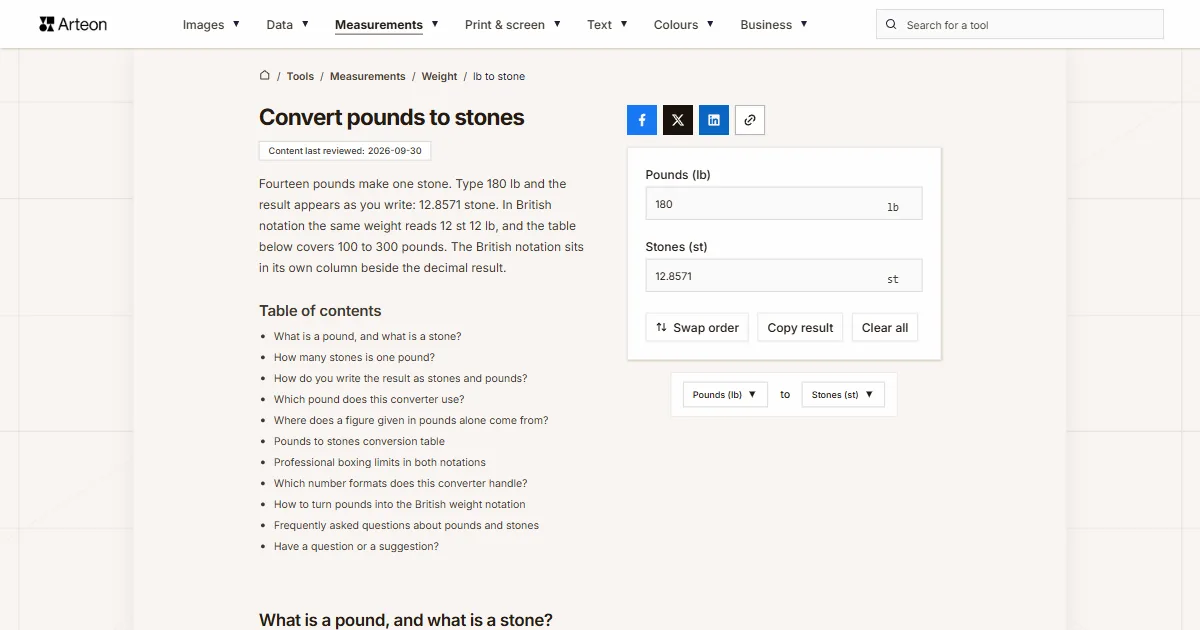
Fourteen pounds make one stone. Type 180 lb and the result appears as you write: 12.8571 stone. In British notation the same weight reads 12 st 12 lb, and the table below covers 100 to 300 pounds. The British notation sits in its own column beside the decimal result.
What is a pound, and what is a stone?
The pound is the base unit of mass in the imperial system and it carries a hard definition: it weighs exactly 0.45359237 kilograms.[1] The United States, the United Kingdom and Ireland all work from that same value.
The stone is the larger unit. Fourteen pounds make one stone, which comes to 6.35029318 kilograms.[2] A pound is therefore a fourteenth of a stone, and that ratio drives every figure on this page.
The split between the two units is geographic. An American gives body weight in pounds alone. A British or Irish speaker divides the same number into whole stones and a pound remainder. Converting pounds to stones is a move from the American notation to the British one.
How many stones is one pound?
One pound is 0.0714 stone, a fourteenth. The formula has a single step: stones = pounds ÷ 14.
Across typical body weights the results look like this. A hundred and forty pounds comes to exactly 10 stone. A hundred and eighty pounds comes to 12.8571 stone. Three hundred pounds comes to 21.4286 stone.
The range that covers adult body weight starts in practice around a hundred pounds and reaches three hundred. The lower end is a little over seven stone, the upper a little over twenty-one. The table below covers all of it.
The decimal result suits comparisons and spreadsheets. In conversation in Britain and Ireland the weight is given in the two-unit notation, and the next section covers it.
The opposite direction is handled by the stones to pounds converter, and the move into metric by the pounds to kilograms converter.
How do you write the result as stones and pounds?
The British notation comes out of the decimal result in two steps. The figure before the point is the whole stones. The part after the point, multiplied by 14, gives the pound remainder.
Take 180 pounds. Dividing by fourteen gives 12.8571 stone, so there are twelve whole stones. The fractional part 0.8571 multiplied by fourteen gives twelve pounds. The whole weight reads 12 st 12 lb.
A second route runs through the remainder of the division and suits mental arithmetic. Twelve stone is 168 pounds, and twelve is left over from a hundred and eighty. The answer comes out the same.
Nine values in the table below land on whole stones with no remainder at all: 112, 126, 140, 154, 168, 182, 196, 210 and 280 pounds. Each of them divides by fourteen exactly.
Which pound does this converter use?
The converter works with the avoirdupois pound of 453.59237 grams, and the field label says so directly: it reads “Pounds (lb)”.
English keeps a second pound in circulation. The troy pound weighs 373.24172 grams and holds twelve troy ounces. The ounce inside it is the unit gold, silver and platinum are priced in.[3] A stone is built from avoirdupois pounds, and that is the pound the field above works in.
The full set of nine pounds from various countries and eras sits in a table on the stones to pounds converter.
Where does a figure given in pounds alone come from?
A bare pound figure usually points to the United States: that is how an American medical record, training app or equipment listing states weight. A two-unit figure points to Britain and Ireland.
The second source is sport, where the stone remains in daily use: professional boxing, wrestling and horse racing.[2] Weight limits are announced in pounds, and British commentary reads them back in stones.
In stones they then fall on whole and half values. The flyweight limit is 112 pounds, exactly eight stone. The featherweight limit is 126 pounds, exactly nine.[4]
Two divisions land on half stones. Welterweight stops at 147 pounds, ten and a half stone. Light heavyweight stops at 175 pounds, twelve and a half. The table below gives the full set in both notations.
Pounds to stones conversion table
| Pounds | Stones | British notation | Kilograms |
|---|---|---|---|
| 100 lb | 7.1429 st | 7 st 2 lb | 45.36 kg |
| 110 lb | 7.8571 st | 7 st 12 lb | 49.9 kg |
| 112 lb | 8 st | 8 st 0 lb | 50.8 kg |
| 120 lb | 8.5714 st | 8 st 8 lb | 54.43 kg |
| 126 lb | 9 st | 9 st 0 lb | 57.15 kg |
| 130 lb | 9.2857 st | 9 st 4 lb | 58.97 kg |
| 135 lb | 9.6429 st | 9 st 9 lb | 61.23 kg |
| 140 lb | 10 st | 10 st 0 lb | 63.5 kg |
| 147 lb | 10.5 st | 10 st 7 lb | 66.68 kg |
| 150 lb | 10.7143 st | 10 st 10 lb | 68.04 kg |
| 154 lb | 11 st | 11 st 0 lb | 69.85 kg |
| 157 lb | 11.2143 st | 11 st 3 lb | 71.21 kg |
| 160 lb | 11.4286 st | 11 st 6 lb | 72.57 kg |
| 165 lb | 11.7857 st | 11 st 11 lb | 74.84 kg |
| 168 lb | 12 st | 12 st 0 lb | 76.2 kg |
| 170 lb | 12.1429 st | 12 st 2 lb | 77.11 kg |
| 175 lb | 12.5 st | 12 st 7 lb | 79.38 kg |
| 180 lb | 12.8571 st | 12 st 12 lb | 81.65 kg |
| 182 lb | 13 st | 13 st 0 lb | 82.55 kg |
| 190 lb | 13.5714 st | 13 st 8 lb | 86.18 kg |
| 196 lb | 14 st | 14 st 0 lb | 88.9 kg |
| 200 lb | 14.2857 st | 14 st 4 lb | 90.72 kg |
| 210 lb | 15 st | 15 st 0 lb | 95.25 kg |
| 220 lb | 15.7143 st | 15 st 10 lb | 99.79 kg |
| 230 lb | 16.4286 st | 16 st 6 lb | 104.33 kg |
| 240 lb | 17.1429 st | 17 st 2 lb | 108.86 kg |
| 250 lb | 17.8571 st | 17 st 12 lb | 113.4 kg |
| 280 lb | 20 st | 20 st 0 lb | 127.01 kg |
| 300 lb | 21.4286 st | 21 st 6 lb | 136.08 kg |
Professional boxing limits in both notations
| Division | Limit in pounds | British notation | Kilograms |
|---|---|---|---|
| Flyweight | 112 lb | 8 st 0 lb | 50.82 kg |
| Bantamweight | 118 lb | 8 st 6 lb | 53.52 kg |
| Featherweight | 126 lb | 9 st 0 lb | 57.15 kg |
| Lightweight | 135 lb | 9 st 9 lb | 61.23 kg |
| Welterweight | 147 lb | 10 st 7 lb | 66.68 kg |
| Middleweight | 160 lb | 11 st 6 lb | 72.57 kg |
| Light heavyweight | 175 lb | 12 st 7 lb | 79.38 kg |
Which number formats does this converter handle?
| What you type | What the converter shows | How we read it |
|---|---|---|
| 180.5 | 12.8929 st | The decimal point from the numeric keypad, written the way English writes it |
| 180,5 | 12.8929 st | A comma pasted from a market that writes decimals that way is read as a decimal point, so the result is the same |
| 1,500 | 107.1429 st | Three digits follow the comma, so we read it as a thousands separator: the field holds one thousand five hundred. A note under the field shows the other possible reading, 1.5. |
| 1 000 | 71.4286 st | A space between thousands, the way a spreadsheet pastes it, does not split the number in two |
| 3/4 | 0.0536 st | We work the fraction out ourselves, so there is no need to turn it into a decimal first |
| 160½ | 11.4643 st | The ½ character copied from a recipe or a label is added to the number in front of it |
| 180.5 lb | 12.8929 st | A unit symbol pasted along with the number is no trouble: we take the number and leave the symbol out |
How to turn pounds into the British weight notation
Four steps from an American pound figure to the notation you hear in the United Kingdom and Ireland.
Type the weight in pounds
The field takes a point or a comma, and fractions too, so 180.5 pounds goes in as 180.5 or 180 1/2.Read the decimal result
For 180 pounds the result field shows 12.8571 st. That form suits a spreadsheet and any comparison between two weights.Split the result into stones and pounds
The figure before the point gives the whole stones, twelve here. The part after the point multiplied by fourteen gives the remainder: 0.8571 × 14 is twelve pounds, so the answer is 12 st 12 lb.Take the number further
The Copy result button puts the value on your clipboard. The Swap order button takes you to the stones to pounds converter.
Convert other units to Stones (st)
Convert Pounds (lb) to other units
Sources
- NIST Guide to the SI, Appendix B.9: Factors for Units — National Institute of Standards and Technology
- Stone (unit) — Wikipedia
- Troy weight — Wikipedia
- Boxing weight classes — Wikipedia
Every figure in the tables was computed from the unit definitions and checked arithmetically before publication. Historical values and the names of local units come from the sources listed above.
Content last reviewed: · written and checked by the Arteon team
Frequently asked questions about pounds and stones
What fraction of a stone is one pound?
One pound is 0.0714 stone, a fourteenth of a stone. The formula is: stones = pounds ÷ 14.
How many stones is 180 lbs?
A hundred and eighty pounds is 12.8571 stone, written 12 st 12 lb. In kilograms that comes to 81.65.
How many stones is 300 lbs?
Three hundred pounds is 21.4286 stone, written 21 st 6 lb. In kilograms that comes to 136.08.
How many stones is 100 lbs?
A hundred pounds is 7.1429 stone, written 7 st 2 lb. In kilograms that comes to 45.36.
How do I turn a decimal result into 12 st 12 lb?
The figure before the point is the whole stones. Multiply the part after the point by 14 for the pound remainder. For 12.8571 stone that gives twelve stone and twelve pounds.
Which pound figures land on whole stones?
The multiples of fourteen: 112, 126, 140, 154, 168, 182, 196, 210 and 280 pounds. They match eight, nine, ten, eleven, twelve, thirteen, fourteen, fifteen and twenty stone.
How many avoirdupois pounds make up one stone?
A stone holds exactly 14 avoirdupois pounds. The full table in that direction sits in the stones to pounds converter.
What is the largest pound remainder in the British notation?
Thirteen pounds. Fourteen makes another whole stone, so the remainder runs from zero to thirteen.
Where does the two-unit notation with stones and pounds come from?
From the United Kingdom and Ireland. The United States gives body weight in pounds alone.
How many stones is a welterweight boxer?
The welterweight limit is 147 pounds, exactly ten and a half stone. In kilograms that comes to 66.68.
How many grams are in an avoirdupois pound?
453.59237 grams. That is the pound a stone is built from and the one the field above counts in. The troy pound weighs 373.24172 grams and belongs to the separate system used for precious metals.
How many kilograms is 180 lbs?
A hundred and eighty pounds is 81.65 kilograms. The full conversion in that direction is handled by the pounds to kilograms converter.
Have a question or a suggestion?
If you spot an error in the tables or have an idea for the converter, write to us.