Convert recipe cups to pints
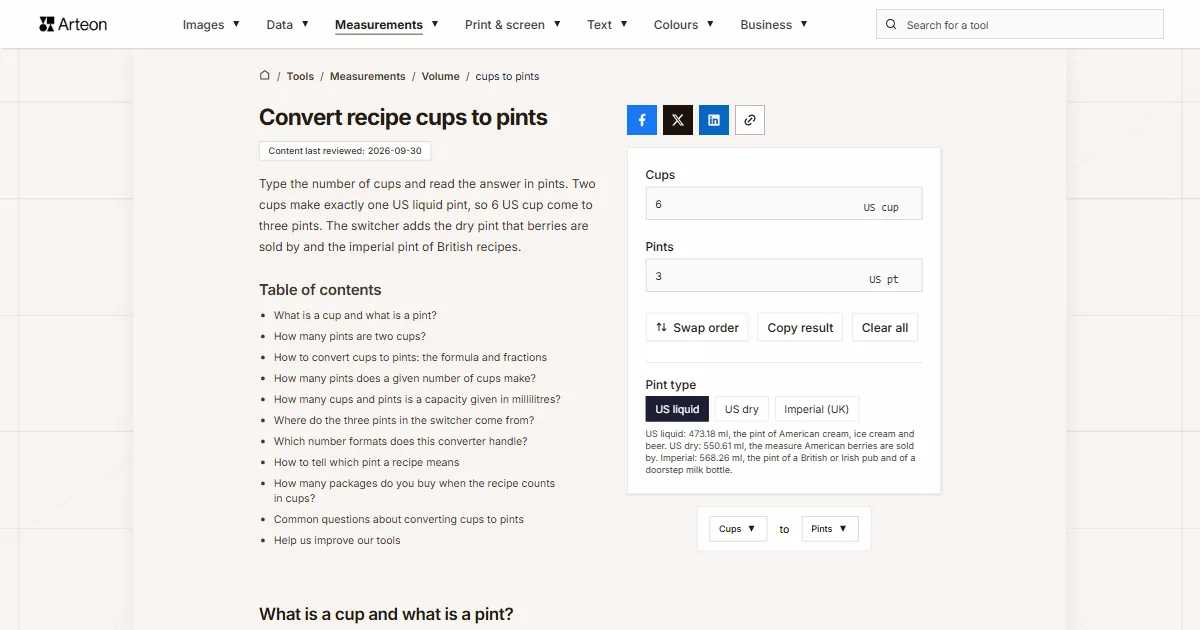
Type the number of cups and read the answer in pints. Two cups make exactly one US liquid pint, so 6 US cup come to three pints. The switcher adds the dry pint that berries are sold by and the imperial pint of British recipes.
What is a cup and what is a pint?
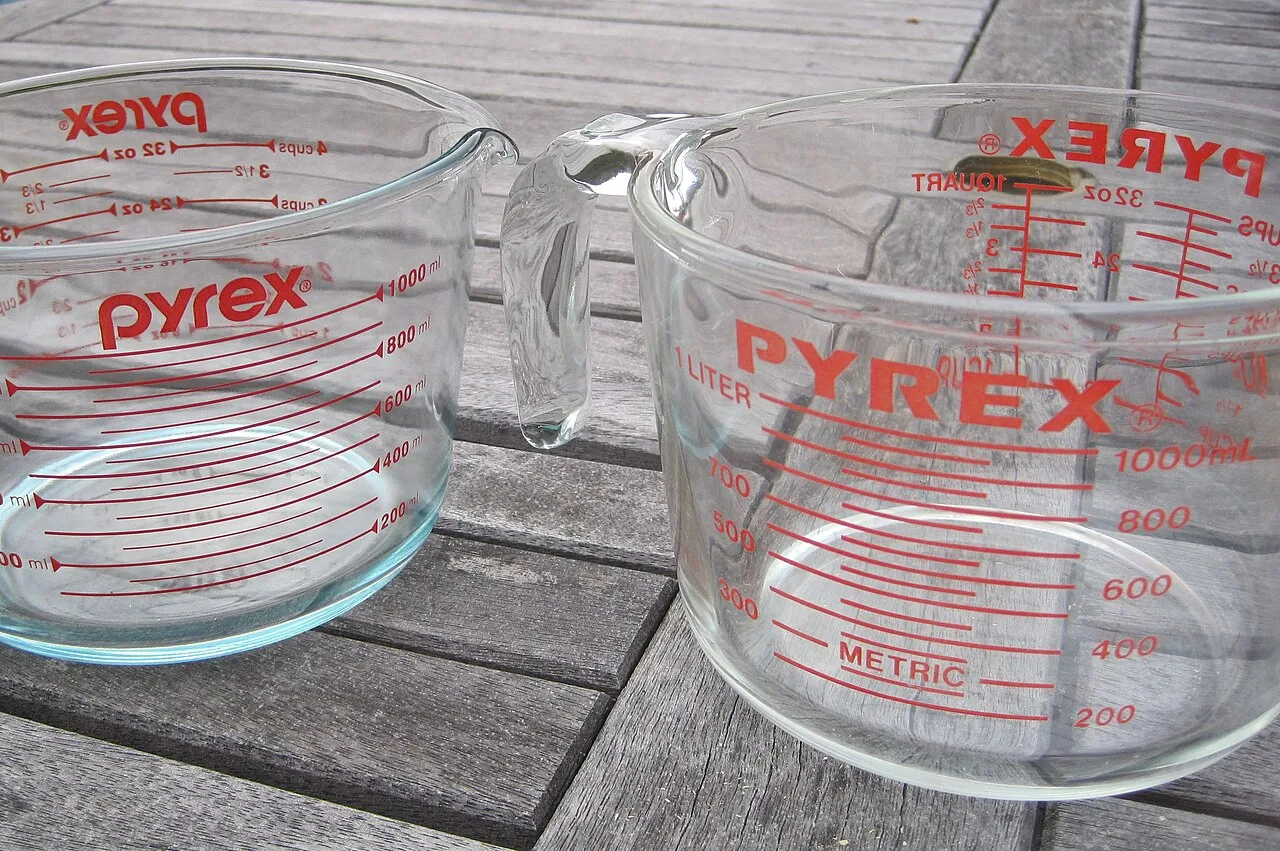
The cup is the measure an American recipe writes in. It holds 236.5882365 millilitres and comes from dividing the gallon: a gallon holds sixteen cups and a hundred and twenty-eight fluid ounces, so a cup works out at eight ounces[1]. American measuring sets carry exactly those sizes: the full cup, the half, the third and the quarter.
The pint is the next measure up in the same series and holds two cups. The US liquid pint holds 473.176473 millilitres[1]. The imperial pint of the United Kingdom and Ireland holds 568.26125 millilitres[2]. A third measure, the dry pint of 550.6104713575 millilitres, covers dry goods and soft fruit.
There is no culinary measuring cup based on the imperial system[3], and British recipes give grams and millilitres. The figure of 284 millilitres that sometimes appears as a British cup is 10 imperial fluid ounces, half a pint, which an 1894 household book gave as the usual capacity of a tumbler[3].
You choose the pint with the Pint type switcher under the fields. The opposite direction is handled by the pints to cups converter, and the cup itself by the cups to millilitres converter.
How many pints are two cups?
Two cups make exactly one US liquid pint. One cup gives half a pint. Four cups give two pints. The split comes out even because the cup was defined as half a liquid pint[1]. Three cups give one and a half pints. Sixteen cups give eight liquid pints, which is a whole US gallon. The same split holds in every American recipe, whatever the ingredient.
With the dry pint the same number of cups gives a smaller figure, because a dry pint holds 550.61 millilitres. Two cups give 0.859 of a dry pint. Eight cups give 3.437 dry pints.
With the imperial pint two cups give 0.833 of a pint and eight cups give 3.331 pints. That measure turns up in recipes and on packaging from the United Kingdom and Ireland.
How to convert cups to pints: the formula and fractions
Divide the number of cups by two and the answer is in liquid pints. Six cups give three pints. Twelve cups give six pints. An odd number ends on a half, so five cups come to two and a half pints.
The other two options carry their own divisors. For the dry pint, multiply the number of cups by 0.4297. For the imperial pint, by 0.4163. Both numbers come from dividing the volume of the cup by the volume of that pint.
The input field takes plain fractions and mixed numbers, so 3/4 or 2 3/4 go in exactly as the recipe writes them. Two and three quarter cups give 1.375 liquid pints.
The measure below the cup is handled by the cups to fluid ounces converter, and the measure above the pint by the pints to quarts converter.
How many pints does a given number of cups make?
| Cups | US liquid pint | US dry pint | Imperial pint |
|---|---|---|---|
| 1/4 | 0.125 pt | 0.107 pt | 0.104 pt |
| 1/3 | 0.167 pt | 0.143 pt | 0.139 pt |
| 1/2 | 0.25 pt | 0.215 pt | 0.208 pt |
| 2/3 | 0.333 pt | 0.286 pt | 0.278 pt |
| 3/4 | 0.375 pt | 0.322 pt | 0.312 pt |
| 1 | 0.5 pt | 0.43 pt | 0.416 pt |
| 1 1/4 | 0.625 pt | 0.537 pt | 0.52 pt |
| 1 1/3 | 0.667 pt | 0.573 pt | 0.555 pt |
| 1 1/2 | 0.75 pt | 0.645 pt | 0.625 pt |
| 1 3/4 | 0.875 pt | 0.752 pt | 0.729 pt |
| 2 | 1 pt | 0.859 pt | 0.833 pt |
| 2 1/4 | 1.125 pt | 0.967 pt | 0.937 pt |
| 2 1/3 | 1.167 pt | 1.003 pt | 0.971 pt |
| 2 1/2 | 1.25 pt | 1.074 pt | 1.041 pt |
| 2 2/3 | 1.333 pt | 1.146 pt | 1.11 pt |
| 2 3/4 | 1.375 pt | 1.182 pt | 1.145 pt |
| 3 | 1.5 pt | 1.289 pt | 1.249 pt |
| 3 1/4 | 1.625 pt | 1.396 pt | 1.353 pt |
| 3 1/2 | 1.75 pt | 1.504 pt | 1.457 pt |
| 3 3/4 | 1.875 pt | 1.611 pt | 1.561 pt |
| 4 | 2 pt | 1.719 pt | 1.665 pt |
| 4 1/4 | 2.125 pt | 1.826 pt | 1.769 pt |
| 4 1/2 | 2.25 pt | 1.934 pt | 1.874 pt |
| 5 | 2.5 pt | 2.148 pt | 2.082 pt |
| 5 1/2 | 2.75 pt | 2.363 pt | 2.29 pt |
| 6 | 3 pt | 2.578 pt | 2.498 pt |
| 6 1/2 | 3.25 pt | 2.793 pt | 2.706 pt |
| 7 | 3.5 pt | 3.008 pt | 2.914 pt |
| 8 | 4 pt | 3.437 pt | 3.331 pt |
| 9 | 4.5 pt | 3.867 pt | 3.747 pt |
| 10 | 5 pt | 4.297 pt | 4.163 pt |
| 11 | 5.5 pt | 4.727 pt | 4.58 pt |
| 12 | 6 pt | 5.156 pt | 4.996 pt |
| 13 | 6.5 pt | 5.586 pt | 5.412 pt |
| 14 | 7 pt | 6.016 pt | 5.829 pt |
| 16 | 8 pt | 6.875 pt | 6.661 pt |
| 18 | 9 pt | 7.734 pt | 7.494 pt |
| 20 | 10 pt | 8.594 pt | 8.327 pt |
| 22 | 11 pt | 9.453 pt | 9.159 pt |
| 24 | 12 pt | 10.312 pt | 9.992 pt |
| 26 | 13 pt | 11.172 pt | 10.825 pt |
| 30 | 15 pt | 12.891 pt | 12.49 pt |
| 32 | 16 pt | 13.75 pt | 13.323 pt |
| 40 | 20 pt | 17.187 pt | 16.653 pt |
| 44 | 22 pt | 18.906 pt | 18.319 pt |
| 50 | 25 pt | 21.484 pt | 20.817 pt |
| 74 | 37 pt | 31.797 pt | 30.809 pt |
| 84 | 42 pt | 36.093 pt | 34.972 pt |
| 98 | 49 pt | 42.109 pt | 40.801 pt |
| 128 | 64 pt | 54.999 pt | 53.291 pt |
How many cups and pints is a capacity given in millilitres?
| Capacity | US cups | Liquid pints | Imperial pints | Where you meet this size |
|---|---|---|---|---|
| 100 ml | 0.423 cup | 0.211 pt | 0.176 pt | A small measuring jug |
| 250 ml | 1.057 cup | 0.528 pt | 0.44 pt | The metric cup of Australia and Canada |
| 330 ml | 1.395 cup | 0.697 pt | 0.581 pt | A drinks can |
| 500 ml | 2.113 cup | 1.057 pt | 0.88 pt | Half a litre, the smaller water bottle |
| 750 ml | 3.17 cup | 1.585 pt | 1.32 pt | A wine bottle |
| 1,000 ml | 4.227 cup | 2.113 pt | 1.76 pt | A litre carton of milk |
| 1,500 ml | 6.34 cup | 3.17 pt | 2.64 pt | A litre and a half water bottle |
| 2,000 ml | 8.454 cup | 4.227 pt | 3.52 pt | Two litres, the large drinks bottle |
Where do the three pints in the switcher come from?
| Kind of pint | Millilitres | Cubic inches | Cups it holds | What it descends from |
|---|---|---|---|---|
| US liquid | 473.18 ml | 28.875 | 2 cup | An eighth of the gallon of 231 cubic inches |
| US dry | 550.61 ml | 33.6 | 2.327 cup | An eighth of the dry gallon, itself taken from the bushel |
| Imperial | 568.26 ml | 34.677 | 2.402 cup | An eighth of the imperial gallon of 4.54609 litres |
Which number formats does this converter handle?
| What you type | What the converter shows | How we read it |
|---|---|---|
| 2.5 | 1.25 US pt | The point is the decimal separator, so this is two and a half cups. |
| 2,5 | 1.25 US pt | A comma followed by one digit is a European decimal comma, so we read it as two and a half. |
| 1,500 | 750 US pt | Three digits after the comma mark a thousands separator, so we count one thousand five hundred cups. A note under the field says: Read as 1500. If you meant 1.5, type 1.5. |
| 1 500 | 750 US pt | A space between the thousands is skipped, so this is one thousand five hundred cups as well. |
| 3/4 | 0.375 US pt | We convert a fraction with a slash directly, so it doesn’t need to become 0.75 first. |
| 1½ | 0.75 US pt | A ½ character copied from a recipe or a label is added to the number in front of it. |
| 2 cups | 1 US pt | A unit pasted along with the number is ignored, and we convert the value alone. |
How to tell which pint a recipe means
The origin of the recipe and the thing you are measuring settle which pint applies.
An American recipe with a liquid ingredient
Leave the switcher on US liquid. That is how every American recipe counts a pint of cream, stock, milk or juice. Two cups then make exactly one pint.A package of soft fruit
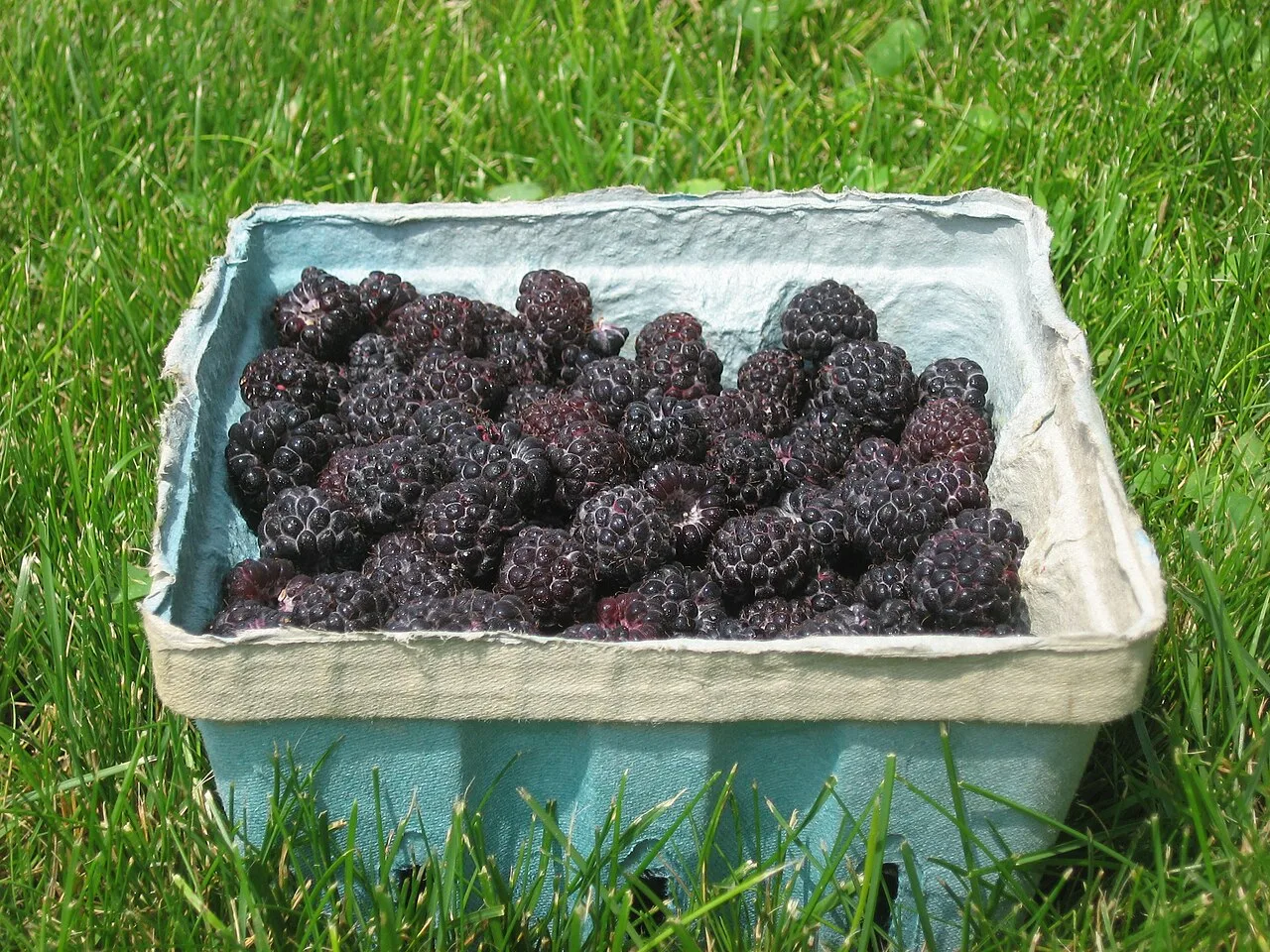
Set the switcher to US dry. Baskets of strawberries, blueberries and cherry tomatoes are measured by the dry pint in the United States, so two cups fill 0.859 of a basket.A recipe from the United Kingdom or Ireland
Set the switcher to Imperial (UK). A British recipe usually gives grams and millilitres, but a pint in such a text means 568.26 millilitres, and two cups then come to 0.833 of a pint.A recipe scaled up
Add up the cups for the whole doubled batch first, and convert that sum to pints afterwards. Ten cups give five liquid pints, so you buy five pint tubs.
How many packages do you buy when the recipe counts in cups?
A recipe calling for four cups of blueberries describes 1.719 dry pints, so two baskets cover it. Six cups come to 2.578 dry pints, which is three baskets. Eight cups come to 3.437 dry pints and then you buy four.
Round the answer up, because baskets are sold whole. What is left over keeps in the fridge and goes into the next dish.
American baskets have had a fixed capacity since 1916, when the Standard Container Act set the measures for packages of small fruit, berries and vegetables[4]. A dry pint occupies 33.6 cubic inches, which is 550.61 millilitres[2].
With liquid ingredients the sum runs straight through, because a tub of cream or ice cream is sold by the liquid pint. Four cups then come to exactly two pint tubs.
Convert other units to Pints
Convert Cups to other units
Sources
- Handbook 44 – 2026, Appendix C. General Tables of Units of Measurement — National Institute of Standards and Technology
- Pint — Wikipedia
- Cup (unit) — Wikipedia
- Standard Fruits and Vegetable Baskets and Containers Act of 1916 — Wikipedia
- Changes to the Nutrition Facts Label — U.S. Food and Drug Administration
Every figure in the tables was computed from the unit definitions and checked arithmetically before publication. Historical values and the names of local units come from the sources listed above.
Content last reviewed: · written and checked by the Arteon team
Common questions about converting cups to pints
How many pints are eight cups?
Four US liquid pints, which is exactly half a gallon[1].
How many pints is a metric cup?
A metric cup of 250 millilitres gives 0.528 of a liquid pint and 0.44 of an imperial pint. That cup is the one Australia, New Zealand and Canada bake with, and the millilitres to cups converter has it as the Metric (250 ml) option of the Cup type switcher.
What does half-pint mean on an American package?
Half a pint, which is exactly one cup and eight fluid ounces[1]. In a recipe the label means one full measuring cup, and on a package it means 236.59 millilitres of contents.
Help us improve our tools
Got an idea for a new feature, found a bug or want to suggest another tool? Write to us.