Convert quarts to gallons
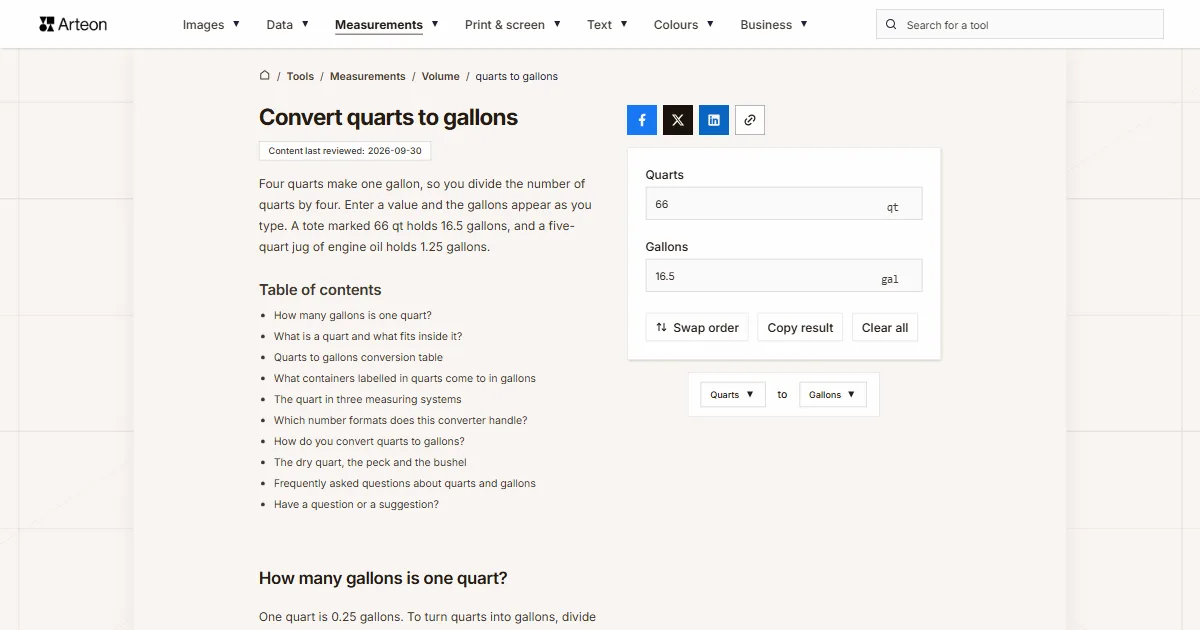
Four quarts make one gallon, so you divide the number of quarts by four. Enter a value and the gallons appear as you type. A tote marked 66 qt holds 16.5 gallons, and a five-quart jug of engine oil holds 1.25 gallons.
How many gallons is one quart?
One quart is 0.25 gallons. To turn quarts into gallons, divide by four: gallons = quarts ÷ 4. Four quarts make exactly one gallon, and twenty quarts make five gallons.
The divisor is the same in every measuring system. The NIST tables print “4 quarts = 1 gallon” both under US liquid measure and under British measures of capacity[1]. You get the gallon figure straight away, and the system only decides how many litres that volume comes to.
A US quart is 0.946 litres, just short of a litre. For the litre value of any number of quarts, use the quarts to litres converter.
What is a quart and what fits inside it?
The quart takes its name from the Latin quartus, “fourth”, and the name gives away its size: it is a quarter of a gallon. English quart, Spanish cuarto de galón and French quart all carry the same root.
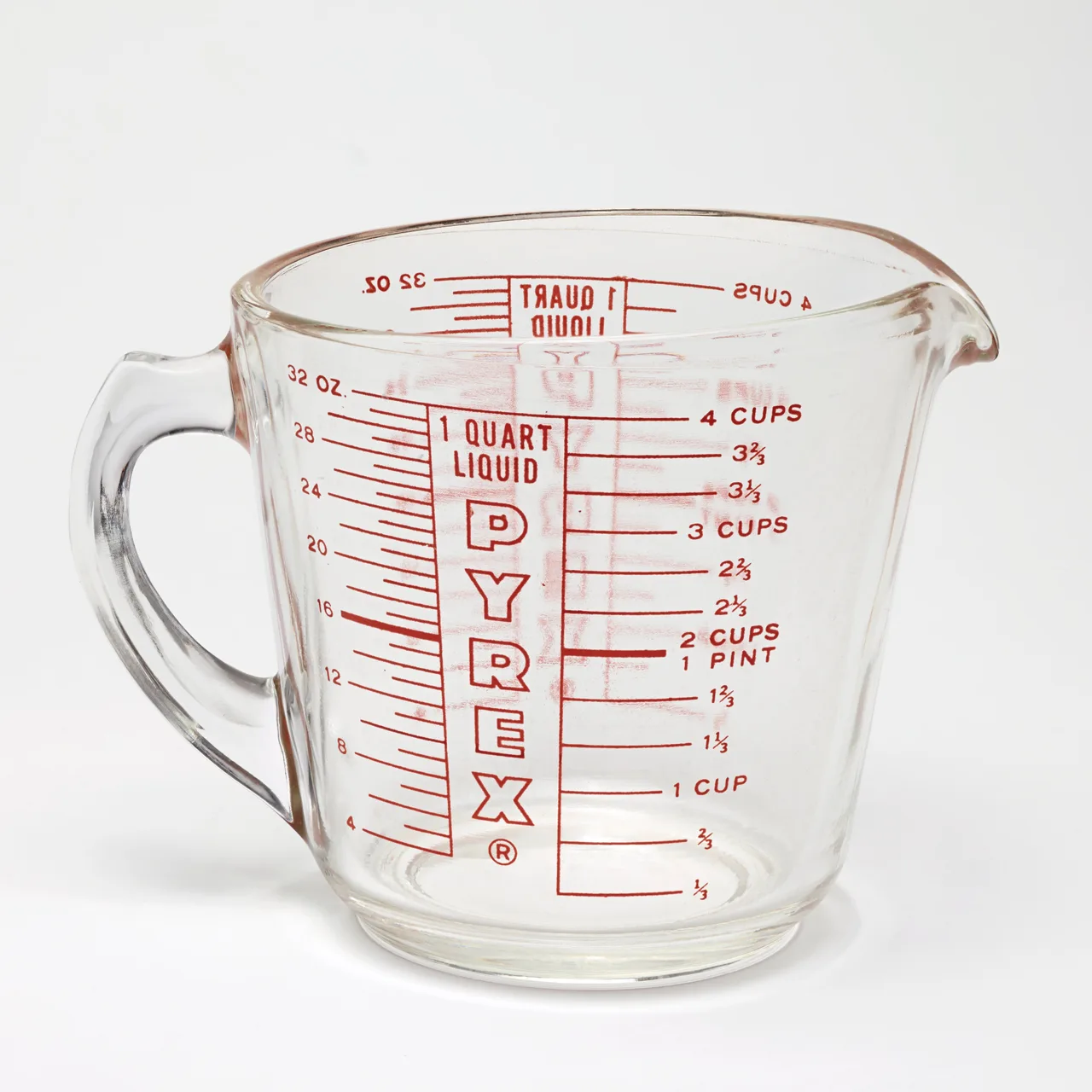
The split downwards is just as regular. A US quart is two pints, four cups and 32 fluid ounces[1]. An imperial quart also has two pints, and it holds 40 imperial ounces, because an imperial pint counts 20 of them rather than 16.
Capacity depends on the system, and there are three figures. The US liquid quart is 0.946352946 litres. The imperial quart holds 1.1365225 litres, a fifth more. The US dry quart is 1.101 litres.

Quarts to gallons conversion table
| Quarts | Gallons | Litres (US measure) |
|---|---|---|
| 1 qt | 0.25 gal | 0.95 l |
| 2 qt | 0.5 gal | 1.89 l |
| 3 qt | 0.75 gal | 2.84 l |
| 4 qt | 1 gal | 3.79 l |
| 5 qt | 1.25 gal | 4.73 l |
| 6 qt | 1.5 gal | 5.68 l |
| 6.5 qt | 1.625 gal | 6.15 l |
| 8 qt | 2 gal | 7.57 l |
| 10 qt | 2.5 gal | 9.46 l |
| 11 qt | 2.75 gal | 10.41 l |
| 12 qt | 3 gal | 11.36 l |
| 16 qt | 4 gal | 15.14 l |
| 17 qt | 4.25 gal | 16.09 l |
| 19 qt | 4.75 gal | 17.98 l |
| 20 qt | 5 gal | 18.93 l |
| 21 qt | 5.25 gal | 19.87 l |
| 22 qt | 5.5 gal | 20.82 l |
| 25 qt | 6.25 gal | 23.66 l |
| 26 qt | 6.5 gal | 24.61 l |
| 27 qt | 6.75 gal | 25.55 l |
| 32 qt | 8 gal | 30.28 l |
| 34 qt | 8.5 gal | 32.18 l |
| 36 qt | 9 gal | 34.07 l |
| 40 qt | 10 gal | 37.85 l |
| 42 qt | 10.5 gal | 39.75 l |
| 44 qt | 11 gal | 41.64 l |
| 45 qt | 11.25 gal | 42.59 l |
| 48 qt | 12 gal | 45.42 l |
| 50 qt | 12.5 gal | 47.32 l |
| 56 qt | 14 gal | 53.00 l |
| 60 qt | 15 gal | 56.78 l |
| 64 qt | 16 gal | 60.57 l |
| 70 qt | 17.5 gal | 66.24 l |
| 80 qt | 20 gal | 75.71 l |
| 90 qt | 22.5 gal | 85.17 l |
| 100 qt | 25 gal | 94.64 l |
| 105 qt | 26.25 gal | 99.37 l |
| 108 qt | 27 gal | 102.21 l |
| 120 qt | 30 gal | 113.56 l |
| 160 qt | 40 gal | 151.42 l |
What containers labelled in quarts come to in gallons
| Container | Quarts | Gallons | Litres |
|---|---|---|---|
| Bottle of engine oil for topping up | 1 qt | 0.25 gal | 0.95 l |
| Jug of oil for one oil change | 5 qt | 1.25 gal | 4.73 l |
| Slow cooker | 6 qt | 1.5 gal | 5.68 l |
| Stockpot for batch cooking | 8 qt | 2 gal | 7.57 l |
| Latching storage tote | 27 qt | 6.75 gal | 25.55 l |
| Large latching storage tote | 66 qt | 16.5 gal | 62.46 l |
| Camping cooler | 100 qt | 25 gal | 94.64 l |
| Workshop tote | 108 qt | 27 gal | 102.21 l |
The quart in three measuring systems
| Measuring system | Quart in litres | Quart in cubic inches | Pints per quart | Quarts per gallon |
|---|---|---|---|---|
| US liquid | 0.946 l | 57.75 in³ | 2 | 4 |
| Imperial (British) | 1.137 l | 69.355 in³ | 2 | 4 |
| US dry | 1.101 l | 67.201 in³ | 2 | 4 |
Which number formats does this converter handle?
| What you type | What the converter shows | How we read it |
|---|---|---|
| 2.5 | 0.625 gal | The point is the decimal separator, so this is two and a half quarts. |
| 2,5 | 0.625 gal | A comma followed by one digit is a European decimal comma, so we read it as two and a half. |
| 1,500 | 375 gal | Three digits after the comma mark a thousands separator, so we count one thousand five hundred quarts. The note “Read as 1500. If you meant 1.5, type 1.5.” appears under the field. |
| 1.500 | 0.375 gal | A single point is always read as the decimal point, so this is one and a half quarts. The note “Read as 1.5. If you meant 1500, type 1500.” appears under the field. |
| 1 500 | 375 gal | A space between the thousands is skipped, so this is one thousand five hundred quarts as well. |
| 3/4 | 0.1875 gal | We convert a fraction with a slash directly, so it doesn’t need to become 0.75 first. |
| 1½ | 0.375 gal | A ½ character copied from a recipe or a label is added to the number in front of it. |
| 5 qt | 1.25 gal | A unit pasted along with the number is ignored, and we convert the value alone. |
How do you convert quarts to gallons?
The whole calculation is one division, and the steps below show how to read the result when the number of quarts does not divide evenly.
Read the number of quarts
On an American package it stands next to qt or next to the word quart. A jug of engine oil usually carries 5 QT, and a storage tote 66 QT.Divide that number by four
Eight quarts make two gallons. Twenty quarts make five gallons. Forty quarts make ten gallons. The converter divides as you type, so the result appears with no button to press.Read the remainder as quarters of a gallon
Dividing by four gives only three possible endings. One quart over a full gallon is 0.25, two quarts are 0.5 and three are 0.75. Twenty-two quarts therefore come to 5.5 gallons.Add the value in litres if you need it
A US quart is 0.946 litres, so five quarts of oil come to 4.73 litres. The same sum for the imperial quart gives 5.68 litres, because its capacity is a fifth larger.
The dry quart, the peck and the bushel
The American system runs two separate sets of volume measures, one for liquids and one for dry goods. The quart appears in both with a different capacity — the liquid one is 57.75 cubic inches and the dry one 67.2[1].
Dry measure keeps an order of its own. Eight dry quarts make a peck, and four pecks make a bushel, which comes to 32 dry quarts[1]. The NIST table runs that series from the pint through the quart and the peck straight to the bushel, with no gallon in it[1].
Britain settled it differently. One set of capacity measures there serves liquids and dry goods alike[1], so the imperial quart has a single capacity whatever it measures, and a peck there is two gallons[2].
The US packaging regulation calls for dry measure when the goods in a package are dry, and liquid measure when they are liquid[3].
Convert Quarts to other units
Sources
- NIST Handbook 44, Appendix C — General Tables of Units of Measurement — National Institute of Standards and Technology
- Weights and Measures Act 1985, Schedule 1 — legislation.gov.uk
- NIST Handbook 130, Uniform Packaging and Labeling Regulation — National Institute of Standards and Technology
Every figure in the tables was computed from the unit definitions and checked arithmetically before publication. Historical values and the names of local units come from the sources listed above.
Content last reviewed: · written and checked by the Arteon team
Frequently asked questions about quarts and gallons
How is 10 quarts written in gallons on an American label?
Ten quarts is 2.5 gallons, or two gallons and two quarts. The model packaging regulation allows both forms: the remainder may be given in the next smaller unit or as a fraction of the largest[3].
What does qt mean on an American package?
Qt is short for quart. Labels use gal for the gallon, pt for the pint and fl oz for the fluid ounce beside it.
How many quarts does a one-litre bottle hold?
A litre is 1.057 US quarts, so a litre bottle is slightly larger than a quart. A half-litre bottle holds a little over half a quart.
Is the imperial quart still in use?
British retail counts in litres and millilitres. Since 1 October 1995 the quart and the gill have appeared on packaging only as a supplementary figure beside the metric one[2].
Have a question or a suggestion?
Write to us if the converter is missing a unit you need, or if one of the figures here looks out of date.