Convert cubic meters to liters
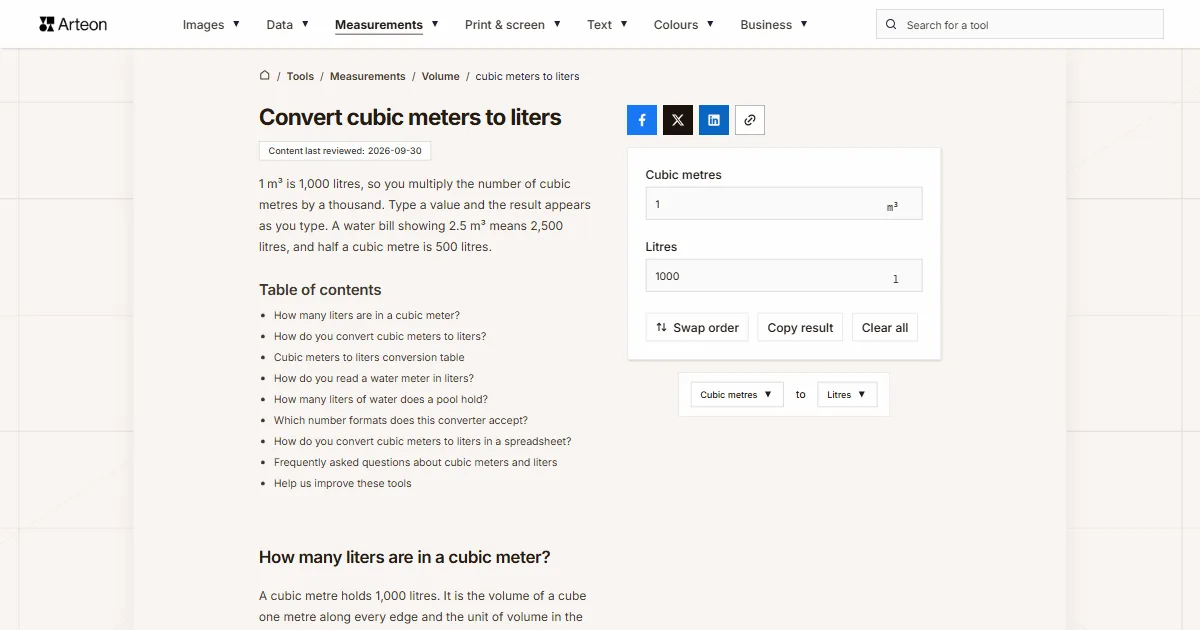
1 m³ is 1,000 litres, so you multiply the number of cubic metres by a thousand. Type a value and the result appears as you type. A water bill showing 2.5 m³ means 2,500 litres, and half a cubic metre is 500 litres.
How many liters are in a cubic meter?
A cubic metre holds 1,000 litres. It is the volume of a cube one metre along every edge and the unit of volume in the International System of Units.[1] A litre is far smaller: one cubic decimetre, or a thousandth of a cubic metre.[2]
Why a thousand? A metre splits into 10 decimetres, and volume counts in three directions. Ten litre boxes fit along the length, ten across and ten up, so the cube holds 10 × 10 × 10 = 1,000 of them.
The proper symbol has a raised 3: m³. On a keyboard without it people type m3, and freight and shipping documents often write CBM.[1] The converter's field accepts all of these, so a figure from a bill or a quote can go in together with its unit.
How do you convert cubic meters to liters?
The formula has one step: litres = cubic metres × 1,000. Multiplying by a thousand moves the decimal point three places to the right. That is why 2.5 m³ is 2,500 l, 0.75 m³ is 750 l and 0.056 m³ is 56 l.
When there are fewer than three digits after the point, fill the gap with zeros: 1.5 m³ is 1,500 l and 12 m³ is 12,000 l. Litres go back to cubic metres in the liters to cubic meters converter. If you need the answer in US or imperial gallons, take the litres from here to the liters to gallons converter.
Cubic meters to liters conversion table
| Cubic metres | Litres |
|---|---|
| 0.001 m³ | 1 l |
| 0.01 m³ | 10 l |
| 0.05 m³ | 50 l |
| 0.1 m³ | 100 l |
| 0.25 m³ | 250 l |
| 0.5 m³ | 500 l |
| 0.75 m³ | 750 l |
| 1 m³ | 1,000 l |
| 1.5 m³ | 1,500 l |
| 2 m³ | 2,000 l |
| 2.5 m³ | 2,500 l |
| 3 m³ | 3,000 l |
| 5 m³ | 5,000 l |
| 6 m³ | 6,000 l |
| 8 m³ | 8,000 l |
| 10 m³ | 10,000 l |
| 12 m³ | 12,000 l |
| 15 m³ | 15,000 l |
| 20 m³ | 20,000 l |
| 25 m³ | 25,000 l |
| 30 m³ | 30,000 l |
| 50 m³ | 50,000 l |
| 100 m³ | 100,000 l |
How do you read a water meter in liters?
Across the European Union a water meter displays the volume it has measured in cubic metres, as the EU directive on measuring instruments sets out.[3] The figure before the decimal point counts whole cubic metres, and the three digits after it are litres. A reading of 123.456 m³ is therefore 123,456 litres.
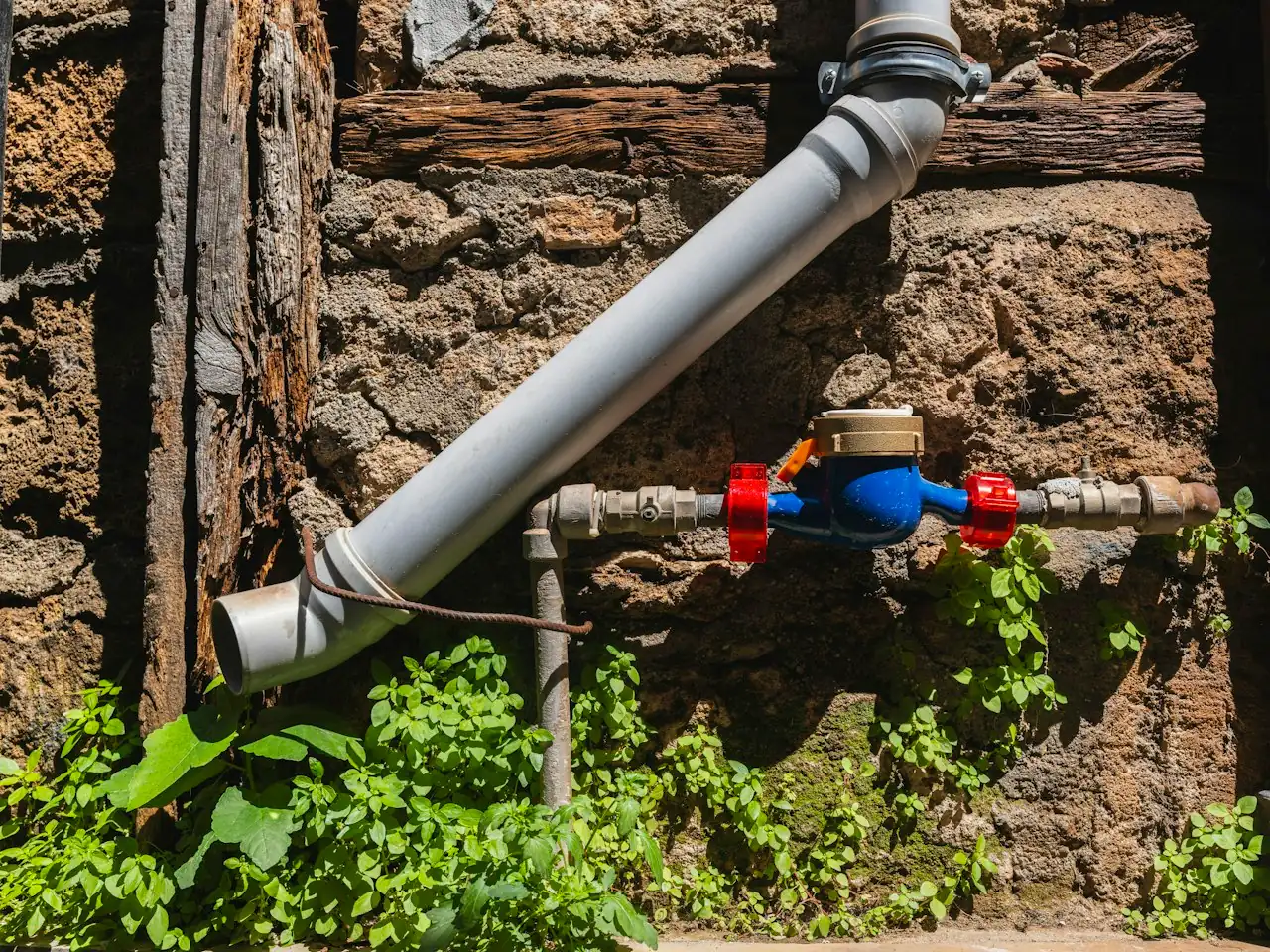
Your use over a period is the difference between two readings. If the meter showed 118.2 m³ in January and 121.7 m³ in February, you used 3.5 m³, which is 3,500 litres. In Australia you may see kilolitres instead: the Northern Territory Government, for example, gives water consumption in kilolitres and megalitres.[4] One kilolitre is the same amount as one cubic metre.
To find the price of a single litre, divide the price per cubic metre by 1,000. At 2.50 per cubic metre in your currency, a litre costs 0.0025, so a 100-litre bath costs 0.25. If your bill charges separately for water supply and for waste water, add the two rates before you divide.
How many liters of water does a pool hold?
| Pool | Volume | Litres |
|---|---|---|
| Paddling pool 2 × 1.5 m, 0.5 m deep | 1.5 m³ | 1,500 l |
| Round pool 12 ft (3.66 m) across, 30 in (0.76 m) deep | 8 m³ | 8,000 l |
| Garden pool 4 × 2 m, 1.2 m deep | 9.6 m³ | 9,600 l |
| Backyard pool 8 × 4 m, 1.5 m deep | 48 m³ | 48,000 l |
| Olympic pool 50 × 25 m, 2 m deep | 2,500 m³ | 2,500,000 l |
Which number formats does this converter accept?
| What you type | What the converter shows | How we read it |
|---|---|---|
| 2.5 | 2500 l | The decimal point separates the fraction, exactly as you would expect. |
| 2,5 | 2500 l | A comma followed by one digit can only be a decimal comma, so we read it as two and a half. |
| 1,500 | 1500000 l | A comma before three digits groups thousands in English, so this is fifteen hundred cubic metres. A note under the field shows the other possible reading, 1.5. |
| 3/4 | 750 l | We work out a fraction with a slash for you, so there is no need to turn it into a decimal first. |
| 2½ | 2500 l | A ½ sign copied from a quote or a document is added to the number in front of it. |
| 12.5 m3 | 12500 l | Bills and quotes often write m3 with an ordinary 3. We treat the 3 as part of the symbol and count 12.5 m³. |
| 2 m^3 | 2000 l | This is how a spreadsheet writes the cubic metre. We skip the caret and the 3 together with the symbol. |
| 0.5 m³ | 500 l | A symbol with a raised 3, copied from a document, leaves the number in front of it unchanged. |
| 3 CBM | 3000 l | The shipping abbreviation is skipped like any other unit, so we count three cubic metres. |
How do you convert cubic meters to liters in a spreadsheet?
A year of meter readings or a list of ordered cubic metres converts with one formula dragged down the column.
Excel: the CONVERT function
Type =CONVERT(A1,"m3","l"). Excel knows the cubic metre as "m3" or "m^3" and the litre as "l" or "L".[6]Google Sheets: write m^3
Google Sheets recognises the cubic metre in CONVERT only as "m^3", so the formula is =CONVERT(A1,"m^3","l").[7] Excel takes it without changes.Plain multiplication
The formula =A1*1000 works in every spreadsheet, LibreOffice Calc included, and does not depend on unit codes.Check one cell first
Enter 1 in A1 and make sure the result is 1000. A #N/A error points to a typo in a unit code.
Convert other units to Litres
Sources
- Cubic metre — Wikipedia
- NIST Special Publication 330, section 4 — 1 L = 1 dm³ = 0.001 m³ — National Institute of Standards and Technology
- Directive 2014/32/EU on measuring instruments, Annex III (water and gas meters) — EUR-Lex
- Litre — kilolitres, megalitres and gigalitres in Northern Territory water figures — Wikipedia
- Olympic-size swimming pool — volume at a depth of 2 metres — Wikipedia
- CONVERT function — Microsoft
- CONVERT — units available in Google Sheets — Google
Every figure in the tables was computed from the unit definitions and checked arithmetically before publication. Historical values and the names of local units come from the sources listed above.
Content last reviewed: · written and checked by the Arteon team
Frequently asked questions about cubic meters and liters
How many liters are in a cubic meter of gas?
Also 1,000 litres, because the conversion is the same for any substance. Like a water meter, a gas meter shows the amount in cubic metres, although the EU directive also allows kilograms for it.[3] Liquid propane is a different matter, since a litre of liquid turns into a few hundred litres of gas, as we explain on the liters to cubic meters page.
How many US gallons are in a cubic meter?
About 264.2 US gallons, or about 220 imperial gallons. The liters to gallons converter gives the exact figure for both once you enter the 1,000 litres.
How many cubic decimeters and cubic centimeters are in a cubic meter?
A cubic metre is 1,000 dm³ or 1,000,000 cm³. A cubic decimetre is also a litre, and a cubic centimetre is a millilitre.[2] A volume in cm³, such as an engine size, converts to litres in the cm³ to liters converter.
How do you convert cubic meters per hour to liters per minute?
Multiply by 1,000, then divide by 60. A pump rated at 6 m³/h therefore moves 100 litres a minute. The converter works with plain volume, so the field above does the first step for you.
Help us improve these tools
Spotted a mistake in a table or have an idea for this converter? Write to us.