Convert milliliters to centiliters
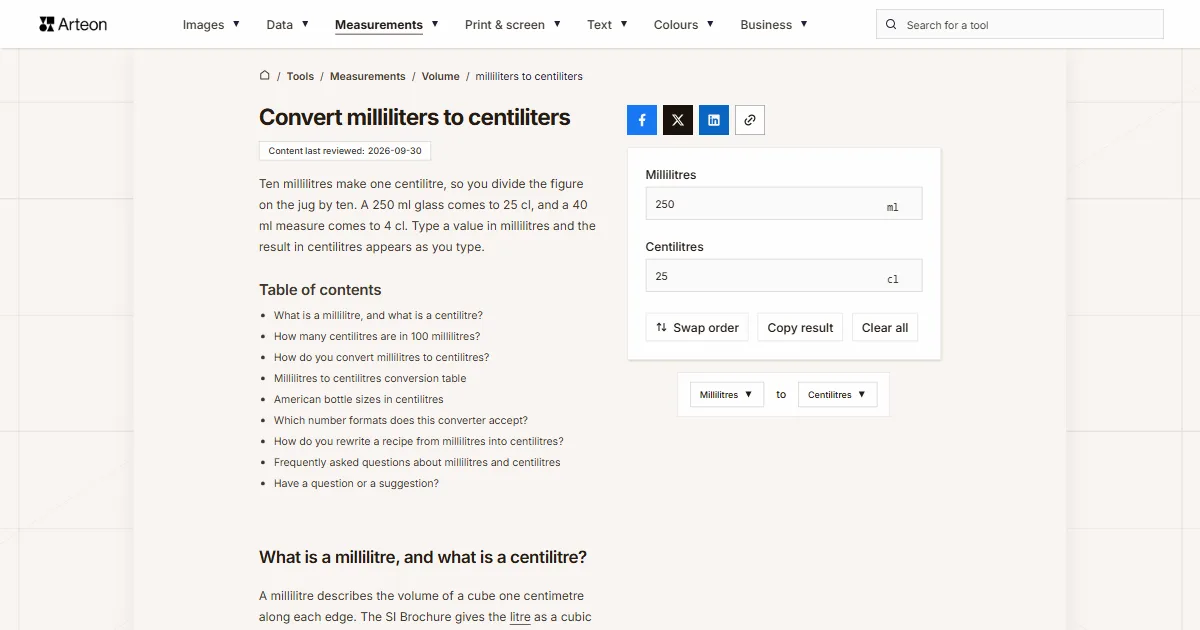
Ten millilitres make one centilitre, so you divide the figure on the jug by ten. A 250 ml glass comes to 25 cl, and a 40 ml measure comes to 4 cl. Type a value in millilitres and the result in centilitres appears as you type.
What is a millilitre, and what is a centilitre?
A millilitre describes the volume of a cube one centimetre along each edge. The SI Brochure gives the litre as a cubic decimetre,[1] and a cubic decimetre holds a thousand cubic centimetres, so one thousandth of a litre comes to exactly one such cube. That is why the marks on a kitchen jug and on a syringe scale are labelled in millilitres.
A centilitre describes one hundredth of a litre, a volume ten times larger than a millilitre. Both names are built the same way: the prefix milli stands for one thousandth and centi for one hundredth.[2] A prefix forms part of the unit and sits against the unit symbol with no space, which gives the spellings ml and cl.[1]
English-speaking kitchens and pharmacies count in millilitres, while the centilitre turns up on the label of a bottle brought back from continental Europe and on a drinks menu there. Both describe the same physical quantity with a different prefix, so moving between them is a single step.
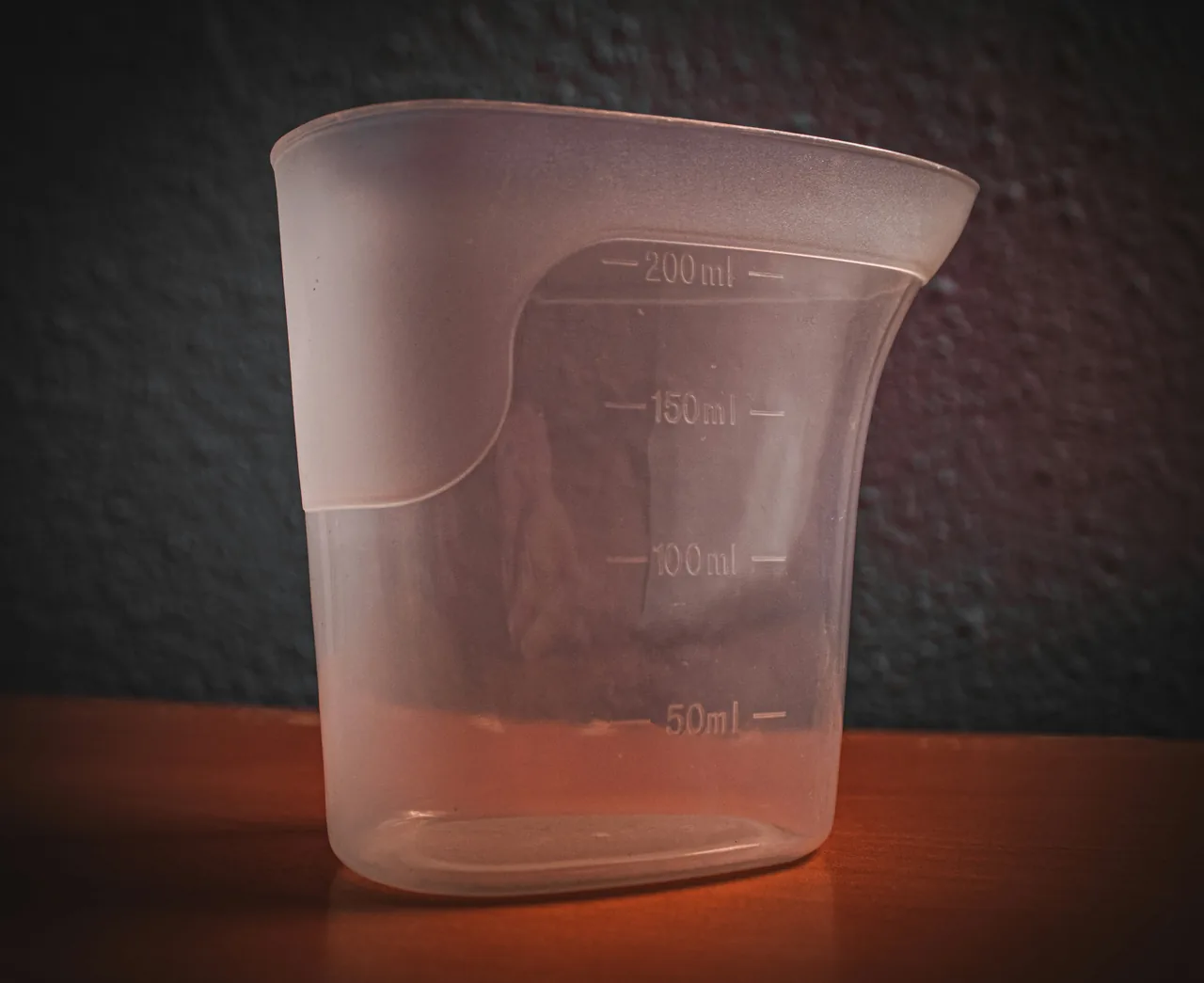
How many centilitres are in 100 millilitres?
One hundred millilitres come to 10 centilitres. The conversion is a division by ten and amounts to moving the decimal point one place to the left. Three answers show how that works in practice. A 250 millilitre glass comes to 25 centilitres. A 500 millilitre water bottle comes to 50 centilitres. A litre carton of juice, at 1,000 millilitres, comes to exactly 100 centilitres.
The divisor of ten follows from the prefixes themselves. Milli describes one thousandth of a litre and centi one hundredth,[2] so one order of magnitude separates the units. The same figure applies in every country, because both values come straight from the litre.
The answer can include a decimal, and that is the correct form of the result. A 5 millilitre dose comes to 0.5 centilitre. A 25 millilitre pour comes to 2.5 centilitres. At quantities this small the millilitre keeps the figure a whole number. The result field shows up to four decimal places, so even 0.05 millilitre appears as 0.005 centilitre.
How do you convert millilitres to centilitres?
The formula reads: centilitres = millilitres ÷ 10. For 330 millilitres the arithmetic gives 33 centilitres. For 750 millilitres it gives 75 centilitres.
Where the figure ends in a zero, you simply drop that zero. For every other value you move the decimal point one place to the left, so 45 millilitres gives 4.5 centilitres and 89.078 millilitres gives 8.9078 centilitres.
The conversion in the other direction is handled by the centilitres to millilitres converter. For capacities around a litre there is the millilitres to litres converter, and for recipes written in decilitres the millilitres to decilitres converter.
Millilitres to centilitres conversion table
| Millilitres | Centilitres | Litres |
|---|---|---|
| 1 ml | 0.1 cl | 0.001 l |
| 2 ml | 0.2 cl | 0.002 l |
| 5 ml | 0.5 cl | 0.005 l |
| 10 ml | 1 cl | 0.01 l |
| 15 ml | 1.5 cl | 0.015 l |
| 20 ml | 2 cl | 0.02 l |
| 25 ml | 2.5 cl | 0.025 l |
| 30 ml | 3 cl | 0.03 l |
| 40 ml | 4 cl | 0.04 l |
| 45 ml | 4.5 cl | 0.045 l |
| 50 ml | 5 cl | 0.05 l |
| 60 ml | 6 cl | 0.06 l |
| 75 ml | 7.5 cl | 0.075 l |
| 100 ml | 10 cl | 0.1 l |
| 125 ml | 12.5 cl | 0.125 l |
| 150 ml | 15 cl | 0.15 l |
| 200 ml | 20 cl | 0.2 l |
| 250 ml | 25 cl | 0.25 l |
| 300 ml | 30 cl | 0.3 l |
| 330 ml | 33 cl | 0.33 l |
| 375 ml | 37.5 cl | 0.375 l |
| 500 ml | 50 cl | 0.5 l |
| 700 ml | 70 cl | 0.7 l |
| 750 ml | 75 cl | 0.75 l |
| 1,000 ml | 100 cl | 1 l |
| 2,000 ml | 200 cl | 2 l |
American bottle sizes in centilitres
| Millilitres in the American rule | Centilitres | Litres |
|---|---|---|
| 50 ml | 5 cl | 0.05 l |
| 100 ml | 10 cl | 0.1 l |
| 187 ml | 18.7 cl | 0.187 l |
| 200 ml | 20 cl | 0.2 l |
| 250 ml | 25 cl | 0.25 l |
| 331 ml | 33.1 cl | 0.331 l |
| 350 ml | 35 cl | 0.35 l |
| 355 ml | 35.5 cl | 0.355 l |
| 375 ml | 37.5 cl | 0.375 l |
| 475 ml | 47.5 cl | 0.475 l |
| 500 ml | 50 cl | 0.5 l |
| 570 ml | 57 cl | 0.57 l |
| 700 ml | 70 cl | 0.7 l |
| 710 ml | 71 cl | 0.71 l |
| 720 ml | 72 cl | 0.72 l |
| 750 ml | 75 cl | 0.75 l |
| 900 ml | 90 cl | 0.9 l |
| 945 ml | 94.5 cl | 0.945 l |
Which number formats does this converter accept?
| What you type | What the converter shows | How we read it |
|---|---|---|
| 250 | 25 cl | A number on its own is read as millilitres, because that is the unit on the field. |
| 250ml | 25 cl | The ml symbol pasted with the number, with or without a space, is skipped, and so is the word millilitres. |
| 12.5 | 1.25 cl | The decimal point separates the fraction, exactly as you would expect. |
| 12,5 | 1.25 cl | A comma followed by one digit can only be a decimal comma, so we read it as twelve and a half. |
| 1,500 | 150 cl | A comma before three digits groups thousands in English, so this is fifteen hundred millilitres. A note under the field shows the other possible reading, 1.5. |
| 1.500 | 0.15 cl | A single point is always read as a decimal point, so the field counts one and a half millilitres. A note under the field shows the other possible reading, 1500. |
| 1 500 | 150 cl | A space between the thousands, as written in much of Europe and in SI style, gives the same result as 1,500. |
| 1/2 | 0.05 cl | We work out a fraction with a slash for you, so half a millilitre needs no conversion to 0.5 first. |
| 2½ | 0.25 cl | A ½ sign copied from a label or a recipe is added to the number in front of it. |
| 0.5 l | 50 cl | Litres from a label are converted to millilitres: the field enters 500 and says so in a line under it. |
How do you rewrite a recipe from millilitres into centilitres?
When a recipe gives its liquids in millilitres and you want them in centilitres, for instance to compare them with a label in cl, these four steps turn one ingredient list into the other.
Divide every liquid quantity by ten
One hundred millilitres of milk becomes 10 centilitres, and 200 millilitres of cream becomes 20 centilitres. The arithmetic is the same for every liquid.Leave the ingredients given in grams alone
Grams measure mass while the centilitre and the millilitre measure volume, so the figures for flour and sugar stay as they are. Turning grams into millilitres needs the density of the particular ingredient and is a separate calculation.Write fractions with a decimal point
A 25 millilitre quantity gives 2.5 centilitres, and 45 millilitres gives 4.5 centilitres. Convert spoon quantities first in the tablespoons to millilitres converter.Check the answer against the product label
The net quantity of a liquid may be given in litres, centilitres or millilitres,[4] so the same product bought in two countries can carry two different figures. Matching your answer to the label confirms the arithmetic.
Convert other units to Centilitres
Convert Millilitres to other units
Sources
- The SI Brochure, 9th edition (2019) — non-SI units accepted for use with the SI — Bureau International des Poids et Mesures (BIPM)
- Metric (SI) prefixes — National Institute of Standards and Technology
- 27 CFR § 5.203 — authorized standards of fill for distilled spirits in the United States — Legal Information Institute, Cornell Law School
- Regulation (EU) No 1169/2011 on the provision of food information to consumers — Article 23 on net quantity — EUR-Lex, European Union
Every figure in the tables was computed from the unit definitions and checked arithmetically before publication. Historical values and the names of local units come from the sources listed above.
Content last reviewed: · written and checked by the Arteon team
Frequently asked questions about millilitres and centilitres
How many centilitres is 1 millilitre?
One millilitre is 0.1 centilitre. The centilitre is ten times larger, so ten millilitres make one centilitre.
How do I convert millilitres to centilitres in a spreadsheet?
A plain division does it: in cell B2 you enter =A2/10, where A2 holds the number of millilitres. The formula behaves the same way in Microsoft Excel, in Google Sheets and in LibreOffice Calc.
How many centilitres are in one decilitre?
One decilitre is 10 centilitres, or 100 millilitres. A decilitre describes one tenth of a litre and a centilitre one hundredth, so ten centilitres fit inside a decilitre.
Have a question or a suggestion?
If you have spotted a mistake in the tables or have an idea for improving the converter, write to us.