Convert millilitres to tablespoons
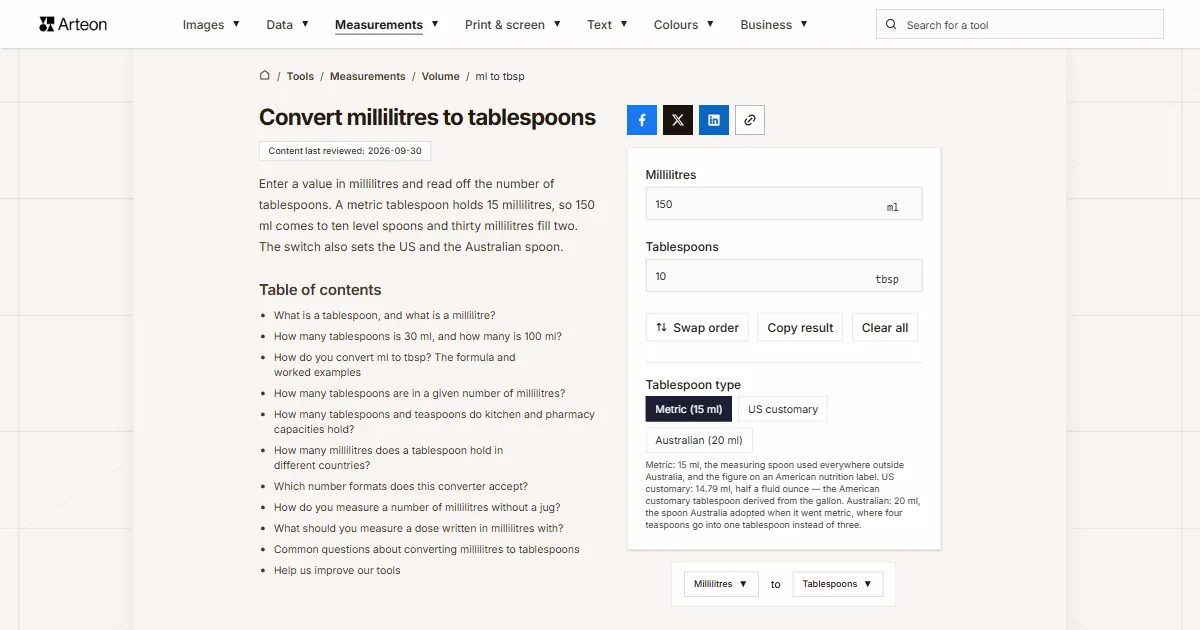
Enter a value in millilitres and read off the number of tablespoons. A metric tablespoon holds 15 millilitres, so 150 ml comes to ten level spoons and thirty millilitres fill two. The switch also sets the US and the Australian spoon.
What is a tablespoon, and what is a millilitre?
A millilitre is a thousandth of a litre, the volume of a cube one centimetre along each edge. This is the unit printed on a medicine bottle, a measuring jug and an oral syringe, because it describes every liquid with a single number.
A tablespoon is a cooking measure of volume and also the piece of cutlery it takes its name from. The metric tablespoon holds 15 millilitres, the figure the United Kingdom uses too; only Australia counts differently[1].
Two markets count with a spoon of their own. The US customary tablespoon is half a fluid ounce, that is 14.79 millilitres, while American food-labelling law puts a round 15 millilitres on the nutrition panel[2]. Australia adopted a twenty-millilitre spoon when it went metric[3].
You set the spoon with the Tablespoon type switch under the converter fields. The metric spoon comes first, because it is the one a British kitchen has in the drawer.
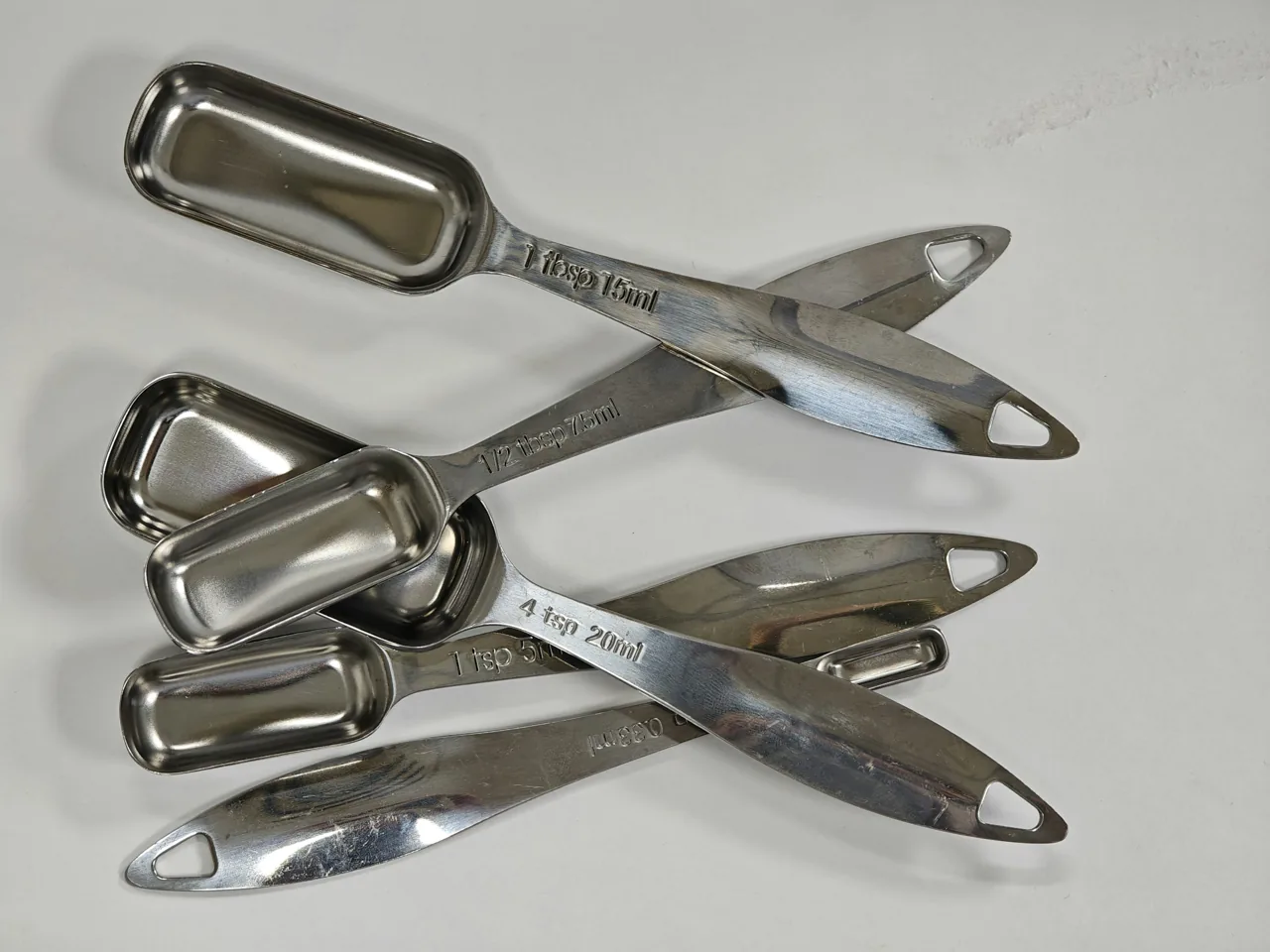
How many tablespoons is 30 ml, and how many is 100 ml?
Thirty millilitres come to exactly two tablespoons. One hundred millilitres give 6.6667 tablespoons, which is six level spoons plus two thirds of another.
One division gets you there: millilitres divided by the capacity of the spoon. With the metric spoon the divisor is 15.
Four answers come out of that sum more often than any others. Fifteen millilitres make exactly one tablespoon. Forty-five millilitres give three. One hundred and fifty millilitres come to ten. And 240 millilitres, the cup of an American nutrition label, hold sixteen.
The Australian spoon gives different figures for the same volumes. It measures one hundred millilitres in five level spoons, because 100 divides by 20 without a remainder.
For the sum the other way round, from spoons to millilitres, use the tablespoons to millilitres converter.
How do you convert ml to tbsp? The formula and worked examples
Divide the number of millilitres by the capacity of the spoon in your hand.
The formula: tablespoons = millilitres ÷ 15 for the metric spoon. For the US spoon the divisor is 14.7868, and for the Australian one it is 20.
Take a dose from a medicine bottle. Ten millilitres divided by 15 give 0.6667 of a tablespoon. That portion is easier to measure as two 5-millilitre teaspoons, because three teaspoons make one tablespoon.
Now take a recipe. One hundred millilitres of oil divided by 15 give 6.6667 metric tablespoons. The same volume is 6.7628 US tablespoons. With the Australian spoon it comes to five.
The field reads decimals and fractions alike, so 12.5 and 12 1/2 return the same result. A comma and a full stop are interchangeable.
A volume given in litres goes through the litres to millilitres converter, and a recipe amount written in cups through the cups to millilitres converter.
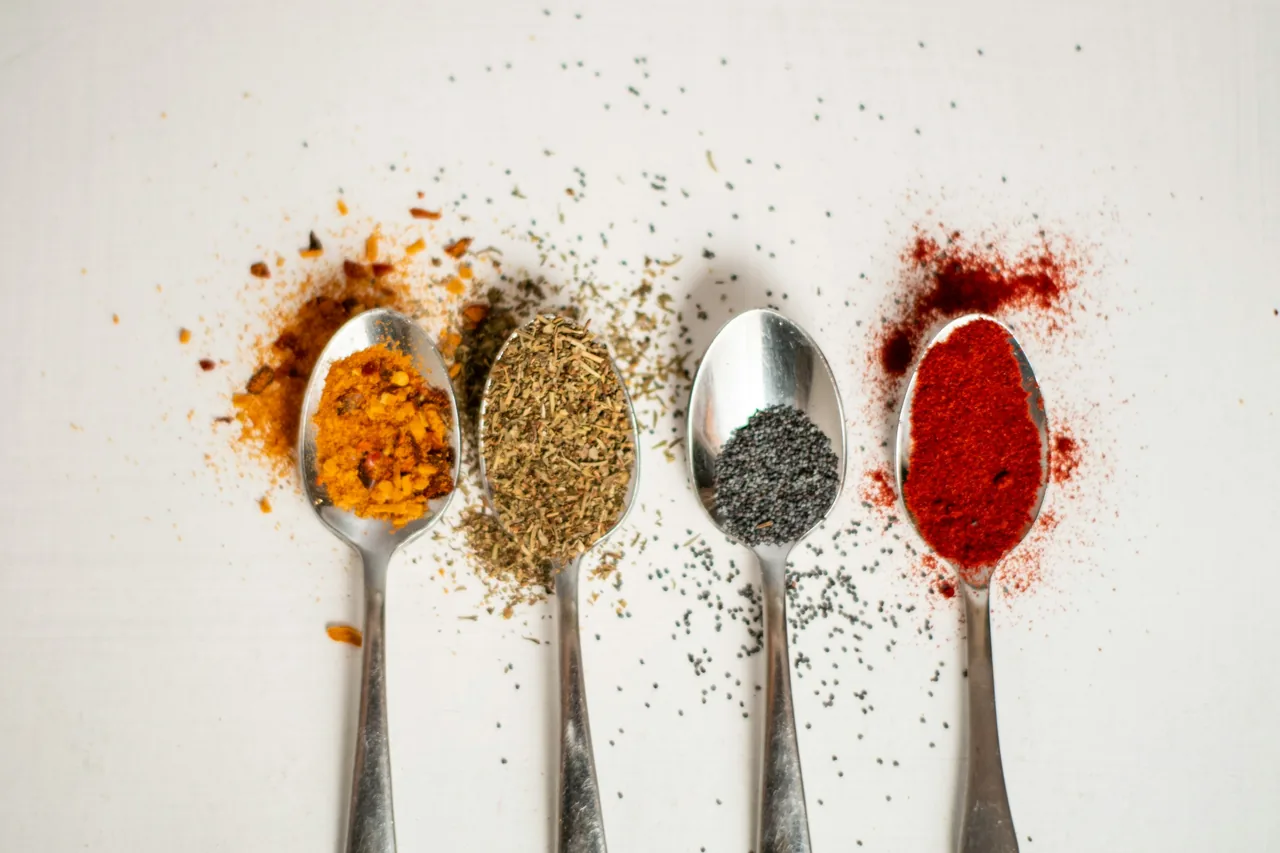
How many tablespoons are in a given number of millilitres?
| Millilitres | Metric tablespoons (15 ml) | US tablespoons (14.79 ml) | Australian tablespoons (20 ml) |
|---|---|---|---|
| 1 ml | 0.0667 | 0.0676 | 0.05 |
| 2 ml | 0.1333 | 0.1353 | 0.1 |
| 3 ml | 0.2 | 0.2029 | 0.15 |
| 4 ml | 0.2667 | 0.2705 | 0.2 |
| 5 ml | 0.3333 | 0.3381 | 0.25 |
| 6 ml | 0.4 | 0.4058 | 0.3 |
| 7 ml | 0.4667 | 0.4734 | 0.35 |
| 8 ml | 0.5333 | 0.541 | 0.4 |
| 9 ml | 0.6 | 0.6087 | 0.45 |
| 10 ml | 0.6667 | 0.6763 | 0.5 |
| 11 ml | 0.7333 | 0.7439 | 0.55 |
| 12 ml | 0.8 | 0.8115 | 0.6 |
| 12.5 ml | 0.8333 | 0.8454 | 0.625 |
| 14 ml | 0.9333 | 0.9468 | 0.7 |
| 15 ml | 1 | 1.0144 | 0.75 |
| 16 ml | 1.0667 | 1.082 | 0.8 |
| 18 ml | 1.2 | 1.2173 | 0.9 |
| 20 ml | 1.3333 | 1.3526 | 1 |
| 24 ml | 1.6 | 1.6231 | 1.2 |
| 25 ml | 1.6667 | 1.6907 | 1.25 |
| 30 ml | 2 | 2.0288 | 1.5 |
| 35 ml | 2.3333 | 2.367 | 1.75 |
| 40 ml | 2.6667 | 2.7051 | 2 |
| 45 ml | 3 | 3.0433 | 2.25 |
| 50 ml | 3.3333 | 3.3814 | 2.5 |
| 60 ml | 4 | 4.0577 | 3 |
| 70 ml | 4.6667 | 4.734 | 3.5 |
| 75 ml | 5 | 5.0721 | 3.75 |
| 80 ml | 5.3333 | 5.4102 | 4 |
| 85 ml | 5.6667 | 5.7484 | 4.25 |
| 90 ml | 6 | 6.0865 | 4.5 |
| 100 ml | 6.6667 | 6.7628 | 5 |
| 110 ml | 7.3333 | 7.4391 | 5.5 |
| 120 ml | 8 | 8.1154 | 6 |
| 125 ml | 8.3333 | 8.4535 | 6.25 |
| 150 ml | 10 | 10.1442 | 7.5 |
| 175 ml | 11.6667 | 11.8349 | 8.75 |
| 200 ml | 13.3333 | 13.5256 | 10 |
| 225 ml | 15 | 15.2163 | 11.25 |
| 240 ml | 16 | 16.2307 | 12 |
| 250 ml | 16.6667 | 16.907 | 12.5 |
| 300 ml | 20 | 20.2884 | 15 |
| 330 ml | 22 | 22.3173 | 16.5 |
| 350 ml | 23.3333 | 23.6698 | 17.5 |
| 400 ml | 26.6667 | 27.0512 | 20 |
| 500 ml | 33.3333 | 33.814 | 25 |
| 750 ml | 50 | 50.721 | 37.5 |
| 1000 ml | 66.6667 | 67.628 | 50 |
How many tablespoons and teaspoons do kitchen and pharmacy capacities hold?
| Capacity | Tablespoons (15 ml) | Teaspoons (5 ml) | Where you meet it |
|---|---|---|---|
| 5 ml | 0.3333 | 1 | A dose from a medicine leaflet and the spoon supplied with a syrup |
| 10 ml | 0.6667 | 2 | A syrup measure and an oral syringe |
| 15 ml | 1 | 3 | The spoon from a kitchen measuring set |
| 20 ml | 1.3333 | 4 | The spoon from an Australian recipe |
| 30 ml | 2 | 6 | One fluid ounce as rounded on an American label |
| 50 ml | 3.3333 | 10 | A miniature spirits bottle |
| 60 ml | 4 | 12 | A quarter cup on an American label |
| 100 ml | 6.6667 | 20 | A syrup bottle and a small water bottle |
| 120 ml | 8 | 24 | Half a cup on an American label |
| 125 ml | 8.3333 | 25 | Half a metric cup |
| 200 ml | 13.3333 | 40 | A drinking glass and a small juice carton |
| 250 ml | 16.6667 | 50 | A metric cup |
| 330 ml | 22 | 66 | A drinks can |
| 500 ml | 33.3333 | 100 | A water bottle and a carton of cream |
| 1000 ml | 66.6667 | 200 | A litre, the size of a milk carton |
How many millilitres does a tablespoon hold in different countries?
| Kind of spoon | Millilitres | In metric tablespoons | Where you meet it |
|---|---|---|---|
| Metric tablespoon | 15 ml | 1 | Europe and the United Kingdom |
| Tablespoon on a US label | 15 ml | 1 | United States: nutrition panels |
| US customary tablespoon | 14.78676478125 ml | 0.9858 | United States: recipes and measuring sets |
| Australian tablespoon | 20 ml | 1.3333 | Australia: recipes and measuring sets |
| Pre-metric British tablespoon | 14.2065 ml | 0.9471 | United Kingdom: cookbooks written before metrication |
| Victorian serving tablespoon | 25 ml | 1.6667 | United Kingdom: the nineteenth and early twentieth century |
| Dessertspoon | 10 ml | 0.6667 | Europe: recipes and medicine doses |
| Teaspoon | 5 ml | 0.3333 | Europe, the United States and Australia alike |
Which number formats does this converter accept?
| What you type | What the converter shows | Note |
|---|---|---|
| 30 | 2 tbsp | A plain number is read as millilitres, because that’s what the field is labeled. |
| 30 ml | 2 tbsp | The ml symbol pasted along with the number is skipped, so only the number counts. |
| 30 millilitres | 2 tbsp | The whole word is skipped the same way, so a line copied from a recipe needs no tidying. |
| 12.5 | 0.8333 tbsp | The period is your decimal point, and that’s exactly how we read it. |
| 12,5 | 0.8333 tbsp | A comma with fewer than three digits after it is a decimal comma from a European recipe, so we read twelve and a half millilitres. |
| 12 1/2 | 0.8333 tbsp | A mixed number is read the way a recipe writes it, as twelve and a half millilitres. |
| 7½ | 0.5 tbsp | The ½ character copied from a recipe is added to the number in front of it. |
| 1.500 | 0.1 tbsp | A single period is always read as a decimal point, so the field takes one and a half millilitres. A note under the field says: Read as 1.5. If you meant 1500, type 1500. |
| 1,500 | 100 tbsp | A comma followed by three digits groups thousands, so the field reads fifteen hundred millilitres. A note under the field says: Read as 1500. If you meant 1.5, type 1.5. |
| 0.5 l | 33.3333 tbsp | Litres are turned into millilitres by the field itself, so half a litre counts as 500 ml. |
| 2 tsp | 0.6667 tbsp | Teaspoons typed with tsp are turned into millilitres first and then into tablespoons. |
| 1 tbsp | 1 tbsp | A tablespoon typed with tbsp is turned into millilitres first and then into tablespoons. |
How do you measure a number of millilitres without a jug?
All four ways use equipment already in the kitchen and the medicine cabinet.
With a spoon from a measuring set
Read off the table above how many spoons match your figure in millilitres, then take that many portions. Level the spoon with the back of a knife, because only a level spoon holds 15 millilitres.With a teaspoon, when the portion is smaller than a spoonful
Three 5-millilitre teaspoons make one tablespoon. Fifteen millilitres are therefore three teaspoons, ten millilitres are two and five millilitres are one.With an oral syringe from the pharmacy
A syringe is graduated in millilitres, so you read the figure straight off without converting anything. The FDA guidance asks that the device supplied with a medicine carry the same units of measure as the dosing directions on the label[4].With kitchen scales, when the ingredient is watery
One millilitre of water weighs one gram, so 100 millilitres of water read 100 grams on the scales. Olive oil is lighter than water at the same volume and honey is heavier, so for those the scales and the jug give different figures.
What should you measure a dose written in millilitres with?
An oral syringe or the cup supplied with the medicine, because both are graduated in millilitres.
The US Food and Drug Administration set this out in guidance published in May 2011. A device supplied with a medicine should carry the same units of measure as the dosing directions, and the agency names household spoons as a route to giving too small or too large a dose[4].
A measurement confirms it. A team in Athens collected cutlery from twenty-five households and measured its capacity: 71 teaspoons and 49 tablespoons. The paper concludes that teaspoons and tablespoons are unreliable dosing devices[5].
Convert other units to Tablespoons
Convert Millilitres to other units
Sources
- Tablespoon — Wikipedia
- 21 CFR 101.9 — Nutrition labeling of food — Legal Information Institute, Cornell Law School
- AS 1325-1972 — Metric measuring cups and spoons and standard litre measure for domestic purposes — Standards Australia
- Dosage Delivery Devices for Orally Ingested OTC Liquid Drug Products — U.S. Food and Drug Administration
- Inaccuracies in dosing drugs with teaspoons and tablespoons — International Journal of Clinical Practice
Every figure in the tables was computed from the unit definitions and checked arithmetically before publication. Historical values and the names of local units come from the sources listed above.
Content last reviewed: · written and checked by the Arteon team
Common questions about converting millilitres to tablespoons
Is 5 ml one tablespoon?
Five millilitres come to one teaspoon. A tablespoon holds 15 millilitres, so three teaspoons make one tablespoon. The 5-millilitre measure supplied with a cough syrup is that teaspoon.
How many tablespoons is 30 ml?
Thirty millilitres are two metric tablespoons. The US spoon gives 2.0288 tablespoons and the Australian one gives one and a half. An American label calls the same volume one fluid ounce[2].
How many tablespoons is 100 ml?
One hundred millilitres are 6.6667 metric tablespoons, which is six spoons plus two teaspoons. The Australian spoon measures the same volume in five level portions.
How many tablespoons is 150 ml?
One hundred and fifty millilitres are exactly ten metric tablespoons. The US spoon gives 10.1442 and the Australian one gives 7.5.
Is a tablespoon 15 or 20 ml?
A tablespoon holds 15 millilitres across Europe and the United Kingdom. Twenty millilitres is the Australian spoon[3]. For a recipe from Australia, set the Tablespoon type switch to the Australian spoon.
How many tablespoons is 240 ml?
Two hundred and forty millilitres are sixteen metric tablespoons, because 240 divides by 15 exactly. That is the cup of an American nutrition label[2], which is why an American recipe counts sixteen tablespoons to a cup. The cup itself goes through the millilitres to cups converter.
What does the T stand for in a recipe?
A capital T, along with Tb, tbsp and Tbsp, stands for the tablespoon. A lower-case t and the abbreviation tsp stand for the teaspoon[1]. American cookbooks tell the two measures apart by the case of that letter.
How much does a tablespoon from the cutlery drawer hold?
Cutlery has no fixed capacity, so the figure depends on the model. The conversions on this page use the tablespoon from a kitchen measuring set, which holds 15 millilitres. A study that measured 49 tablespoons collected from twenty-five households found cutlery unreliable for dosing medicines[5].
Help us improve our tools
Have an idea for a new feature, found a bug or want to suggest another tool? Write to us.