Convert milliliters to deciliters
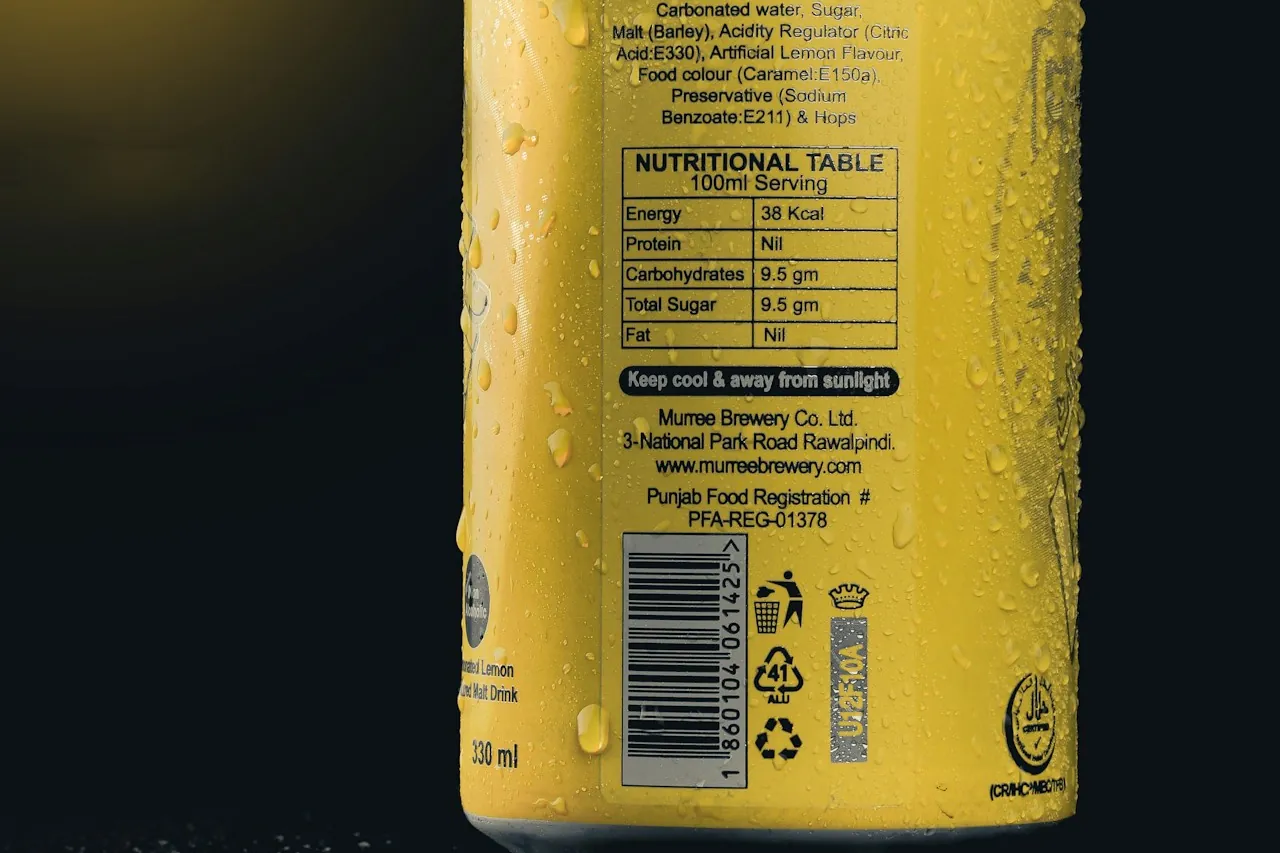
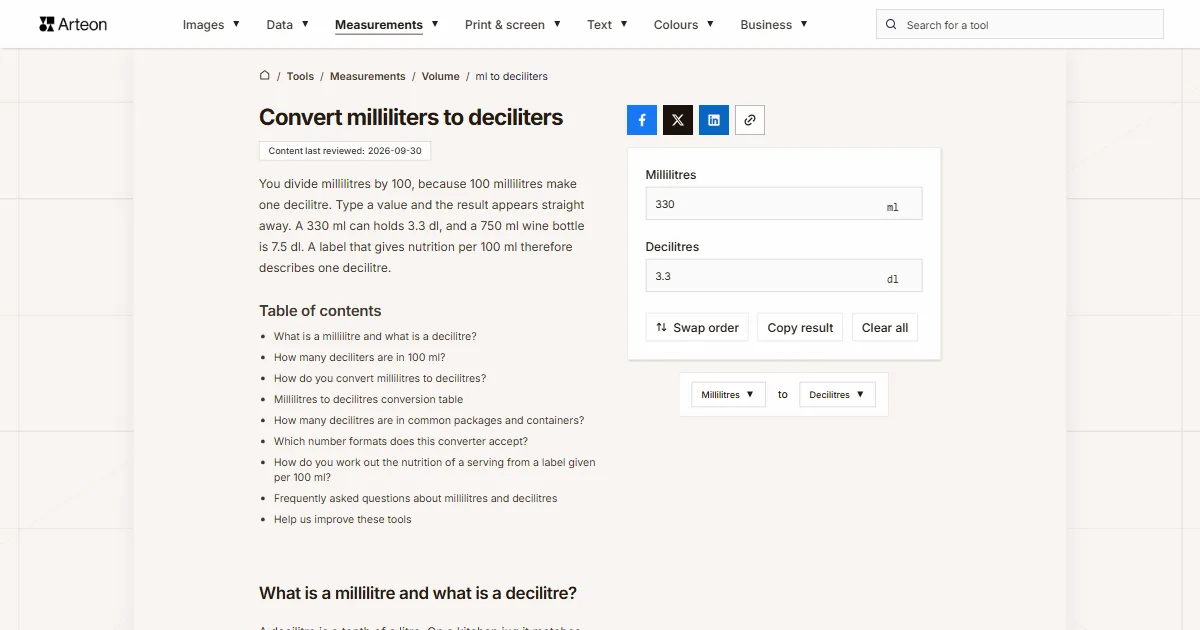
You divide millilitres by 100, because 100 millilitres make one decilitre. Type a value and the result appears straight away. A 330 ml can holds 3.3 dl, and a 750 ml wine bottle is 7.5 dl. A label that gives nutrition per 100 ml therefore describes one decilitre.
What is a millilitre and what is a decilitre?
A decilitre is a tenth of a litre. On a kitchen jug it matches the line marked 100, because a decilitre holds exactly 100 cubic centimetres, and so 100 millilitres.[1]
A millilitre has the volume of one cubic centimetre, a cube with sides of 1 cm. It is the unit printed on cans, bottles and cosmetics, and on the scale of a syringe.
The prefix milli means one thousandth, and deci means one tenth.[2] A decilitre is therefore 100 times larger than a millilitre. The same volume written in decilitres gives a number 100 times smaller.
How many deciliters are in 100 ml?
100 millilitres is exactly 1 decilitre. Divide any number of millilitres by 100 and you have the result in decilitres. The result is exact, because both units come from the litre and differ by a fixed factor of 100.
A 250 ml glass holds 2.5 decilitres. A 330 ml can is 3.3 decilitres. A 500 ml bottle gives exactly 5 decilitres.
Smaller amounts have a zero before the decimal point. A 5 ml teaspoon is 0.05 decilitre. 35 ml comes to 0.35 decilitre.
When a volume is given in litres, turn it into millilitres first. A 1.5 l bottle holds 1,500 ml. Dividing that by 100 gives 15 decilitres.
You will see volumes written this way in Switzerland. The consumer protection office of the canton of Aargau shows a bottle of cola as 3.3 dl on its sample drinks menu. Wine by the glass has a 1 dl serving in the same sample, and draught beer comes in 2, 3 and 5 dl measures.[3]
How do you convert millilitres to decilitres?
The formula has a single step: decilitres = millilitres ÷ 100. Dividing by 100 moves the decimal point two places to the left, so 450 ml becomes 4.5 dl.
When the number of millilitres ends in two zeros, drop them, so 700 ml is 7 dl. When there are fewer than 100 millilitres, put a zero and a decimal point before the result. That is why 85 ml gives 0.85 dl.
For the opposite direction, use the decilitres to millilitres converter. If you need the result in litres, the millilitres to litres converter gives it directly.
Millilitres to decilitres conversion table
| Millilitres | Decilitres | Litres |
|---|---|---|
| 1 ml | 0.01 dl | 0.001 l |
| 5 ml | 0.05 dl | 0.005 l |
| 10 ml | 0.1 dl | 0.01 l |
| 15 ml | 0.15 dl | 0.015 l |
| 20 ml | 0.2 dl | 0.02 l |
| 25 ml | 0.25 dl | 0.025 l |
| 30 ml | 0.3 dl | 0.03 l |
| 35 ml | 0.35 dl | 0.035 l |
| 40 ml | 0.4 dl | 0.04 l |
| 45 ml | 0.45 dl | 0.045 l |
| 50 ml | 0.5 dl | 0.05 l |
| 60 ml | 0.6 dl | 0.06 l |
| 75 ml | 0.75 dl | 0.075 l |
| 80 ml | 0.8 dl | 0.08 l |
| 85 ml | 0.85 dl | 0.085 l |
| 90 ml | 0.9 dl | 0.09 l |
| 100 ml | 1 dl | 0.1 l |
| 125 ml | 1.25 dl | 0.125 l |
| 150 ml | 1.5 dl | 0.15 l |
| 200 ml | 2 dl | 0.2 l |
| 220 ml | 2.2 dl | 0.22 l |
| 230 ml | 2.3 dl | 0.23 l |
| 240 ml | 2.4 dl | 0.24 l |
| 250 ml | 2.5 dl | 0.25 l |
| 280 ml | 2.8 dl | 0.28 l |
| 300 ml | 3 dl | 0.3 l |
| 330 ml | 3.3 dl | 0.33 l |
| 350 ml | 3.5 dl | 0.35 l |
| 400 ml | 4 dl | 0.4 l |
| 450 ml | 4.5 dl | 0.45 l |
| 500 ml | 5 dl | 0.5 l |
| 600 ml | 6 dl | 0.6 l |
| 700 ml | 7 dl | 0.7 l |
| 750 ml | 7.5 dl | 0.75 l |
| 800 ml | 8 dl | 0.8 l |
| 900 ml | 9 dl | 0.9 l |
| 1,000 ml | 10 dl | 1 l |
| 1,500 ml | 15 dl | 1.5 l |
| 2,000 ml | 20 dl | 2 l |
| 5,000 ml | 50 dl | 5 l |
How many decilitres are in common packages and containers?
| Package or container | Millilitres | Decilitres |
|---|---|---|
| Teaspoon 5 ml | 5 ml | 0.05 dl |
| Juice box 200 ml | 200 ml | 2 dl |
| Glass 250 ml | 250 ml | 2.5 dl |
| Can 330 ml | 330 ml | 3.3 dl |
| Water bottle 500 ml | 500 ml | 5 dl |
| Spirits bottle 700 ml | 700 ml | 7 dl |
| Wine bottle 750 ml | 750 ml | 7.5 dl |
| Litre carton 1,000 ml | 1,000 ml | 10 dl |
Which number formats does this converter accept?
| What you type | What the converter shows | How we read it |
|---|---|---|
| 250 | 2.5 dl | A number on its own is read as millilitres, because that is the unit on the field. |
| 250ml | 2.5 dl | The ml symbol pasted with the number, with or without a space, is skipped, and so is the word millilitres. |
| 12.5 | 0.125 dl | The decimal point separates the fraction, exactly as you would expect. |
| 12,5 | 0.125 dl | A comma followed by one or two digits can only be a decimal comma, so the result is the same. |
| 1,500 | 15 dl | A comma before three digits groups thousands in English, so this is fifteen hundred millilitres. A note under the field shows the other possible reading, 1.5. |
| 1.500 | 0.015 dl | A single point is always read as a decimal point, so the field counts one and a half millilitres. A note under the field shows the other possible reading, 1500. |
| 1 500 | 15 dl | A space between the thousands, as written in much of Europe and in SI style, gives the same result as 1,500. |
| 1/2 | 0.005 dl | We work out a fraction with a slash for you, so half a millilitre needs no conversion to 0.5 first. |
| 2½ | 0.025 dl | A ½ sign copied from a label or a recipe is added to the number in front of it. |
| 0.5 l | 5 dl | Litres are converted to millilitres: the field enters 500 and says so in a line under it. |
How do you work out the nutrition of a serving from a label given per 100 ml?
EU rules require nutrient amounts to be given per 100 g or per 100 ml,[4] and the same article applies in the United Kingdom.[5] A drink label therefore describes one decilitre, and these four steps scale it to the amount you pour.
Read the value in the per 100 ml column
Take the figure from the column headed 100 ml, for example 42 kcal. That figure applies to one decilitre of the drink.Turn the serving into decilitres
Divide the capacity of the glass or can by 100. A 250 ml glass is 2.5 dl. A 330 ml can is 3.3 dl.Multiply the value by the number of decilitres
At 42 kcal per 100 ml, a 2.5 dl glass gives 105 kcal. A 3.3 dl can gives 138.6 kcal.Work out sugar and salt the same way
The same multiplier applies to every line of the label table. At 10.6 g of sugar per 100 ml, a 3.3 dl can contains 34.98 g of sugar.
Convert other units to Decilitres
Convert Millilitres to other units
Sources
- Litre — Wikipedia
- Metric (SI) prefixes — National Institute of Standards and Technology
- Merkblatt Nr. 5: Angaben auf der Getränkekarte — sample drinks menu with volumes in decilitres (German) — Canton of Aargau, Consumer Protection Office
- Nutrition declaration — EU food labelling rules — Your Europe, European Commission
- Regulation (EU) No 1169/2011, Article 32 — expression per 100 g or per 100 ml — legislation.gov.uk
- 21 CFR 101.9 — Nutrition labeling of food — Legal Information Institute, Cornell Law School
Every figure in the tables was computed from the unit definitions and checked arithmetically before publication. Historical values and the names of local units come from the sources listed above.
Content last reviewed: · written and checked by the Arteon team
Frequently asked questions about millilitres and decilitres
How many decilitres are in a US cup?
For nutrition labelling a cup means 240 mL,[6] which is 2.4 decilitres. The millilitres to cups converter lets you choose between three cup sizes.
How do I write a volume given in centilitres as decilitres?
Divide the number of centilitres by ten. A 70 cl bottle is therefore 7 dl. A 33 cl can is 3.3 dl.
Help us improve these tools
Have an idea for a feature, spotted a mistake or want to suggest another tool? Write to us.