Convert kilopascals to bar
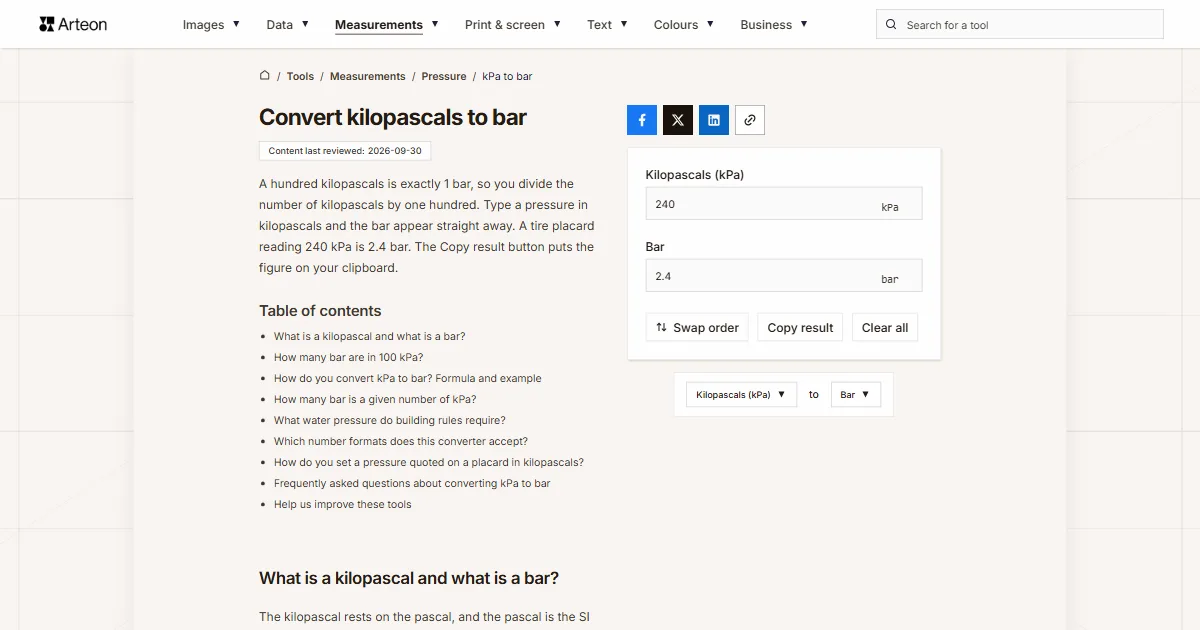
A hundred kilopascals is exactly 1 bar, so you divide the number of kilopascals by one hundred. Type a pressure in kilopascals and the bar appear straight away. A tire placard reading 240 kPa is 2.4 bar. The Copy result button puts the figure on your clipboard.
What is a kilopascal and what is a bar?
The kilopascal rests on the pascal, and the pascal is the SI unit of pressure. The SI Brochure expresses it as a newton per square metre[1]. That means one newton of force spread evenly over one square metre. The scale is easy to picture: a sheet of paper weighing 80 grams per square metre presses on a desk with about 0.8 pascal.
Because the pascal describes such a small pressure, a prefix is added to it in practice. Kilo stands for a thousand[1], so a kilopascal is a thousand pascals. The same definition gives a second way of writing the unit: if the pascal is a newton per square metre, the kilopascal is a kilonewton per square metre[1]. A value written in kN/m² and the same value in kPa carry an identical number.
The bar has a different origin. The International Bureau of Weights and Measures (BIPM), which looks after the SI, lists it among the historical names for decimal multiples of SI units and gives the value 1 bar = 0.1 MPa = 10⁵ Pa[1]. The name was adopted by Resolution 7 of the 9th General Conference on Weights and Measures in 1948[1].
A hundred kilopascals make a hundred thousand pascals, which is exactly one bar. There is more about the units themselves in the articles on the pascal and the bar.
How many bar are in 100 kPa?
A hundred kilopascals is 1 bar. You divide the number of kilopascals by one hundred: bar = kPa ÷ 100[2]. The divisor is exact, so the calculation comes down to moving the decimal point two places to the left.
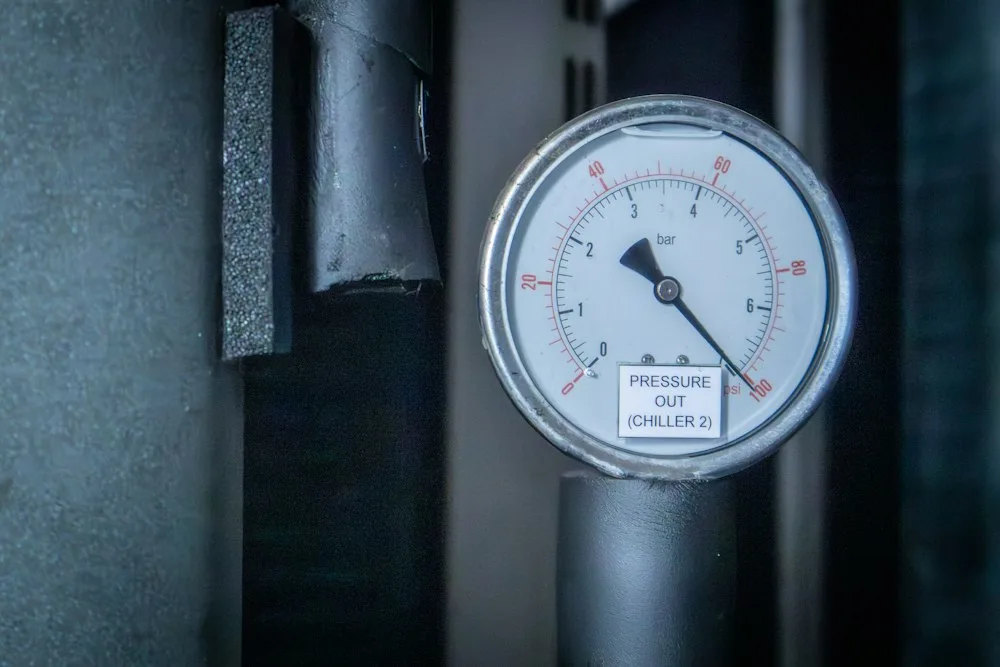
The values on placards and on water systems follow from this formula. One kilopascal is 0.01 bar. A tire placard reading 240 kPa describes 2.4 bar. A water system rated at 300 kPa runs at 3 bar. That lets you line up a gauge reading and a figure from a manual in your head.
In kilopascals the same value comes out in whole units. The Kia Seltos owner’s manual gives tire pressure in kilopascals[3]. In Canada it covers the weather too: the national climate service reports atmospheric pressure in kilopascals, where Europe writes hectopascals[4].
To turn a pressure written in bar into kilopascals, use the bar to kPa converter.
How do you convert kPa to bar? Formula and example
The formula has a single term: bar = kPa ÷ 100. Take a gauge reading of 250 kPa. Divide it by one hundred and you get 2.5 bar.
The same rule covers fractions and long figures alike. A reading of 80 kPa becomes 0.8 bar. A reading of 1,200 kPa becomes 12 bar. Every digit of the input figure survives into the result.
At small values the answer falls below a hundredth of a bar, and another unit of the same family serves better there. Ten kilopascals is 0.1 bar, which is a hundred millibar. The millibar matches the hectopascal, because the World Meteorological Organization records that identity as a definition[5].
The other pressure units are handled by the kPa to psi converter and the psi to kPa converter.
How many bar is a given number of kPa?
| Pressure in kilopascals | Pressure in bar |
|---|---|
| 1 kPa | 0.01 bar |
| 5 kPa | 0.05 bar |
| 10 kPa | 0.1 bar |
| 15 kPa | 0.15 bar |
| 20 kPa | 0.2 bar |
| 25 kPa | 0.25 bar |
| 30 kPa | 0.3 bar |
| 40 kPa | 0.4 bar |
| 50 kPa | 0.5 bar |
| 60 kPa | 0.6 bar |
| 70 kPa | 0.7 bar |
| 80 kPa | 0.8 bar |
| 90 kPa | 0.9 bar |
| 100 kPa | 1 bar |
| 110 kPa | 1.1 bar |
| 120 kPa | 1.2 bar |
| 130 kPa | 1.3 bar |
| 140 kPa | 1.4 bar |
| 150 kPa | 1.5 bar |
| 160 kPa | 1.6 bar |
| 170 kPa | 1.7 bar |
| 180 kPa | 1.8 bar |
| 190 kPa | 1.9 bar |
| 200 kPa | 2 bar |
| 210 kPa | 2.1 bar |
| 220 kPa | 2.2 bar |
| 230 kPa | 2.3 bar |
| 240 kPa | 2.4 bar |
| 250 kPa | 2.5 bar |
| 260 kPa | 2.6 bar |
| 270 kPa | 2.7 bar |
| 280 kPa | 2.8 bar |
| 290 kPa | 2.9 bar |
| 300 kPa | 3 bar |
| 320 kPa | 3.2 bar |
| 350 kPa | 3.5 bar |
| 400 kPa | 4 bar |
| 450 kPa | 4.5 bar |
| 500 kPa | 5 bar |
| 600 kPa | 6 bar |
| 700 kPa | 7 bar |
| 800 kPa | 8 bar |
| 900 kPa | 9 bar |
| 1,000 kPa | 10 bar |
| 1,200 kPa | 12 bar |
| 1,500 kPa | 15 bar |
| 2,000 kPa | 20 bar |
| 3,000 kPa | 30 bar |
| 5,000 kPa | 50 bar |
| 10,000 kPa | 100 bar |
What water pressure do building rules require?
| Rule and threshold | Figure in the rule | Value in bar |
|---|---|---|
| Poland, minimum at every draw-off point | 0.05 MPa, that is 50 kPa | 0.5 bar |
| Poland, maximum at every draw-off point | 0.6 MPa, that is 600 kPa | 6 bar |
| Spain, minimum at an ordinary tap | 100 kPa | 1 bar |
| Spain, minimum at a flush valve and a water heater | 150 kPa | 1.5 bar |
| Spain, maximum at a point of use | 500 kPa | 5 bar |
| Czechia, minimum for buildings up to two storeys | 0.15 MPa, that is 150 kPa | 1.5 bar |
| Czechia, minimum for buildings above two storeys | 0.25 MPa, that is 250 kPa | 2.5 bar |
| Czechia, maximum in the distribution network | 0.6 MPa, that is 600 kPa | 6 bar |
| Portugal, lower limit of the service pressure | 50 kPa | 0.5 bar |
| Portugal, upper limit of the service pressure | 600 kPa | 6 bar |
| Portugal, recommended range | 150–300 kPa | 1.5–3 bar |
| Standard atmosphere, for comparison | 101.325 kPa | 1.01325 bar |
Which number formats does this converter accept?
| What you type | What the converter shows | Note |
|---|---|---|
| 250 | 2.5 bar | A plain number is read as kilopascals, because that's how the field is labeled. |
| 101.3 | 1.013 bar | The period is your decimal point, and that's exactly how we read it. |
| 101,3 | 1.013 bar | A comma with fewer than three digits after it is a decimal comma from a European document, so the result is the same. |
| 250 kPa | 2.5 bar | The unit symbol pasted along with the number is skipped. |
| 2.5 bar | 2.5 bar | The field recognizes bar by its symbol, so the value comes back unchanged. |
| 36 psi | 2.4821 bar | A psi value, such as one from a US tire placard, is converted to kilopascals first. |
| 1013 hPa | 1.013 bar | Hectopascals from a weather report are converted too, and 1013 hPa is 101.3 kPa. |
| 1.500 | 0.015 bar | A single period is a decimal point, so we read one and a half kilopascals. A note under the field says “Read as 1.5. If you meant 1500, type 1500.” |
| 1,500 | 15 bar | A comma followed by three digits groups thousands, so the field reads fifteen hundred kilopascals. A note under the field says “Read as 1500. If you meant 1.5, type 1.5.” |
| 1 500 | 15 bar | A space between the thousands is skipped, so this is fifteen hundred kilopascals as well. |
| -80 | -0.8 bar | A minus sign marks vacuum, a gauge reading below the pressure of the surroundings, and the factor stays the same. |
| -0.8 bar | -0.8 bar | The minus sign stays when the entry uses a different unit from the field. |
How do you set a pressure quoted on a placard in kilopascals?
A placard in kilopascals and a gauge in bar put these two units side by side. The steps use a value of 240 kPa.
Read the figure off the placard
The label with tire sizes and recommended pressures sits on the driver’s side centre pillar[3]. In this example it reads 240 kPa.Move the decimal point two places to the left
That gives you bar. From 240 kPa you get 2.4 bar.Match the result to the compressor scale
A value of 240 kPa is 2.4 bar. In pounds-force per square inch the same value comes to 34.81 psi, and the full conversion with its table is on the kPa to psi converter. With all three figures to hand you can read the compressor you meet.Measure the pressure on cold tires
The figure on the placard refers to tires that have cooled down, because driving warms the air inside them and lifts the reading. The Kia Seltos manual states that warm tires exceed the recommended cold pressure by 28–41 kPa[3], which is 0.28–0.41 bar. A measurement taken before setting off therefore gives a figure comparable with the one the manufacturer asks for.
Convert other units to Bar
Convert Kilopascals (kPa) to other units
Sources
- SI Brochure, 9th edition (2019), Table 4, Table 7 and Table 8 — Bureau International des Poids et Mesures
- NIST Guide to the SI, Appendix B.8: Factors for Units Listed Alphabetically — National Institute of Standards and Technology
- Kia Seltos owner’s manual, chapter “Tyres and wheels” — Kia Corporation
- Glossary – Climate, entry “Station Pressure (kPa)” — Environment and Climate Change Canada
- Guide to Instruments and Methods of Observation (WMO-No. 8), 2023 edition, Volume I, section 1.5.1 — World Meteorological Organization
- Polish regulation on the technical conditions for buildings (Dz.U. 2022 poz. 1225), § 114(1) — Sejm RP, Internetowy System Aktów Prawnych
- Código Técnico de la Edificación, Basic Document HS 4 Water supply, section 2.1.3 — Ministerio de Vivienda y Agenda Urbana
- Czech Decree No. 428/2001 Sb., § 15(4) and (5) — Ministerstvo zemědělství ČR
- Portuguese Decreto Regulamentar No. 23/95, Articles 21 and 87 — Diário da República Portuguesa
Every figure in the tables was computed from the unit definitions and checked arithmetically before publication. Historical values and the names of local units come from the sources listed above.
Content last reviewed: · written and checked by the Arteon team
Frequently asked questions about converting kPa to bar
How many bar is 240 kPa from a tire placard?
A value of 240 kPa is 2.4 bar. Both figures describe the same inflation, so a placard in kilopascals and a gauge scaled in bar agree with each other. In pounds-force per square inch it comes to 34.81 psi, which the kPa to psi converter will work out for you.
How many bar is 1 kPa?
One kilopascal is 0.01 bar, a hundredth of a bar. The same value is ten millibar. At pressures this small the millibar is the easier unit to quote, because the figure then stays above one.
Is the kilopascal on a placard the same unit as the hectopascal in a forecast?
Both belong to the pascal family and a prefix separates them. A hectopascal is a hundred pascals and a kilopascal a thousand, so one kilopascal holds ten hectopascals. Meteorology uses the hectopascal, because the World Meteorological Organization names it as the unit of pressure in observations and records the identity 1 mbar = 1 hPa[5]. A pressure of 1,013.25 hPa is therefore 101.325 kPa and 1.01325 bar.
Why does one country quote pressure in kilopascals and another in megapascals?
The rules were drafted separately and each of them uses a different prefix from the same family of units. Spain gives its minimum water pressure as 100 kPa[7] and Portugal as 50 kPa[9]. In the Polish[6] and Czech[8] rules the same range stands in megapascals. The values remain comparable, because only the factor separates them.
Is a kilopascal the same as a kilonewton per square metre?
Yes. The pascal is defined as a newton per square metre[1], so adding the prefix kilo to both sides of that expression gives a kilonewton per square metre. A value written in kN/m² therefore carries the same number in kilopascals, and one bar comes to 100 kN/m².
Help us improve these tools
Have an idea for a feature, found a bug or want to suggest another tool? Write to us.