Convert psi to bar
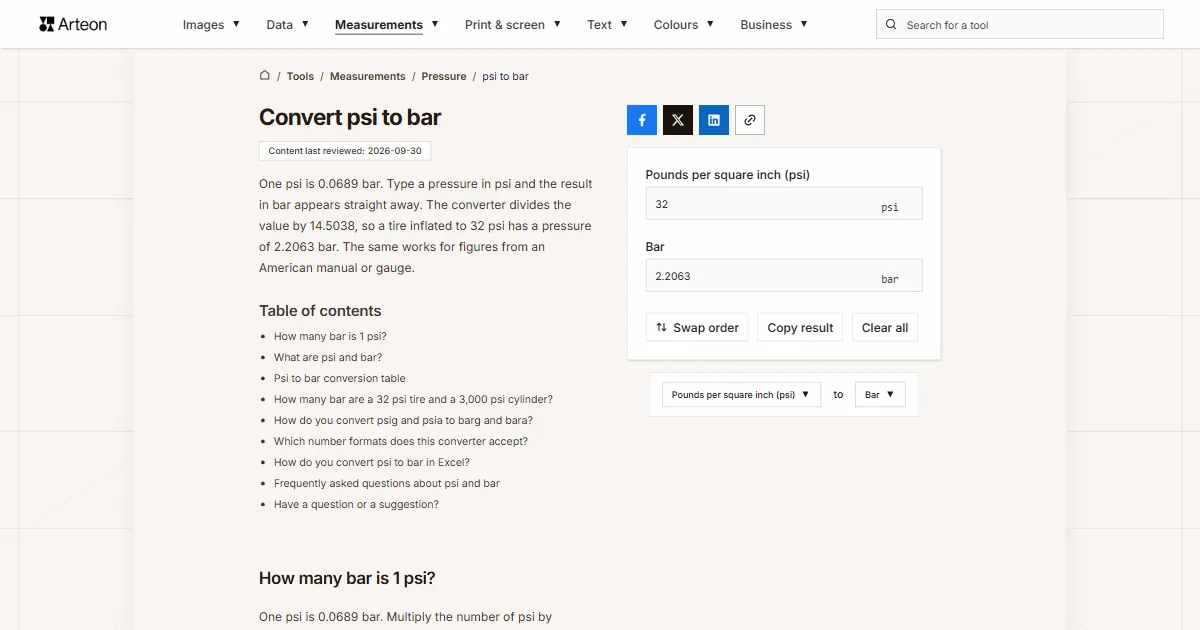
One psi is 0.0689 bar. Type a pressure in psi and the result in bar appears straight away. The converter divides the value by 14.5038, so a tire inflated to 32 psi has a pressure of 2.2063 bar. The same works for figures from an American manual or gauge.
How many bar is 1 psi?
One psi is 0.0689 bar. Multiply the number of psi by 0.0689476, or divide it by 14.5038: bar = psi × 0.0689476[1]. The same formula holds for fractions and negative values.
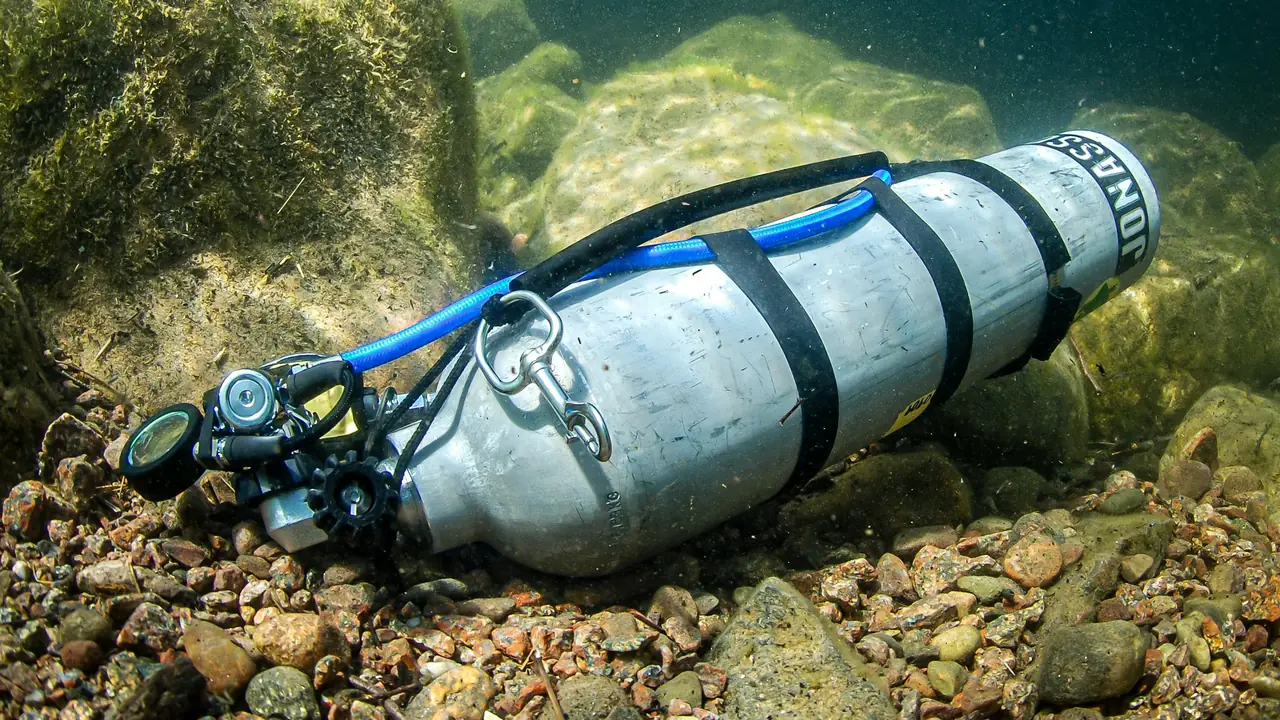
The formula gives the values you copy from an American manual or a gauge marked in psi. A tire inflated to 32 psi has 2.21 bar. A pressure of 35 psi gives 2.41 bar. A hundred psi is 6.89 bar. The 3,000 psi quoted for scuba cylinders is 206.84 bar.
For a quick estimate in your head, divide the number of psi by 14.5. At 32 psi you get 2.207 bar. The exact result is 2.206 bar. The estimate is 0.026% above the exact result, so up to 50 psi the difference stays under a thousandth of a bar. The converter works from the exact value of psi, 6,894.757 pascals rounded[1], and shows the result to four decimal places.
To turn a pressure in bar into psi, use the bar to psi converter.
What are psi and bar?
Psi describes the pressure produced by a force of one pound-force acting on an area of one square inch[2]. The unit is used primarily in the United States[2].
The value of psi follows from three definitions. The avoirdupois pound is exactly 0.45359237 kilograms[3]. Multiplied by standard gravity, it gives a pound-force of 4.4482216152605 newtons[3]. The third definition is the inch, and a square inch is a square one inch on each side. Dividing the pound-force by a square inch gives 6,894.757 pascals per psi, rounded[1].
The bar is 100,000 pascals[1] and roughly equal to the air pressure at the Earth's surface[4]. It is not an SI unit, but the NIST guide to the SI records that in 1978 the CIPM considered it permissible to keep using it alongside the SI[5].
Psi to bar conversion table
| Psi | Bar |
|---|---|
| 1 psi | 0.069 bar |
| 5 psi | 0.345 bar |
| 10 psi | 0.689 bar |
| 14.7 psi | 1.014 bar |
| 15 psi | 1.034 bar |
| 20 psi | 1.379 bar |
| 25 psi | 1.724 bar |
| 28 psi | 1.931 bar |
| 29 psi | 1.999 bar |
| 30 psi | 2.068 bar |
| 32 psi | 2.206 bar |
| 33 psi | 2.275 bar |
| 34 psi | 2.344 bar |
| 35 psi | 2.413 bar |
| 36 psi | 2.482 bar |
| 38 psi | 2.62 bar |
| 40 psi | 2.758 bar |
| 42 psi | 2.896 bar |
| 44 psi | 3.034 bar |
| 45 psi | 3.103 bar |
| 50 psi | 3.447 bar |
| 60 psi | 4.137 bar |
| 65 psi | 4.482 bar |
| 70 psi | 4.826 bar |
| 75 psi | 5.171 bar |
| 80 psi | 5.516 bar |
| 90 psi | 6.205 bar |
| 100 psi | 6.895 bar |
| 110 psi | 7.584 bar |
| 120 psi | 8.274 bar |
| 125 psi | 8.618 bar |
| 145 psi | 9.997 bar |
| 150 psi | 10.342 bar |
| 200 psi | 13.79 bar |
| 250 psi | 17.237 bar |
| 300 psi | 20.684 bar |
| 400 psi | 27.579 bar |
| 500 psi | 34.474 bar |
| 1,000 psi | 68.948 bar |
| 1,500 psi | 103.421 bar |
| 2,000 psi | 137.895 bar |
| 2,500 psi | 172.369 bar |
| 3,000 psi | 206.843 bar |
| 3,500 psi | 241.317 bar |
| 4,000 psi | 275.79 bar |
| 4,500 psi | 310.264 bar |
| 5,000 psi | 344.738 bar |
| 6,000 psi | 413.685 bar |
| 10,000 psi | 689.476 bar |
How many bar are a 32 psi tire and a 3,000 psi cylinder?
| Psi | Bar | Where the value comes from |
|---|---|---|
| 32 psi | 2.206 bar | Typical overpressure in a passenger car tire |
| 36 psi | 2.482 bar | Tire pressure on the sample label in the US federal standard FMVSS 110, written as 248 kPa (36 psi) |
| 3,000 psi | 206.843 bar | A full scuba tank and the working pressure of an aluminum S80 cylinder |
| 5,000 psi | 344.738 bar | H35 hydrogen refueling, also described as 350 bar |
| 10,000 psi | 689.476 bar | H70 hydrogen refueling, also described as 700 bar |
How do you convert psig and psia to barg and bara?
| Gauge pressure (psig) | Absolute pressure (psia) | Gauge pressure (barg) | Absolute pressure (bara) |
|---|---|---|---|
| 0 psig | 14.696 psia | 0 barg | 1.013 bara |
| 30 psig | 44.696 psia | 2.068 barg | 3.082 bara |
| 32 psig | 46.696 psia | 2.206 barg | 3.22 bara |
| 35 psig | 49.696 psia | 2.413 barg | 3.426 bara |
| 100 psig | 114.696 psia | 6.895 barg | 7.908 bara |
| 3,000 psig | 3,014.696 psia | 206.843 barg | 207.856 bara |
Which number formats does this converter accept?
| What you type | What the converter shows | Note |
|---|---|---|
| 32 | 2.2063 bar | A plain number is read as psi, because that's how the field is labeled. |
| 32.5 | 2.2408 bar | The period is your decimal point, and that's exactly how we read it. |
| 32,5 | 2.2408 bar | A comma with fewer than three digits after it is a decimal comma from a European document, so the result is the same. |
| 32 psi | 2.2063 bar | The unit symbol pasted along with the number is skipped. |
| 32 1/2 | 2.2408 bar | We work out a slash fraction ourselves, so the mixed number reads as thirty-two and a half psi. |
| 2.2 bar | 2.2 bar | The field recognizes bar by its symbol, so the value comes back unchanged. |
| 220 kPa | 2.2 bar | Kilopascals are converted too, and 220 kPa is 2.2 bar. |
| 1.500 | 0.1034 bar | A single period is a decimal point, so we read 1.5 psi. A note under the field says “Read as 1.5. If you meant 1500, type 1500.” |
| 1,500 | 103.4214 bar | A comma followed by three digits groups thousands, so the field reads fifteen hundred psi. A note under the field says “Read as 1500. If you meant 1.5, type 1.5.” |
| 1 500 | 103.4214 bar | A space between the thousands is skipped, so this is fifteen hundred psi as well. |
| -5 | -0.3447 bar | A minus sign marks vacuum, a gauge reading below the pressure of the surroundings, and the factor stays the same. |
| -0.8 bar | -0.8 bar | The minus sign stays when the entry uses a different unit from the field. |
How do you convert psi to bar in Excel?
Excel turns psi into kilopascals, and you get bar by dividing that result by a hundred. The steps use a 32 psi tire as the example.
Enter the pressure in psi
Type the number of psi into a cell, for example 32 in cell A2.Convert psi into kilopascals
The CONVERT function has the syntax CONVERT(number,from_unit,to_unit). Its pressure table lists the codes Pa, atm, mmHg, psi and Torr, and the prefix k can be added to the pascal[10]. You then turn the result in kilopascals into bar with a single division.Divide the result by 100
A hundred kilopascals make one bar. The formula =CONVERT(A2,"psi","kPa")/100 returns 2.2063 bar for 32 psi.Copy the formula to the next rows
Once you copy the cell down the column, each row works out bar from its own value in psi.
Convert other units to Bar
Convert Pounds per square inch (psi) to other units
Sources
- NIST Guide to the SI, Appendix B.8: Factors for Units Listed Alphabetically — National Institute of Standards and Technology
- Pound per square inch — Wikipedia
- Pound (force) — Wikipedia
- Bar (Einheit) — Wikipedia
- NIST Guide to the SI, Chapter 5: Units Outside the SI — National Institute of Standards and Technology
- 49 CFR § 571.110, Tire selection and rims and motor home/recreation vehicle trailer load carrying capacity information — Legal Information Institute, Cornell Law School
- Diving cylinder — Wikipedia
- Gaseous Dispensing — Hydrogen Fuel Cell Partnership (H2FCP)
- Bar (unit) — Wikipedia
- CONVERT function — Microsoft
Every figure in the tables was computed from the unit definitions and checked arithmetically before publication. Historical values and the names of local units come from the sources listed above.
Content last reviewed: · written and checked by the Arteon team
Frequently asked questions about psi and bar
Is 14.7 psi one bar?
A value of 14.7 psi is 1.0135 bar. It roughly matches a standard atmosphere, which is 1.01325 bar[1]. One bar corresponds to 14.5038 psi.
What does psig mean on a gauge?
The g stands for gauge and means the gauge shows pressure measured from atmospheric pressure[2]. A reading of 32 psig converts to 2.2063 barg.
Are psi and lbf/in² the same unit?
Yes. Psi is short for pound per square inch, or more accurately pound-force per square inch, written with the symbol lbf/in²[2].
How many bar is 1 ksi?
A ksi is a thousand psi, or 68.9476 bar. The unit is used mainly in materials science to give tensile strength[2].
Have a question or a suggestion?
Write to us if you want to convert another pressure unit or you spot a value in the tables that needs fixing.