Convert petabytes to exabytes
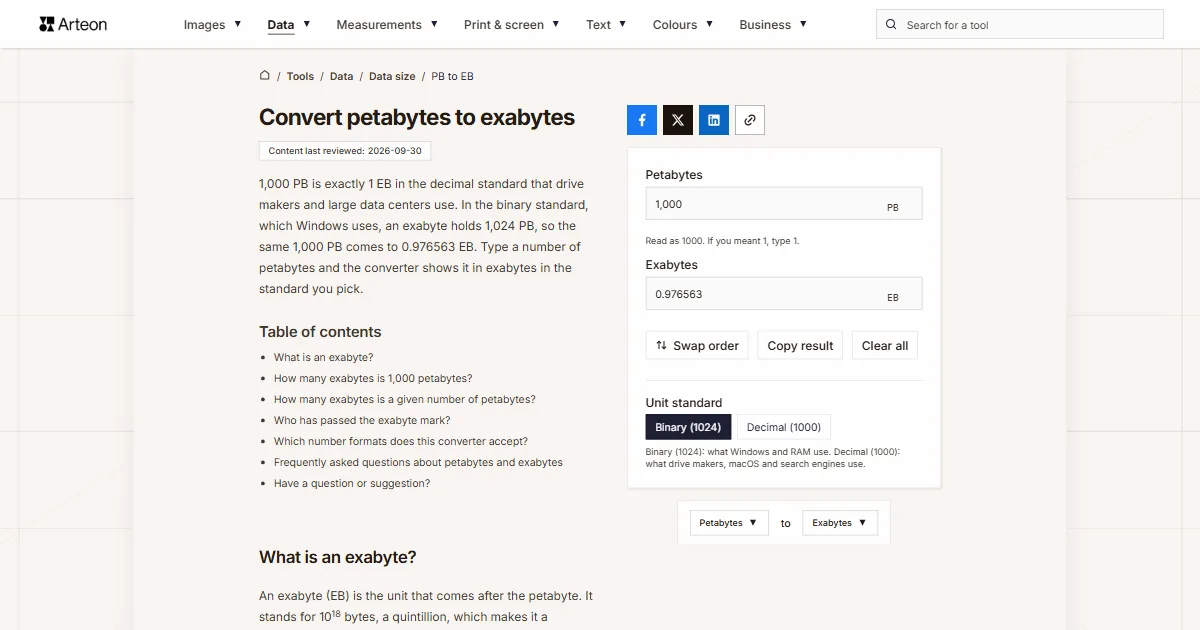
1,000 PB is exactly 1 EB in the decimal standard that drive makers and large data centers use. In the binary standard, which Windows uses, an exabyte holds 1,024 PB, so the same 1,000 PB comes to 0.976563 EB. Type a number of petabytes and the converter shows it in exabytes in the standard you pick.
What is an exabyte?
An exabyte (EB) is the unit that comes after the petabyte. It stands for 1018 bytes, a quintillion, which makes it a thousand petabytes. Its power-of-two counterpart is the exbibyte (EiB), 260 bytes[1]. Exabytes describe the storage of the largest research centers and archives, not of a single storage array.
Windows counts in powers of two but labels the result with decimal symbols[2]. That is why the converter has a Unit standard switch: pick Decimal (1000) for figures from data center announcements and spec sheets, and Binary (1024) for figures from your operating system.
How many exabytes is 1,000 petabytes?
1,000 petabytes is 1 EB in decimal and 0.976563 EB in binary. The formula is short:
- decimal: EB = PB ÷ 1,000,
- binary: EB = PB ÷ 1,024.
The two standards are 2.4% apart for this pair, because only one step separates the units. With large figures that still adds up: 100,000 PB is 100 EB in decimal and 97.66 EB in binary, a gap of more than two exabytes.
In Excel, the CONVERT function does the job. =CONVERT(A2,"Pbyte","Ebyte") works in decimal and =CONVERT(A2,"Pibyte","Eibyte") in binary[3]. The EB to PB converter handles the other direction, and the PB to TB converter the smaller units.
How many exabytes is a given number of petabytes?
| Petabytes | Binary (1024) | Decimal (1000) |
|---|---|---|
| 1 PB | 0.0009766 EB | 0.001 EB |
| 10 PB | 0.009766 EB | 0.01 EB |
| 50 PB | 0.048828 EB | 0.05 EB |
| 100 PB | 0.097656 EB | 0.1 EB |
| 200 PB | 0.195313 EB | 0.2 EB |
| 250 PB | 0.244141 EB | 0.25 EB |
| 500 PB | 0.488281 EB | 0.5 EB |
| 512 PB | 0.5 EB | 0.512 EB |
| 750 PB | 0.732422 EB | 0.75 EB |
| 1,000 PB | 0.976563 EB | 1 EB |
| 1,024 PB | 1 EB | 1.024 EB |
| 2,000 PB | 1.953125 EB | 2 EB |
| 2,048 PB | 2 EB | 2.048 EB |
| 5,000 PB | 4.882813 EB | 5 EB |
| 10,000 PB | 9.765625 EB | 10 EB |
| 100,000 PB | 97.65625 EB | 100 EB |
Who has passed the exabyte mark?
CERN, the European laboratory for particle physics, passed it in late September 2023, when its disk storage crossed one exabyte, or a million terabytes. It took 111,000 devices to get there, mostly hard disks with a growing share of flash drives[4].
CERN describes its exabyte as a million terabytes, so it counts in decimal. The same space shown in Windows would come to about 888 PB, because the system counts petabytes of 250 bytes.
Research storage in Australia is measured in petabytes. In August 2021 the Pawsey Supercomputing Research Centre in Perth announced 130 PB of online and offline storage, including a 60 PB disk system named Acacia after the golden wattle, Australia's national floral emblem[5]. Type 130 with the Decimal (1000) setting and the converter shows 0.13 EB, so that whole system is about an eighth of CERN's exabyte.
Which number formats does this converter accept?
| What you type | What the converter shows | How we read it |
|---|---|---|
| 1.5 | 0.001465 EB | The point separates the decimal part, so we count one and a half petabytes |
| 1,500 | 1.464844 EB | A comma before three digits is a thousands separator in English, so we count fifteen hundred petabytes. A hint appears under the field in case you meant 1.5. |
| 1.500 | 0.001465 EB | A single point always counts as a decimal point, so we read one and a half petabytes. A hint appears under the field, and for fifteen hundred you type 1500 or 1,500. |
| 10 000 | 9.765625 EB | Spaces between thousands, common in European documents, are skipped, so the field holds ten thousand petabytes |
| ½ | 0.0004883 EB | A ½ sign copied from text becomes half a petabyte |
| 2.5e-3 | 0.000002441 EB | Scientific notation from a spreadsheet is read as it is: 2.5e-3 is 0.0025 of a petabyte |
| 254 PB | 0.248047 EB | A unit pasted along with the number is skipped, because it is this field's unit |
| 1,000,000 TB | 0.953674 EB | Terabytes pasted into the petabyte field are written there as 976.5625 PB, with a note under the field |
| 2 exabytes | 2 EB | Exabytes written as a word are recognized too: the field gets 2048 PB, so the result comes back as 2 EB |
Convert other units to Exabytes
Convert Petabytes to other units
Sources
- Byte — Wikipedia
- Binary prefix — Wikipedia
- CONVERT function — Microsoft
- An exabyte of disk storage at CERN — CERN
- Pawsey to deploy 130PB of multi-tier storage — Pawsey Supercomputing Research Centre
Every figure in the tables was computed from the unit definitions and checked arithmetically before publication. Historical values and the names of local units come from the sources listed above.
Content last reviewed: · written and checked by the Arteon team
Frequently asked questions about petabytes and exabytes
Is there an exabyte hard drive?
No. An exabyte is the capacity of a whole data center built from tens of thousands of devices. CERN only crossed the exabyte mark with 111,000 of them[4]. How many drives and tapes make up one petabyte is shown by the TB to PB converter.
Which is bigger, PB or EB?
The exabyte is bigger, a thousand times in decimal and 1,024 times in binary. Units from the exabyte upward are listed on the PB to TB converter page.
Have a question or suggestion?
If you spot a mistake in a table or miss a capacity you need, write to us.