Convert millilitres to gallons
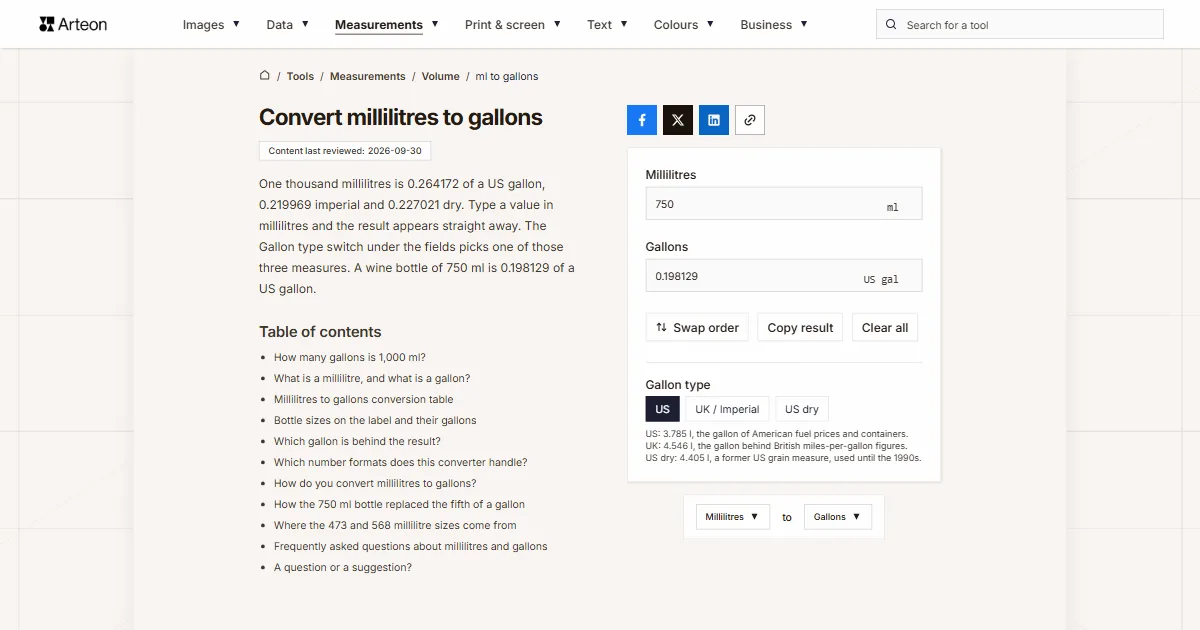
One thousand millilitres is 0.264172 of a US gallon, 0.219969 imperial and 0.227021 dry. Type a value in millilitres and the result appears straight away. The Gallon type switch under the fields picks one of those three measures. A wine bottle of 750 ml is 0.198129 of a US gallon.
How many gallons is 1,000 ml?
One thousand millilitres is 0.264172 of a US gallon. Divide the value in millilitres by 3,785.411784: gallons = millilitres ÷ 3,785.411784[1].
The answers come out small, because a single gallon holds nearly four thousand millilitres. A 500 ml bottle gives 0.132086 of a gallon. A standard 750 ml wine bottle is 0.198129, just under a fifth. A two-litre bottle works out at 0.528344, so it takes two of them to pass a full gallon. Below 3,785.41 millilitres every result is a fraction, with up to six decimal places.
Which gallon you are converting to decides the result. On the imperial setting a thousand millilitres gives 0.219969 of a gallon, because an imperial gallon holds 4,546.09 millilitres[2]. On the US dry setting it gives 0.227021, and that gallon holds 4,404.88 millilitres[3]. The Gallon type switch under the fields sets the measure.
For the other direction use the gallons to millilitres converter, and above a few litres the litres to gallons converter is the easier read.
What is a millilitre, and what is a gallon?
The prefix milli- means a thousandth, so a millilitre is a thousandth of a litre. It takes up exactly one cubic centimetre, which makes 10 millilitres and 10 cubic centimetres the same volume[4].
In the US table of liquid volume the gallon sits at the top, and the smaller units come from dividing it. A gallon splits into 4 quarts, 8 pints and 128 fluid ounces, and each of those divisions has its own figure in millilitres[5]. A quart is 946.35 millilitres. A pint is 473.18 millilitres. A fluid ounce is 29.57 millilitres, and the ounces to millilitres converter handles that last step on its own.
The imperial series divides the gallon into the same four quarts and eight pints, but fits 160 imperial ounces inside it, so its ounce measures 28.41 millilitres[2]. The same unit name covers a different volume in each system, which is why the country a label comes from matters.
Millilitres to gallons conversion table
| Millilitres | US gallon | Imperial gallon | US dry gallon |
|---|---|---|---|
| 50 ml | 0.013209 gal | 0.010998 gal | 0.011351 gal |
| 100 ml | 0.026417 gal | 0.021997 gal | 0.022702 gal |
| 150 ml | 0.039626 gal | 0.032995 gal | 0.034053 gal |
| 200 ml | 0.052834 gal | 0.043994 gal | 0.045404 gal |
| 240 ml | 0.063401 gal | 0.052793 gal | 0.054485 gal |
| 250 ml | 0.066043 gal | 0.054992 gal | 0.056755 gal |
| 300 ml | 0.079252 gal | 0.065991 gal | 0.068106 gal |
| 330 ml | 0.087177 gal | 0.072590 gal | 0.074917 gal |
| 355 ml | 0.093781 gal | 0.078089 gal | 0.080592 gal |
| 375 ml | 0.099065 gal | 0.082488 gal | 0.085133 gal |
| 400 ml | 0.105669 gal | 0.087988 gal | 0.090808 gal |
| 450 ml | 0.118877 gal | 0.098986 gal | 0.102159 gal |
| 473 ml | 0.124953 gal | 0.104045 gal | 0.107381 gal |
| 500 ml | 0.132086 gal | 0.109985 gal | 0.113510 gal |
| 550 ml | 0.145295 gal | 0.120983 gal | 0.124861 gal |
| 600 ml | 0.158503 gal | 0.131982 gal | 0.136212 gal |
| 700 ml | 0.184920 gal | 0.153978 gal | 0.158915 gal |
| 750 ml | 0.198129 gal | 0.164977 gal | 0.170266 gal |
| 800 ml | 0.211338 gal | 0.175975 gal | 0.181617 gal |
| 900 ml | 0.237755 gal | 0.197972 gal | 0.204319 gal |
| 946 ml | 0.249907 gal | 0.208091 gal | 0.214762 gal |
| 1,000 ml | 0.264172 gal | 0.219969 gal | 0.227021 gal |
| 1,200 ml | 0.317006 gal | 0.263963 gal | 0.272425 gal |
| 1,500 ml | 0.396258 gal | 0.329954 gal | 0.340531 gal |
| 1,750 ml | 0.462301 gal | 0.384946 gal | 0.397286 gal |
| 2,000 ml | 0.528344 gal | 0.439938 gal | 0.454041 gal |
| 2,500 ml | 0.660430 gal | 0.549923 gal | 0.567552 gal |
| 3,000 ml | 0.792516 gal | 0.659908 gal | 0.681062 gal |
| 3,500 ml | 0.924602 gal | 0.769892 gal | 0.794573 gal |
| 3,785 ml | 0.999891 gal | 0.832584 gal | 0.859274 gal |
| 4,000 ml | 1.056688 gal | 0.879877 gal | 0.908083 gal |
| 4,500 ml | 1.188774 gal | 0.989862 gal | 1.021593 gal |
| 5,000 ml | 1.320860 gal | 1.099846 gal | 1.135104 gal |
| 6,000 ml | 1.585032 gal | 1.319815 gal | 1.362124 gal |
| 7,000 ml | 1.849204 gal | 1.539785 gal | 1.589145 gal |
| 7,500 ml | 1.981290 gal | 1.649769 gal | 1.702656 gal |
| 8,000 ml | 2.113376 gal | 1.759754 gal | 1.816166 gal |
| 9,000 ml | 2.377548 gal | 1.979723 gal | 2.043187 gal |
| 10,000 ml | 2.641721 gal | 2.199692 gal | 2.270207 gal |
| 12,000 ml | 3.170065 gal | 2.639631 gal | 2.724249 gal |
| 15,000 ml | 3.962581 gal | 3.299539 gal | 3.405311 gal |
| 20,000 ml | 5.283441 gal | 4.399385 gal | 4.540415 gal |
Bottle sizes on the label and their gallons
| Capacity on the label | US gallons | Where the figure comes from |
|---|---|---|
| 50 ml | 0.013209 gal | A round metric value, the smallest on the list |
| 100 ml | 0.026417 gal | A round metric value |
| 187 ml | 0.049400 gal | A quarter bottle of wine, called a piccolo or split |
| 200 ml | 0.052834 gal | A round metric value |
| 250 ml | 0.066043 gal | A round metric value |
| 355 ml | 0.093781 gal | Twelve fluid ounces, 354.88 millilitres rounded |
| 375 ml | 0.099065 gal | A half bottle of wine, demi in French |
| 473 ml | 0.124953 gal | A US pint, an eighth of a US gallon |
| 500 ml | 0.132086 gal | A round metric value, used for sweet wines |
| 568 ml | 0.150050 gal | An imperial pint, an eighth of an imperial gallon |
| 620 ml | 0.163787 gal | A clavelin, the bottle for vin jaune from the Jura |
| 750 ml | 0.198129 gal | A standard wine bottle |
| 1,000 ml | 0.264172 gal | A litre, a round metric value |
| 1,500 ml | 0.396258 gal | A magnum, two standard bottles |
| 3,000 ml | 0.792516 gal | A double magnum or jeroboam, four standard bottles |
Which gallon is behind the result?
| Gallon type | Millilitres in one gallon | Gallons from one litre | Where it is used | Option on the switch |
|---|---|---|---|---|
| US liquid | 3,785.41 ml | 0.2642 gal | The United States, plus fuel sales in Colombia, Ecuador and Peru | US |
| Imperial | 4,546.09 ml | 0.2200 gal | UK fuel-economy figures and petrol in parts of the Caribbean | UK / Imperial |
| US dry | 4,404.88 ml | 0.2270 gal | Grain in the United States until the 1990s | US dry |
Which number formats does this converter handle?
| What you type | What the converter shows | How we read it |
|---|---|---|
| 3785.41 | 1 US gal | The point is the decimal separator, so this is 3,785.41 millilitres, which is one US gallon. |
| 3785,41 | 1 US gal | A comma followed by two digits is read as a European decimal comma, so the result is the same. |
| 3,785.41 | 1 US gal | A comma between the thousands together with a decimal point also goes through as it is, so the result is one US gallon again. |
| 1,500 | 0.396258 US gal | Three digits after the comma mark a thousands separator, so we count one thousand five hundred millilitres. A note under the field says: Read as 1500. If you meant 1.5, type 1.5. |
| 1 500 | 0.396258 US gal | A space between the thousands is skipped, so this is one thousand five hundred millilitres, or one and a half litres. |
| 5 l | 1.32086 US gal | The field turns litres written with the l symbol into millilitres itself, so you can type five litres without any maths. |
| 128 fl oz | 1 US gal | The field recognises fluid ounces from a US label by the fl oz symbol and converts them straight away: a hundred and twenty-eight ounces make one gallon. |
How do you convert millilitres to gallons?
The calculation is one division. The steps show how to match the divisor to the country the figure comes from.
Read the capacity off the packaging
The capacity appears on the label in millilitres or litres. Multiply a figure in litres by a thousand: a 1.5 l bottle is 1,500 millilitres.Set the gallon on the Gallon type switch
The switch sits under both fields and offers three buttons: US, UK / Imperial and US dry. When a document says only gallon and comes from the States, the US option is the one you want.Type the value in millilitres
The result appears as you type and carries up to six decimal places, so it stays visible at small capacities too: 50 millilitres is 0.013209 of a gallon.Read the gallons and take them further
The Copy result button puts the number on the clipboard. For a bulk order multiply it by the number of packs: twelve 750 ml bottles come to 2.377548 US gallons.
How the 750 ml bottle replaced the fifth of a gallon
The 750 millilitre bottle took the place of an older American size based on the gallon. In the United States wine and distilled spirits were sold in bottles called fifths, a fifth of a US gallon: 25.6 fluid ounces, which works out at 757.08 millilitres. For distilled spirits it was the usual bottle size until 1980[8].
In 1975 the Bureau of Alcohol, Tobacco and Firearms proposed metric bottle sizes to take effect in January 1979, with a one-year changeover period[8]. The 750 millilitre bottle that replaced the fifth, sometimes called a metric fifth, is 7.08 millilitres smaller, just under 1 per cent, and it is now the usual size of a wine bottle[8].
The arithmetic runs the other way too. Six 750 millilitre bottles make 4,500 millilitres, which is 714.59 millilitres more than a US gallon and 46.09 millilitres less than an imperial gallon.
Where the 473 and 568 millilitre sizes come from
A bottle of 473 millilitres and one of 568 millilitres both hold a pint, measured in two different systems. The US pint is an eighth of a US gallon: divide the gallon by eight and you get 473.18 millilitres[5].
The imperial pint is an eighth of an imperial gallon, and British weights-and-measures law gives its capacity directly: 0.56826125 of a cubic decimetre[2]. The two pints share a name and differ by 95.08 millilitres.
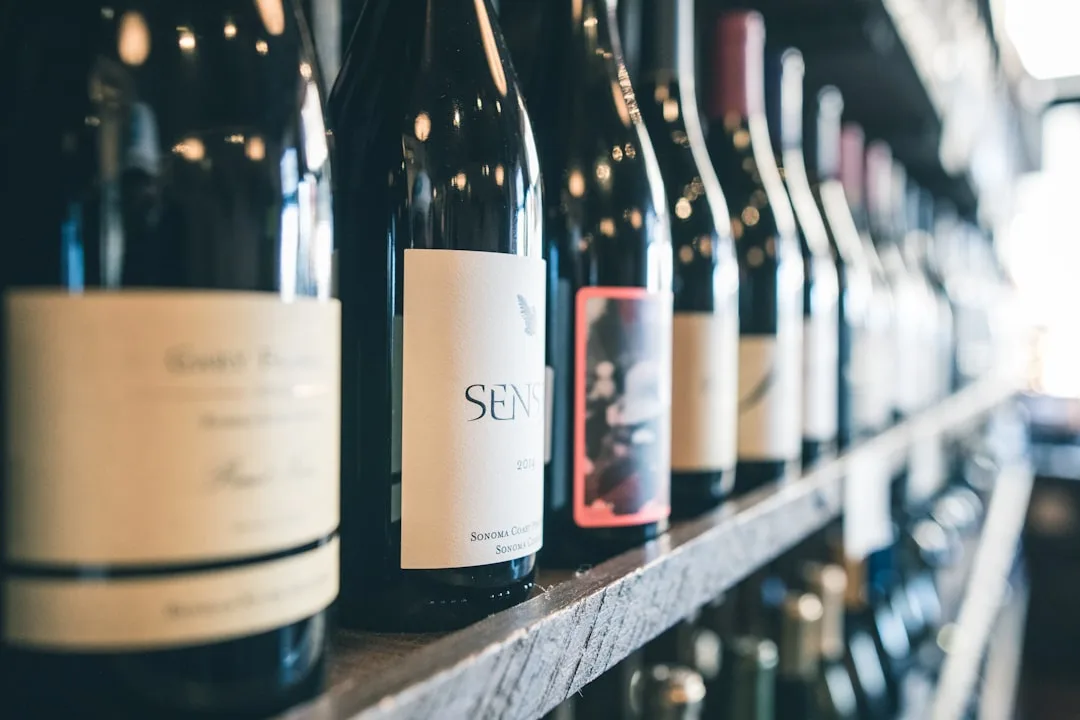
The US alcohol tax bureau keeps both values on its list of permitted wine bottle capacities, next to the metric 500 and 1,000 millilitres[6]. That is why a single shelf in the States can carry 473, 500 and 568 millilitre wine bottles side by side, each one the product of a different system.
Convert other units to Gallons
Convert Millilitres to other units
Sources
- NIST Special Publication 811, appendix B.9 — conversion factors — National Institute of Standards and Technology
- Weights and Measures Act 1985, Schedule 1 — legislation.gov.uk
- Gallon — Wikipedia
- Litre — Wikipedia
- NIST Handbook 44 – 2026, Appendix C. General Tables of Units of Measurement — National Institute of Standards and Technology
- Wine Labeling: Net Contents — authorized standards of fill — Alcohol and Tobacco Tax and Trade Bureau
- Wine bottle — Wikipedia
- Fifth (unit) — Wikipedia
Every figure in the tables was computed from the unit definitions and checked arithmetically before publication. Historical values and the names of local units come from the sources listed above.
Content last reviewed: · written and checked by the Arteon team
Frequently asked questions about millilitres and gallons
How many 750 ml bottles fill one gallon?
A US gallon holds 5.05 bottles of 750 millilitres, an imperial gallon 6.06. Five full bottles come to 3,750 millilitres, 35.41 millilitres short of a US gallon.
Why is 3,785 ml not quite a full gallon?
A US gallon is 3,785.41 millilitres, so 3,785 millilitres gives 0.999891 of a gallon. The missing 0.41 of a millilitre is less than a tenth of a teaspoon. Type 3,785.41 and the converter already shows a full 1 gallon.
How many gallons is 500 ml of water?
Half a litre, meaning 500 millilitres, is 0.132086 of a US gallon. Density makes no difference here, because the conversion is one of volume, so 500 millilitres of juice and of oil give the same number of gallons.
A question or a suggestion?
Write to us if the converter is missing a unit you need, or if one of the numbers here looks out of date.