Convert barrels to gallons
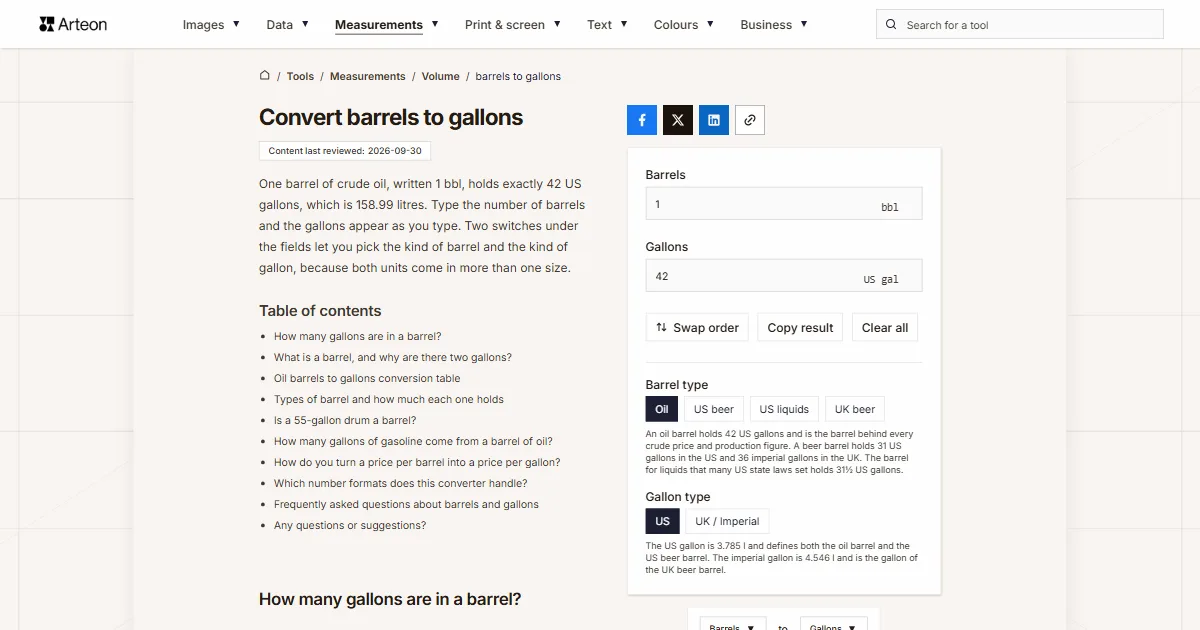
One barrel of crude oil, written 1 bbl, holds exactly 42 US gallons, which is 158.99 litres. Type the number of barrels and the gallons appear as you type. Two switches under the fields let you pick the kind of barrel and the kind of gallon, because both units come in more than one size.
How many gallons are in a barrel?
A barrel of oil holds 42 US gallons. That figure is a definition, not a rounded measurement, so the formula is simple: gallons = barrels × 42. Ten barrels make 420 gallons and a thousand barrels make 42,000 gallons[1].
Other barrels hold less or more. US federal tax on beer is based on a barrel of 31 gallons[2]. A British beer barrel holds 36 gallons, but they are imperial gallons, and each one is about a fifth bigger than a US gallon[3]. In US gallons that same barrel comes to 43.234.
You set both units with the switches under the fields. Barrel type offers Oil, US beer, US liquids and UK beer, and Gallon type offers US and UK / Imperial. Switch an oil barrel to imperial gallons and you get 34.972, while the symbol next to the result changes from US gal to UK gal.
To go the other way, use the gallons to barrels converter. If you need the gallon itself in metric, the gallons to litres converter has the same US and imperial switch.
What is a barrel, and why are there two gallons?
An oil barrel, symbol bbl, is a unit of volume rather than a container. Crude travels by pipeline and tanker, yet prices, output and reserves are still counted in barrels[3]. When a news report says a country pumps a million barrels a day, it means 42 million US gallons of crude.
The gallon comes in two sizes. The US gallon is 231 cubic inches, or 3.785 litres, while the British imperial gallon is defined as the volume of ten pounds of water and works out at 4.546 litres[1]. The oil barrel is defined in US gallons, so oil figures use them wherever they are published. Pick UK / Imperial when your figure comes from a British brewery or an older British document.
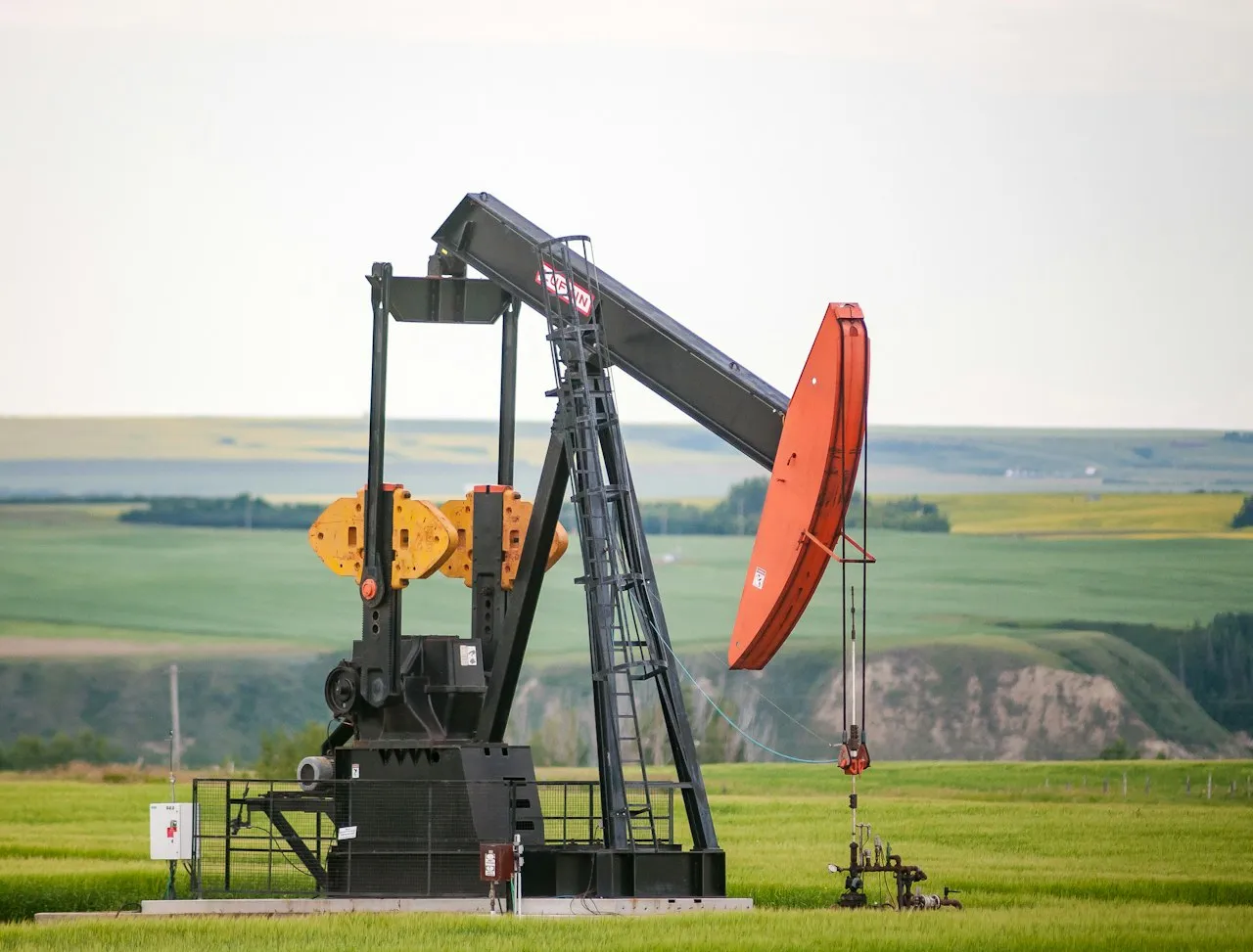
Why 42? After the first Pennsylvania well in 1859, crude was sold in barrels of any size, and buyers did not trust them. Around 1866 local producers agreed to sell by the gallon, and in 1872 their association adopted the 42-gallon barrel, the size of an old English wine cask called the tierce, as the standard[3].
Oil barrels to gallons conversion table
| Oil barrels | US gallons | Imperial gallons | Litres |
|---|---|---|---|
| 0.25 bbl | 10.5 US gal | 8.743 UK gal | 39.747 l |
| 0.5 bbl | 21 US gal | 17.486 UK gal | 79.494 l |
| 1 bbl | 42 US gal | 34.972 UK gal | 158.987 l |
| 2 bbl | 84 US gal | 69.945 UK gal | 317.975 l |
| 3 bbl | 126 US gal | 104.917 UK gal | 476.962 l |
| 4 bbl | 168 US gal | 139.889 UK gal | 635.949 l |
| 5 bbl | 210 US gal | 174.862 UK gal | 794.936 l |
| 6 bbl | 252 US gal | 209.834 UK gal | 953.924 l |
| 7 bbl | 294 US gal | 244.806 UK gal | 1,112.911 l |
| 8 bbl | 336 US gal | 279.779 UK gal | 1,271.898 l |
| 9 bbl | 378 US gal | 314.751 UK gal | 1,430.886 l |
| 10 bbl | 420 US gal | 349.723 UK gal | 1,589.873 l |
| 12 bbl | 504 US gal | 419.668 UK gal | 1,907.848 l |
| 15 bbl | 630 US gal | 524.585 UK gal | 2,384.809 l |
| 20 bbl | 840 US gal | 699.446 UK gal | 3,179.746 l |
| 25 bbl | 1,050 US gal | 874.308 UK gal | 3,974.682 l |
| 30 bbl | 1,260 US gal | 1,049.169 UK gal | 4,769.619 l |
| 40 bbl | 1,680 US gal | 1,398.893 UK gal | 6,359.492 l |
| 50 bbl | 2,100 US gal | 1,748.616 UK gal | 7,949.365 l |
| 60 bbl | 2,520 US gal | 2,098.339 UK gal | 9,539.238 l |
| 75 bbl | 3,150 US gal | 2,622.924 UK gal | 11,924.047 l |
| 100 bbl | 4,200 US gal | 3,497.232 UK gal | 15,898.729 l |
| 150 bbl | 6,300 US gal | 5,245.847 UK gal | 23,848.094 l |
| 200 bbl | 8,400 US gal | 6,994.463 UK gal | 31,797.459 l |
| 250 bbl | 10,500 US gal | 8,743.079 UK gal | 39,746.824 l |
| 300 bbl | 12,600 US gal | 10,491.695 UK gal | 47,696.188 l |
| 500 bbl | 21,000 US gal | 17,486.158 UK gal | 79,493.647 l |
| 750 bbl | 31,500 US gal | 26,229.237 UK gal | 119,240.471 l |
| 1,000 bbl | 42,000 US gal | 34,972.316 UK gal | 158,987.295 l |
| 2,000 bbl | 84,000 US gal | 69,944.632 UK gal | 317,974.59 l |
| 5,000 bbl | 210,000 US gal | 174,861.579 UK gal | 794,936.475 l |
| 10,000 bbl | 420,000 US gal | 349,723.158 UK gal | 1,589,872.949 l |
| 100,000 bbl | 4,200,000 US gal | 3,497,231.575 UK gal | 15,898,729.493 l |
| 1,000,000 bbl | 42,000,000 US gal | 34,972,315.754 UK gal | 158,987,294.928 l |
Types of barrel and how much each one holds
| Barrel | US gallons | Litres | Where it is used |
|---|---|---|---|
| Oil barrel (bbl) | 42 US gal | 158.987 l | Crude prices, production and reserves are quoted in it worldwide. |
| US beer barrel (US bbl) | 31 US gal | 117.348 l | US beer tax and keg sizes are based on it. |
| UK beer barrel (UK bbl) | 43.234 US gal | 163.659 l | British brewers use it, and it holds exactly 36 imperial gallons. |
| Barrel for liquids (fl bbl) | 31.5 US gal | 119.24 l | Many state laws fix the barrel for liquids at this size. |
| Proof spirits barrel | 40 US gal | 151.416 l | Federal law recognises this barrel for proof spirits. |
Is a 55-gallon drum a barrel?
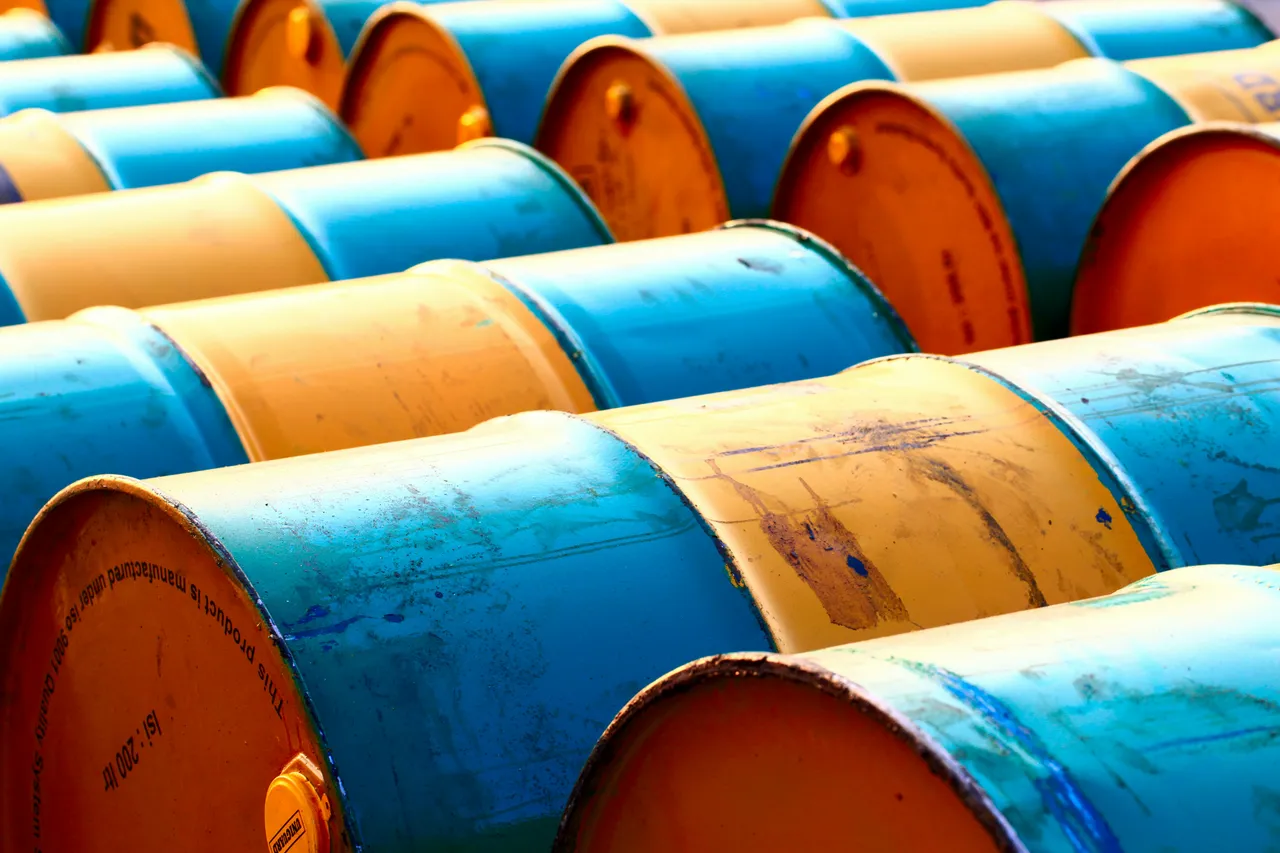
No. The steel drum used for oil and chemicals holds 55 US gallons in the United States and 200 litres elsewhere, so it is bigger than an oil barrel[3]. A 55-gallon drum is 1.3095 barrels, and a 200-litre drum is 52.83 US gallons, or 1.258 barrels.
So when someone points at a drum in a yard, they mean a container. When someone quotes the price of oil, they mean 42 gallons.
How many gallons of gasoline come from a barrel of oil?
| Product | Gallons | Litres |
|---|---|---|
| Motor gasoline | 19.57 gal | 74.081 l |
| Diesel and heating oil (distillates) | 12.47 gal | 47.204 l |
| Jet fuel | 4.41 gal | 16.694 l |
| Petroleum coke | 2.06 gal | 7.798 l |
| Still gas | 1.68 gal | 6.359 l |
| Propane, butane and other gas liquids | 1.55 gal | 5.867 l |
| Asphalt and road oil | 0.84 gal | 3.18 l |
| Residual fuel oil | 0.71 gal | 2.688 l |
| All products | 44.65 gal | 169.019 l |
How do you turn a price per barrel into a price per gallon?
Divide the barrel price by 42. At 70 dollars a barrel, a gallon of crude costs 1.67 dollars. In countries that sell fuel by the litre, such as the UK, Canada and Australia, divide by 158.99 instead, which gives 0.44 dollars a litre.
That is the price of the raw material, not of fuel at the pump. A gallon of gasoline also carries the cost of refining, transport, taxes and the retailer's margin, so the barrel price alone cannot tell you what you pay at the station.
Which number formats does this converter handle?
| What you type | What the converter shows | How we read it |
|---|---|---|
| 2.5 | 105 US gal | The decimal point is read the way English writes it. |
| 2,5 | 105 US gal | A comma pasted from a European document is read as a decimal point, so the result is the same. |
| 1,500 | 63000 US gal | Three digits follow the comma, so we read it as a thousands separator: the field holds fifteen hundred barrels. A note under the field shows the other possible reading, 1.5. |
| 3/4 | 31.5 US gal | We work out the fraction ourselves, so there is no need to turn it into a decimal first. |
| 3½ | 147 US gal | The ½ character copied from a document is added to the number in front of it. |
| 2.5 bbl | 105 US gal | A unit symbol pasted with the number is no trouble: we take the number and leave the symbol out. |
| 1.5 million | 63000000 US gal | The word million from a news story multiplies the number by a million, just as a reader would. |
| 5 Mbbl | 210000 US gal | In oil company reports M stands for a thousand, so we count five thousand barrels. |
| 250 MMbbl | 10500000000 US gal | A double M stands for a million, so a reserves figure like this counts as 250 million barrels. |
Convert other units to Gallons
Convert Barrels to other units
Sources
- Handbook 44 – 2026, Appendix C. General Tables of Units of Measurement — National Institute of Standards and Technology
- 27 CFR 25.11, Meaning of terms — Electronic Code of Federal Regulations
- Barrel (unit) — Wikipedia
- Refining crude oil: inputs and outputs — U.S. Energy Information Administration
Every figure in the tables was computed from the unit definitions and checked arithmetically before publication. Historical values and the names of local units come from the sources listed above.
Content last reviewed: · written and checked by the Arteon team
Frequently asked questions about barrels and gallons
What does bbl stand for?
Bbl is the abbreviation for barrel. The double b is usually explained as a plural (1 bl, 2 bbl) or as a way to keep it apart from bl, the symbol for a bale. The popular story about Standard Oil's blue barrels is unlikely, because bbl was in use before the US oil industry began in 1859[3].
What do Mbbl and MMbbl mean?
Mbbl is a thousand barrels and MMbbl a million. The M comes from the Latin mille, so it has nothing to do with the SI prefix mega, and the Society of Petroleum Engineers advises writing the numbers out in full to avoid the mix-up[3]. The converter's field understands both forms.
How many gallons per minute is one barrel per day?
One barrel a day is 42 gallons every 24 hours, or 0.0292 gallons per minute[3]. A field producing a million barrels a day therefore delivers 42 million gallons of crude daily.
How much does a barrel of oil weigh?
It depends on the crude. A tonne of oil usually fills between 6 and 8 barrels[3], so one barrel weighs roughly 125 to 167 kilograms, or about 276 to 367 pounds. Light crude sits near the lower end and heavy crude near the upper end.
How many gallons is a firkin?
A firkin holds 9 imperial gallons, a quarter of a UK beer barrel[3]. That is 40.915 litres, or 72 imperial pints.
Any questions or suggestions?
Write to us if the converter is missing a barrel or unit you need, or if any figure here looks out of date.