Convert US cups to gallons
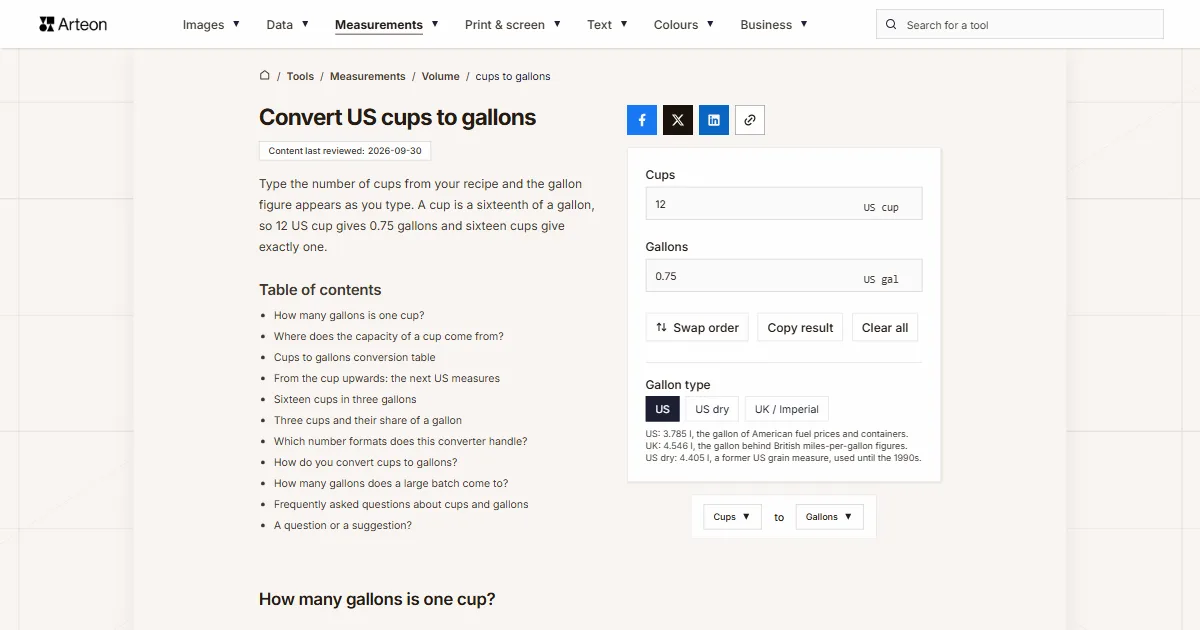
Type the number of cups from your recipe and the gallon figure appears as you type. A cup is a sixteenth of a gallon, so 12 US cup gives 0.75 gallons and sixteen cups give exactly one.
How many gallons is one cup?
One US cup is 0.0625 gallons, a sixteenth of a gallon. To turn cups into gallons, divide the number by sixteen: gallons = cups ÷ 16. Sixteen cups therefore make exactly one gallon.
Four cups give 0.25 gallons, which is one quart. Eight cups give half a gallon. Twelve cups give 0.75 gallons. The basis is in the definitions: NIST tables describe the cup as eight fluid ounces and the gallon as 128 fluid ounces[1], so dividing one by the other gives sixteen.
The Gallon type switch under the fields changes the measure of the answer. With the US dry gallon the same sixteen cups give 0.8594 gallons, and with the imperial gallon 0.8327 gallons, because both are larger than the American one. The US gallon is set by default. The conversion the other way round is in the gallons to cups converter.
Where does the capacity of a cup come from?
The capacity of a cup follows straight from the gallon. The American gallon is exactly 231 cubic inches and the inch is exactly 2.54 centimetres, so the gallon holds 3785.411784 millilitres. Divide that by sixteen and 236.5882365 millilitres are left, which is the full, unrounded capacity of the cup[1].
Smaller kitchen measures describe the same unit. A US cup is eight fluid ounces, sixteen tablespoons or forty-eight teaspoons. Sets of dry measuring cups usually come in 1/4, 1/3, 1/2 and 1 cup[2], and the field on this page takes those fractions directly.
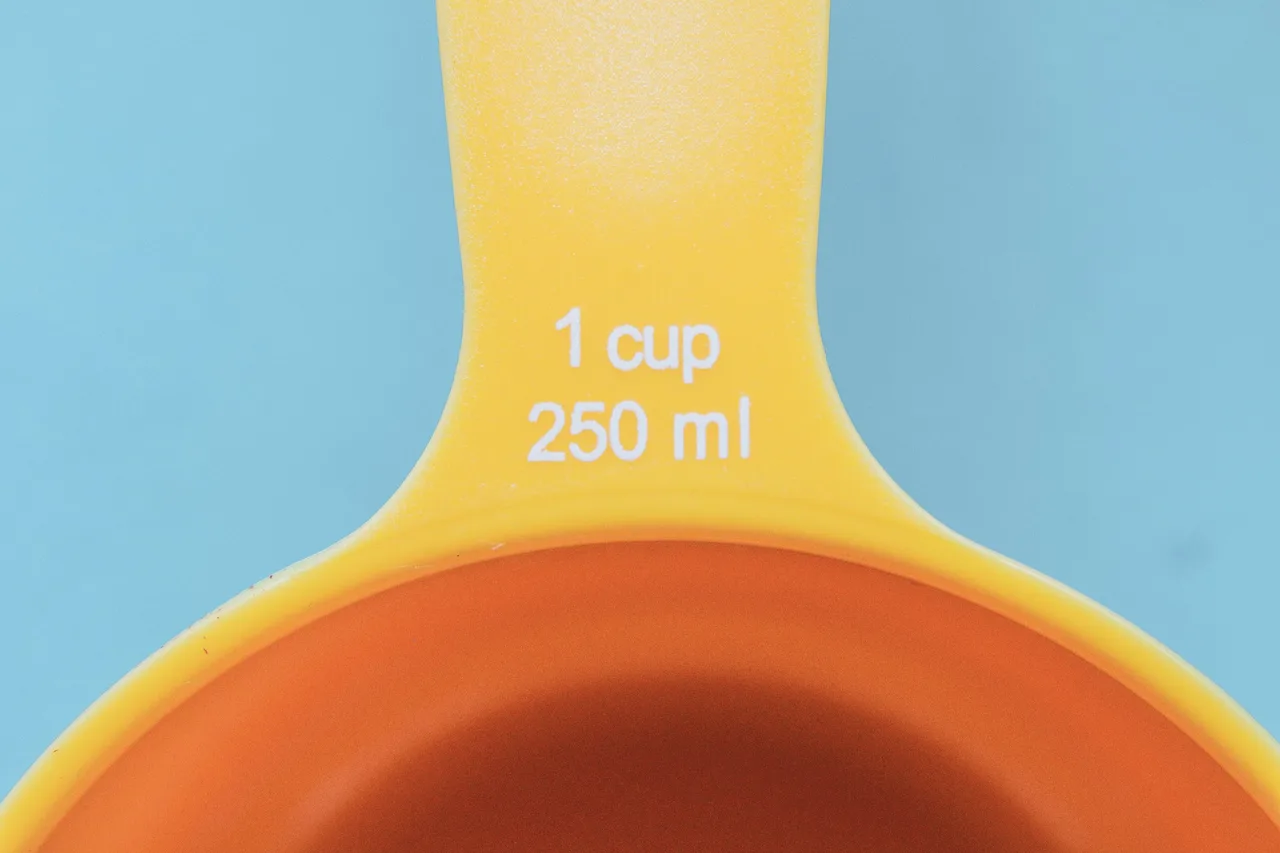
The cup itself has three values today and only one of them comes from the gallon. The labelling cup holds 240 millilitres, a figure set in American food-labelling law. The metric cup holds exactly 250 millilitres and is used in Australia, Canada and New Zealand[3]. Their capacities go through the cups to ml converter.
Cups to gallons conversion table
| Cups | Gallons | Litres |
|---|---|---|
| 1 cup | 0.0625 gal | 0.24 l |
| 2 cups | 0.125 gal | 0.47 l |
| 3 cups | 0.1875 gal | 0.71 l |
| 4 cups | 0.25 gal | 0.95 l |
| 5 cups | 0.3125 gal | 1.18 l |
| 6 cups | 0.375 gal | 1.42 l |
| 7 cups | 0.4375 gal | 1.66 l |
| 8 cups | 0.5 gal | 1.89 l |
| 9 cups | 0.5625 gal | 2.13 l |
| 10 cups | 0.625 gal | 2.37 l |
| 11 cups | 0.6875 gal | 2.6 l |
| 12 cups | 0.75 gal | 2.84 l |
| 13 cups | 0.8125 gal | 3.08 l |
| 14 cups | 0.875 gal | 3.31 l |
| 15 cups | 0.9375 gal | 3.55 l |
| 16 cups | 1 gal | 3.79 l |
| 18 cups | 1.125 gal | 4.26 l |
| 20 cups | 1.25 gal | 4.73 l |
| 24 cups | 1.5 gal | 5.68 l |
| 27 cups | 1.6875 gal | 6.39 l |
| 30 cups | 1.875 gal | 7.1 l |
| 32 cups | 2 gal | 7.57 l |
| 36 cups | 2.25 gal | 8.52 l |
| 40 cups | 2.5 gal | 9.46 l |
| 48 cups | 3 gal | 11.36 l |
| 50 cups | 3.125 gal | 11.83 l |
| 60 cups | 3.75 gal | 14.2 l |
| 64 cups | 4 gal | 15.14 l |
| 80 cups | 5 gal | 18.93 l |
| 84 cups | 5.25 gal | 19.87 l |
| 96 cups | 6 gal | 22.71 l |
| 100 cups | 6.25 gal | 23.66 l |
| 128 cups | 8 gal | 30.28 l |
| 160 cups | 10 gal | 37.85 l |
| 192 cups | 12 gal | 45.42 l |
From the cup upwards: the next US measures
| Measure | Cups | Fluid ounces | Pints | Quarts | Gallons | Millilitres |
|---|---|---|---|---|---|---|
| Fluid ounce | 0.125 | 1 | 0.0625 | 0.03125 | 0.0078125 | 29.57 |
| Gill | 0.5 | 4 | 0.25 | 0.125 | 0.03125 | 118.29 |
| Cup | 1 | 8 | 0.5 | 0.25 | 0.0625 | 236.59 |
| Pint | 2 | 16 | 1 | 0.5 | 0.125 | 473.18 |
| Quart | 4 | 32 | 2 | 1 | 0.25 | 946.35 |
| Half gallon | 8 | 64 | 4 | 2 | 0.5 | 1,892.71 |
| Gallon | 16 | 128 | 8 | 4 | 1 | 3,785.41 |
Sixteen cups in three gallons
| Gallon | Capacity | 16 cups come to | 1 cup comes to |
|---|---|---|---|
| US liquid | 3.785411784 l | 1 gal | 0.0625 gal |
| US dry | 4.40488377086 l | 0.8594 gal | 0.0537 gal |
| Imperial (UK) | 4.54609 l | 0.8327 gal | 0.052 gal |
Three cups and their share of a gallon
| Cup | Capacity | Share of a US gallon | Per US gallon |
|---|---|---|---|
| US customary | 236.5882365 ml | 0.0625 | 16 |
| US legal (labelling) | 240 ml | 0.0634 | 15.7725 |
| Metric | 250 ml | 0.066 | 15.1416 |
Which number formats does this converter handle?
| What you type | What the converter shows | How we read it |
|---|---|---|
| 2.5 | 0.1563 US gal | The point is the decimal separator, so this is two and a half cups. |
| 2,5 | 0.1563 US gal | A comma followed by one digit is a European decimal comma, so we read it as two and a half. |
| 1,500 | 93.75 US gal | Three digits after the comma mark a thousands separator, so we count one thousand five hundred cups. A note under the field says: Read as 1500. If you meant 1.5, type 1.5. |
| 1 500 | 93.75 US gal | A space between the thousands is skipped, so this is one thousand five hundred cups as well. |
| 3/4 | 0.0469 US gal | We convert a fraction with a slash directly, so it doesn’t need to become 0.75 first. |
| 1½ | 0.0938 US gal | A ½ character copied from a recipe or a label is added to the number in front of it. |
| 2 cups | 0.125 US gal | A unit pasted along with the number doesn’t get in the way, so we count two cups. |
| 2 pt | 0.25 US gal | The field reads pt as the US pint, so two pints are four cups, which is a quarter of a gallon. |
How do you convert cups to gallons?
The arithmetic is one division, and the four steps cover fraction notation and the choice of gallon as well.
Add up the cups from the recipe or the shopping list
Cooking for a crowd gives a high total. Four cups of milk, six cups of juice and two cups of water come to twelve cups.Divide the total by sixteen
Twelve cups give 0.75 gallons. Sixteen cups give one gallon. Forty cups give 2.5 gallons. The converter does the division while you type, so the result is there without a button press.Enter a fraction of a cup with a slash or a decimal point
Half a cup written as 1/2 gives 0.0313 gallons, and three quarters written as 3/4 gives 0.0469 gallons. The mixed form 2 1/2, with a space between the whole number and the fraction, works too and gives 0.1563 gallons.Change the gallon only when the source calls for it
The Gallon type switch sits under both columns and sets the measure of the answer. The Swap order button moves you to converting gallons into cups, Copy result puts the figure on the clipboard, and Clear all empties both fields.
How many gallons does a large batch come to?
An American recipe gives amounts in cups and the shopping happens in gallons, and dividing by sixteen converts one into the other. Twelve cups of milk are 0.75 gallons, three quarters of a jug. Sixteen cups are one jug exactly. Twenty-four cups are a gallon and a half.
A party drink needs larger amounts. Forty cups of punch are 2.5 gallons. Eighty cups are five gallons, or 18.93 litres. A hundred and sixty cups come to ten gallons.
The same arithmetic answers the question about servings when you run it the other way. A 12-ounce cup holds one and a half US cups, so five gallons cover 53 full cups. A 16-ounce cup holds two, and the same five gallons cover 40 servings.
Convert other units to Gallons
Convert Cups to other units
Sources
- Handbook 44 – 2026, Appendix C. General Tables of Units of Measurement — National Institute of Standards and Technology
- Measuring cup — Wikipedia
- Cup (unit) — Wikipedia
- Gallon — Wikipedia
Every figure in the tables was computed from the unit definitions and checked arithmetically before publication. Historical values and the names of local units come from the sources listed above.
Content last reviewed: · written and checked by the Arteon team
Frequently asked questions about cups and gallons
How many gallons do twelve metric cups of 250 ml make?
0.7925 US gallons, because twelve metric cups are exactly 3 litres. Twelve US cups give 0.75 gallons, so the metric measure comes out 0.0425 gallons higher. To get the figure in the converter, type 12.68, because 3 litres are 12.68 US cups.
Do dry cups and liquid cups give different answers?
No, because both measure volume and a cup holds the same amount in either. They differ in how you fill them. A dry measuring cup is filled to the top and the excess is scraped off. Liquid measuring cups tend to be clear, so the level of the liquid is easier to judge[2].
Which gallon should I pick for British figures?
The imperial one, the UK / Imperial option in the Gallon type switch. It holds 4.54609 litres[4], so eight US cups come to 0.4163 imperial gallons against half a US gallon.
How many gallons are in a 2-litre bottle?
0.5283 US gallons. Two litres are 8.4535 US cups, and dividing that number by sixteen gives the same figure in gallons.
Can I convert cups straight into litres?
Yes. Sixteen cups are 3.7854 litres and a single cup 0.2366 litres. The figure in millilitres comes from the cups to ml converter, and dividing that result by a thousand gives litres.
A question or a suggestion?
Write to us if the converter is missing a unit you need, or if one of the figures looks out of date.