Convert pints to liters
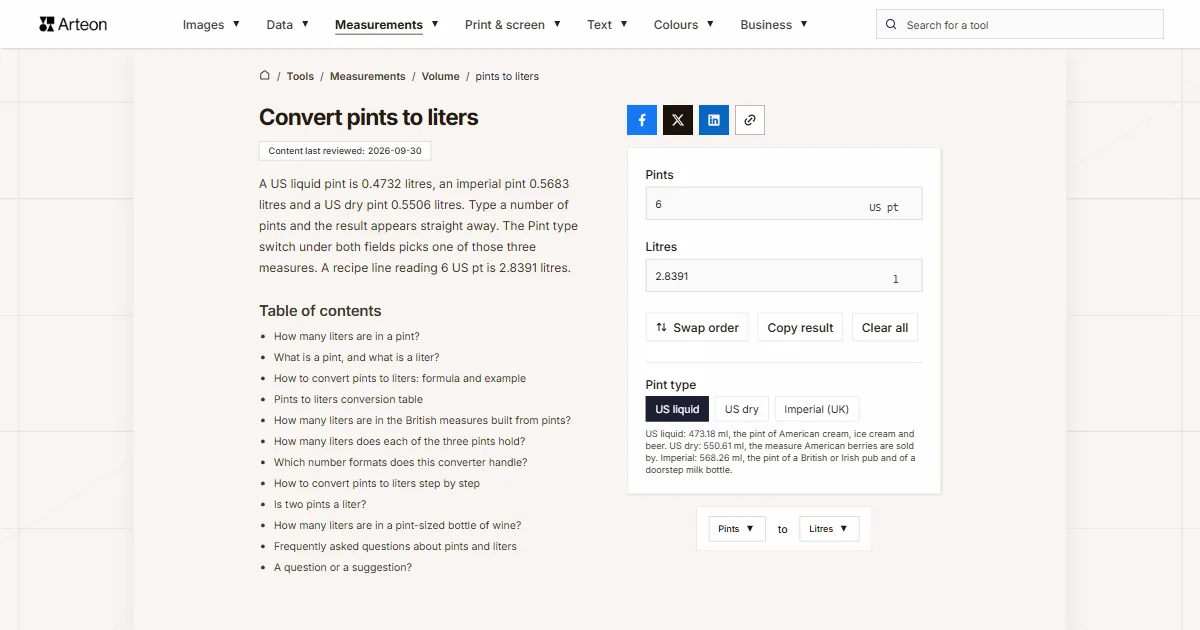
A US liquid pint is 0.4732 litres, an imperial pint 0.5683 litres and a US dry pint 0.5506 litres. Type a number of pints and the result appears straight away. The Pint type switch under both fields picks one of those three measures. A recipe line reading 6 US pt is 2.8391 litres.
How many liters are in a pint?
One US liquid pint is 0.4732 litres[1]. You multiply the number of pints by 0.473176473 and the answer comes out in litres.
That multiplier gives three values you meet across US volume measures. Two pints make 0.9464 litres and together form one quart. Four pints come to 1.8927 litres. Eight pints make up the US gallon, which holds 3.7854 litres.
The pint poured in a British pub is larger. An imperial pint holds 0.56826125 litres, the figure set by the British weights and measures act[2]. Two of those pints come to 1.1365 litres. Eight imperial pints are 4.5461 litres, a full imperial gallon. The third measure, the US dry pint, holds 0.5506 litres.
You pick the measure with the Pint type switch under the fields, and the multiplier changes with it. The result field gives litres to four decimal places.
What is a pint, and what is a liter?
The litre is a metric measure and holds the volume of a cube one decimetre, or ten centimetres, on a side[1]. It holds exactly one thousand millilitres, so every step inside the metric measures is a move of the decimal point.
The pint belongs to another system. It is an eighth of a gallon, and the gallon has several definitions, so the pint has just as many. The US liquid gallon measures 231 cubic inches, and that is where the pint of 0.4732 litres comes from[1]. The British act fixes the imperial gallon at 4.54609 cubic decimetres, so an eighth of it is 0.56826125 litres[2].
The third pint comes from the US series of dry measures and holds 0.5506 litres[1]. The British tables apply the same measures of capacity to liquid and to dry goods, and they say so outright[1].
The pint is one of the few imperial measures British rules kept for trade: draught beer and cider may be dispensed by the pint, and milk may be sold by the pint in returnable containers[3]. The same pint in millilitres is shown by the pints to ml converter.
How to convert pints to liters: formula and example
One multiplication does the whole job. You multiply the number of pints by 0.473176473 and the answer comes out in litres.
Take a US recipe for lemonade that calls for six pints of water. Six pints times 0.473176473 gives 2.8391 litres. Two 1.5-litre bottles cover that amount. The first gives 1.5 litres and you measure the remaining 1.3391 litres out of the second.
Writing the units out shows why the answer lands in litres: 6 pt × (0.473176473 l ÷ 1 pt) = 2.8391 l. The pint appears twice in that line, once above the bar and once below it, so it cancels and litres are what remain.
For the imperial pint the multiplier is 0.56826125, and for the US dry pint it is 0.5506104713575. The Pint type switch substitutes the right figure on its own, and it recalculates even when you change the measure after typing the number.
The liters to pints converter does the sum the other way round, and the pints to quarts converter gives the same pints in quarts.
Pints to liters conversion table
| Pints | US liquid | US dry | Imperial |
|---|---|---|---|
| 0.25 pt | 0.1183 l | 0.1377 l | 0.1421 l |
| 0.5 pt | 0.2366 l | 0.2753 l | 0.2841 l |
| 0.75 pt | 0.3549 l | 0.4130 l | 0.4262 l |
| 1 pt | 0.4732 l | 0.5506 l | 0.5683 l |
| 1.5 pt | 0.7098 l | 0.8259 l | 0.8524 l |
| 2 pt | 0.9464 l | 1.1012 l | 1.1365 l |
| 2.5 pt | 1.1829 l | 1.3765 l | 1.4207 l |
| 3 pt | 1.4195 l | 1.6518 l | 1.7048 l |
| 4 pt | 1.8927 l | 2.2024 l | 2.2730 l |
| 5 pt | 2.3659 l | 2.7531 l | 2.8413 l |
| 6 pt | 2.8391 l | 3.3037 l | 3.4096 l |
| 7 pt | 3.3122 l | 3.8543 l | 3.9778 l |
| 8 pt | 3.7854 l | 4.4049 l | 4.5461 l |
| 8.5 pt | 4.0220 l | 4.6802 l | 4.8302 l |
| 9 pt | 4.2586 l | 4.9555 l | 5.1144 l |
| 10 pt | 4.7318 l | 5.5061 l | 5.6826 l |
| 10.5 pt | 4.9684 l | 5.7814 l | 5.9667 l |
| 12 pt | 5.6781 l | 6.6073 l | 6.8191 l |
| 20 pt | 9.4635 l | 11.0122 l | 11.3652 l |
| 21 pt | 9.9367 l | 11.5628 l | 11.9335 l |
| 30 pt | 14.1953 l | 16.5183 l | 17.0478 l |
| 35 pt | 16.5612 l | 19.2714 l | 19.8891 l |
| 50 pt | 23.6588 l | 27.5305 l | 28.4131 l |
| 80 pt | 37.8541 l | 44.0488 l | 45.4609 l |
How many liters are in the British measures built from pints?
| British measure | Pints | Litres |
|---|---|---|
| Gill | 0.25 | 0.1421 l |
| Pint | 1 | 0.5683 l |
| Quart | 2 | 1.1365 l |
| Gallon | 8 | 4.5461 l |
| Peck | 16 | 9.0922 l |
| Bushel | 64 | 36.3687 l |
| Quarter | 512 | 290.9498 l |
How many liters does each of the three pints hold?
| Pint type | Litres | Where it comes from | Switch option |
|---|---|---|---|
| US liquid | 0.473176473 l | An eighth of the US gallon of 231 cubic inches | US liquid |
| US dry | 0.5506104713575 l | Half of the US dry quart from the series of dry measures | US dry |
| Imperial | 0.56826125 l | An eighth of the imperial gallon of 4.54609 cubic decimetres | Imperial (UK) |
Which number formats does this converter handle?
| What you type | What the converter shows | How we read it |
|---|---|---|
| 2.5 | 1.1829 l | The point is the decimal separator, so this is two and a half pints. |
| 2,5 | 1.1829 l | A comma followed by one digit is a European decimal comma, so we read it as two and a half. |
| 1,500 | 709.7647 l | Three digits after the comma mark a thousands separator, so we count one thousand five hundred pints. A note under the field says: Read as 1500. If you meant 1.5, type 1.5. |
| 1 500 | 709.7647 l | A space between the thousands is skipped, so this is one thousand five hundred pints as well. |
| 3/4 | 0.3549 l | We convert a fraction with a slash directly, so it doesn’t need to become 0.75 first. |
| 1½ | 0.7098 l | A ½ character copied from a recipe or a label is added to the number in front of it. |
| 2 pt | 0.9464 l | A unit pasted along with the number is ignored, and we convert the value alone. |
How to convert pints to liters step by step
The first four steps go through the converter, and the last one moves the same arithmetic into a spreadsheet for when you have more than one figure.
Work out where the number of pints comes from
A US recipe and the label on a liquid from the United States describe the US liquid pint. Draught beer and cider, and milk in a returnable bottle from the United Kingdom, describe the imperial pint. The US series of dry measures describes the dry pint.Set that measure with the Pint type switch
The switch sits under both fields and has three buttons: US liquid, US dry and Imperial (UK). The line beneath them gives the capacity of each of those pints, so you can see the choice before you type a number.Type the number of pints
The result appears as you type. The field takes a decimal point and a comma, and it takes a fraction with a slash, so 2 1/2 gives the same answer as 2.5.Read the litres and take them further
The Copy result button puts the figure on the clipboard. The Swap order button turns the page round to converting litres into pints, and Clear all empties both fields before the next sum.Convert a whole column in a spreadsheet
In Excel this is the CONVERT function, with the syntax CONVERT(number,from_unit,to_unit). Writing =CONVERT(A2,"pt","l") converts the US pint, and =CONVERT(A2,"uk_pt","l") the imperial one. Write the unit codes in lower case, because the function is case sensitive[4].
Is two pints a liter?
Two US pints are 0.9464 litres. A full litre is 0.0536 litres away, just under 54 millilitres.
With the imperial pint the same sum comes out on the other side. Two imperial pints give 1.1365 litres, which is 0.1365 litres more than a litre. That surplus is over thirteen percent of a litre.
The more pints there are, the wider the gap between the two measures. Ten imperial pints are 5.6826 litres and ten US pints are 4.7318 litres. Between those two figures lie 0.9508 litres, a shade more than two US pints hold.
How many liters are in a pint-sized bottle of wine?
0.5683 litres. Since 19 September 2024, British rules allow 568 millilitres as a quantity in which prepacked still wine and sparkling wine may be sold[5]. The same change added 200 millilitres for still wine and 500 millilitres for sparkling wine.
568 millilitres is one imperial pint, so the bottle carries the capacity a pub glass carries. A standard wine bottle holds 0.75 litres, which is 0.1817 litres more.
The United States allows the same size: its federal list of wine bottle sizes carries 568 millilitres, and next to it 473 millilitres, which is the US pint[6]. On a British shelf the figure is a full imperial pint written in millilitres.
Convert other units to Litres
Convert Pints to other units
Sources
- Handbook 44 – 2026, Appendix C. General Tables of Units of Measurement — National Institute of Standards and Technology
- Weights and Measures Act 1985, Schedule 1 — legislation.gov.uk
- The Units of Measurement Regulations 1995 — legislation.gov.uk
- CONVERT function — Microsoft
- The Weights and Measures (Intoxicating Liquor) (Amendment) Regulations 2024 — legislation.gov.uk
- Authorized standards of fill for wine, 27 CFR 4.72 — Code of Federal Regulations
- Units of measurement used to sell draft beer — Measurement Canada
Every figure in the tables was computed from the unit definitions and checked arithmetically before publication. Historical values and the names of local units come from the sources listed above.
Content last reviewed: · written and checked by the Arteon team
Frequently asked questions about pints and liters
Is a Canadian pint the same measure as a British one?
Yes. Measurement Canada authorises the Canadian (imperial) pint of 568 mL or 20 imperial fluid ounces for selling draft beer, and lists the US customary pint of 473 mL among the units that are not authorised[7]. In the switch it is the Imperial (UK) option.
Why does the result carry four decimal places?
Four places keep the three pints apart even at small counts. A quarter of a pint is 0.1183 litres for the US liquid pint, 0.1377 litres for the dry pint and 0.1421 litres for the imperial pint. At two decimal places two of those three would both read 0.14 litres.
A question or a suggestion?
Write to us if the converter is missing a unit you need, or if one of the numbers here looks out of date.