Convert liters to deciliters
One litre is 10 decilitres, so you multiply the number of litres by ten. Type a value and the result appears as you type. A 1.5 l bottle holds 15 dl, half a litre is 5 dl and a 0.25 l glass holds 2.5 dl. One decilitre also equals 100 millilitres, or 10 centilitres.
What is a liter and what is a deciliter?
A litre is the volume of a cube ten centimetres on each side, which is one cubic decimetre.[1] Metric prefixes build smaller and larger units from it, from the millilitre to the hectolitre.
The decilitre comes from one of those prefixes. Deci stands for one tenth, exactly 10⁻¹, and its symbol is the letter d.[2] Placed in front of the litre symbol it gives a unit worth a tenth of a litre, written dl.
The litre itself has two accepted symbols. The lower-case l was adopted in 1879, and the capital L was added a century later, in 1979, so that the symbol would not be read as the digit one.[3] NIST names the capital L as the preferred symbol in the United States.[1]
How many deciliters are in a liter?
A litre holds exactly 10 decilitres. The ratio is exact and holds in every country, because both units belong to the same system of measurement and the decilitre is simply a litre split into ten equal parts.
Everything else follows from that. Half a litre is 5 decilitres. A 0.75 litre wine bottle holds 7.5 decilitres. A 1.5 litre water bottle gives 15 decilitres, and a 0.25 litre glass gives 2.5 decilitres.
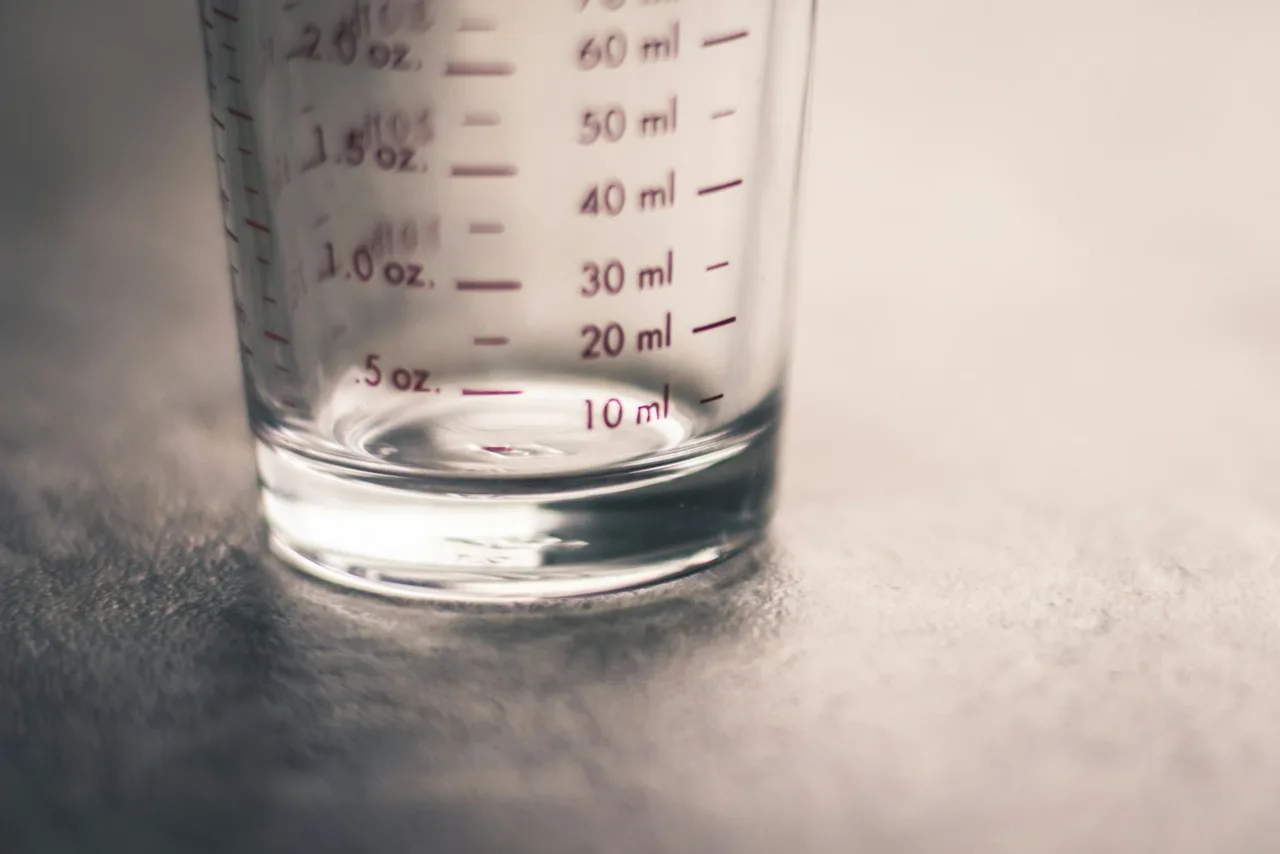
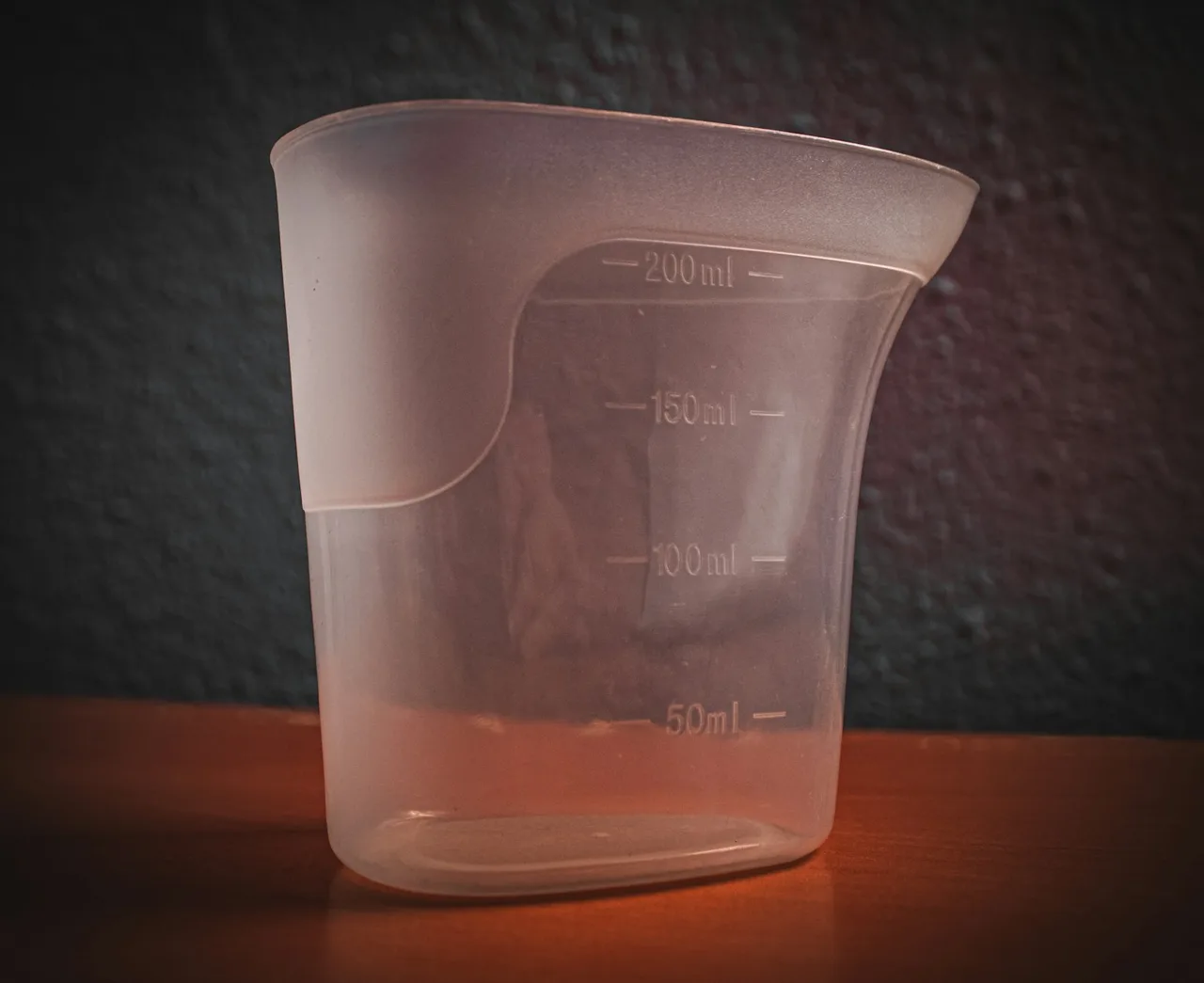
Millilitres are the other side of the same ratio. Since a litre contains 1,000 millilitres and also 10 decilitres, one decilitre works out at 100 millilitres. A kitchen jug graduated every 100 millilitres therefore measures whole decilitres, even though millilitres are what is printed on the side.
A decilitre is a hundred times larger than a millilitre and ten times smaller than a litre. A few hundred millilitres therefore take a single digit: 300 ml is 3 dl and 700 ml is 7 dl.
How do you convert liters to deciliters?
The formula has one step: deciliters = liters × 10. Multiplying by ten moves the decimal point one place to the right, so 2.2 litres is 22 decilitres and 0.3 litres is 3 decilitres.
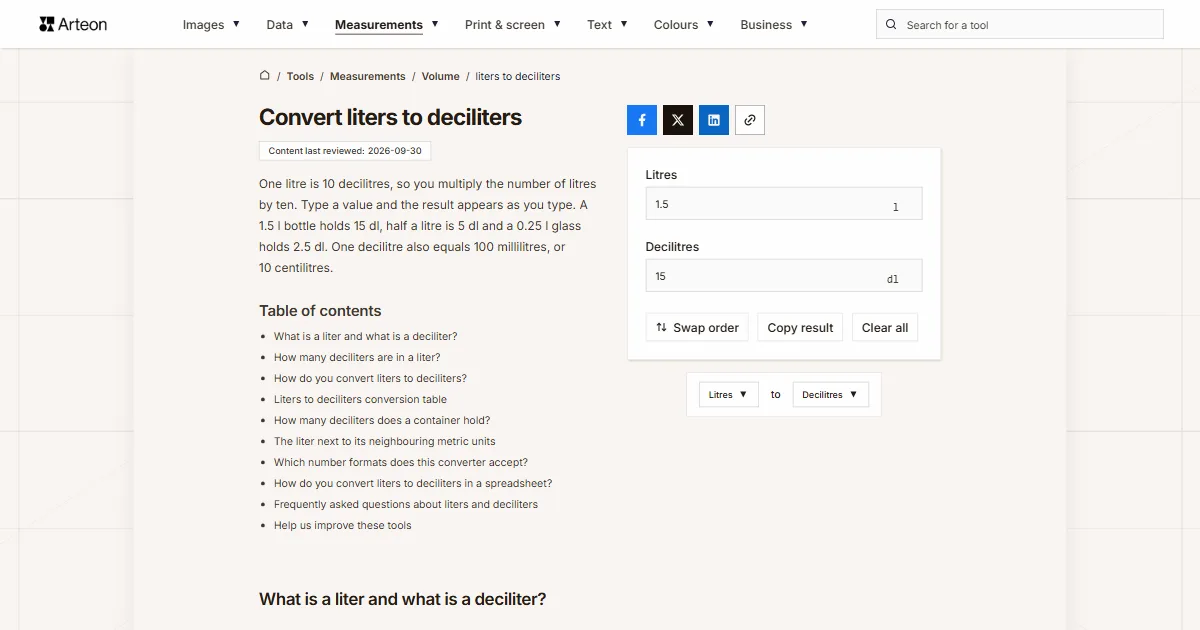
For a single value, moving the decimal point in your head is quicker. For a recipe scaled to a different number of servings, or for a list of capacities, the field above is faster because it answers as soon as you type.
If your figure is already in decilitres and you need litres, go to the deciliters to liters converter. Millilitres from the same family are handled by the liters to ml converter.
Liters to deciliters conversion table
| Liters | Deciliters | Milliliters |
|---|---|---|
| 0.05 l | 0.5 dl | 50 ml |
| 0.1 l | 1 dl | 100 ml |
| 0.2 l | 2 dl | 200 ml |
| 0.25 l | 2.5 dl | 250 ml |
| 0.3 l | 3 dl | 300 ml |
| 0.33 l | 3.3 dl | 330 ml |
| 0.4 l | 4 dl | 400 ml |
| 0.5 l | 5 dl | 500 ml |
| 0.6 l | 6 dl | 600 ml |
| 0.7 l | 7 dl | 700 ml |
| 0.75 l | 7.5 dl | 750 ml |
| 0.8 l | 8 dl | 800 ml |
| 0.9 l | 9 dl | 900 ml |
| 1 l | 10 dl | 1,000 ml |
| 1.25 l | 12.5 dl | 1,250 ml |
| 1.5 l | 15 dl | 1,500 ml |
| 1.75 l | 17.5 dl | 1,750 ml |
| 2 l | 20 dl | 2,000 ml |
| 2.2 l | 22 dl | 2,200 ml |
| 2.5 l | 25 dl | 2,500 ml |
| 3 l | 30 dl | 3,000 ml |
| 3.5 l | 35 dl | 3,500 ml |
| 4 l | 40 dl | 4,000 ml |
| 5 l | 50 dl | 5,000 ml |
| 10 l | 100 dl | 10,000 ml |
| 100 l | 1,000 dl | 100,000 ml |
How many deciliters does a container hold?
| Container | Liters | Deciliters |
|---|---|---|
| Juice box | 0.2 l | 2 dl |
| Small drinking glass | 0.25 l | 2.5 dl |
| European drinks can | 0.33 l | 3.3 dl |
| Half-litre water bottle | 0.5 l | 5 dl |
| Wine bottle | 0.75 l | 7.5 dl |
| Carton of milk | 1 l | 10 dl |
| Large water bottle | 1.5 l | 15 dl |
| Bottle of soda | 2 l | 20 dl |
The liter next to its neighbouring metric units
| Unit | In liters | In deciliters |
|---|---|---|
| Milliliter (ml) | 0.001 l | 0.01 dl |
| Centiliter (cl) | 0.01 l | 0.1 dl |
| Deciliter (dl) | 0.1 l | 1 dl |
| Liter (l) | 1 l | 10 dl |
| Decaliter (dal) | 10 l | 100 dl |
| Hectoliter (hl) | 100 l | 1,000 dl |
Which number formats does this converter accept?
| What you type | What the converter shows | How we read it |
|---|---|---|
| 1.5 | 15 dl | A number on its own is read as litres, because that is the unit on the field. |
| 1.5l | 15 dl | The l symbol pasted with the number, with or without a space, is skipped, and so is the word litres. |
| 0.75 | 7.5 dl | The decimal point separates the fraction, exactly as you would expect. |
| 0,75 | 7.5 dl | A comma followed by one or two digits can only be a decimal comma, so the result is the same. |
| 1,500 | 15,000 dl | A comma before three digits groups thousands in English, so this is fifteen hundred litres. A note under the field shows the other possible reading, 1.5. |
| 1.500 | 15 dl | A single point is always read as a decimal point, so the field counts one and a half litres. A note under the field shows the other possible reading, 1500. |
| 1 500 | 15,000 dl | A space between the thousands, as written in much of Europe and in SI style, gives the same result as 1,500. |
| 3/4 | 7.5 dl | We work out a fraction with a slash for you, so three quarters of a litre needs no conversion to 0.75 first. |
| 1 1/2 | 15 dl | A mixed number is read as one and a half litres. |
| 2½ | 25 dl | A ½ sign copied from a label or a recipe is added to the number in front of it. |
| 330 ml | 3.3 dl | Millilitres from a can are converted to litres: the field enters 0.33 and says so in a line under it. |
How do you convert liters to deciliters in a spreadsheet?
For one value the field above is quicker. For a whole column of capacities a spreadsheet does it with a single formula dragged down.
Excel: the CONVERT function
The formula reads CONVERT(number, from_unit, to_unit). The litre carries the code "l" and the decilitre is built by adding the prefix "d", so for a value in cell A1 you type =CONVERT(A1,"l","dl"). The documentation states outright that these prefixes may precede any metric unit[4].Plain multiplication, if you would rather skip the function
The formula =A1*10 gives the same answer and works in every spreadsheet, including Google Sheets and LibreOffice Calc. It has the advantage of showing the whole operation, so it is easy to check by eye.Three units in three columns
If the sheet should show litres, decilitres and millilitres side by side, put =A1*10 in column B and =A1*1000 in column C. Both read the same cell A1, so correcting a capacity updates the whole row.Check the formula on one cell first
Before you drag the formula down the column, type 1 into cell A1 and confirm the result is exactly 10. If you use CONVERT, the #N/A error means the function did not recognise a unit. Unit names are case-sensitive, so type the decilitre prefix as a lower-case d.[4]
Convert other units to Decilitres
Convert Litres to other units
Sources
- NIST Special Publication 330, section 4 — non-SI units accepted for use with the SI — National Institute of Standards and Technology
- Metric (SI) prefixes — National Institute of Standards and Technology
- Litre — Wikipedia
- CONVERT function — Microsoft
Every figure in the tables was computed from the unit definitions and checked arithmetically before publication. Historical values and the names of local units come from the sources listed above.
Content last reviewed: · written and checked by the Arteon team
Frequently asked questions about liters and deciliters
How many deciliters are in a cup?
A US customary cup of 236.6 millilitres is about 2.37 decilitres, and a metric cup of 250 millilitres is 2.5 decilitres. The ml to cups converter also offers the 240 ml US legal cup.
How is the deciliter abbreviated?
The symbol is dl, the prefix d placed in front of the litre symbol. Because the litre also takes a capital L, you will see dL as well, and both stand for the same tenth of a litre.
How many cubic centimeters are in a deciliter?
A decilitre is 100 cubic centimetres. A litre is one cubic decimetre, which is 1,000 cubic centimetres, and a decilitre is a tenth of that.[1]
Help us improve these tools
Have an idea for a feature, spotted a mistake or want to suggest another tool? Write to us.