Convert pints to millilitres
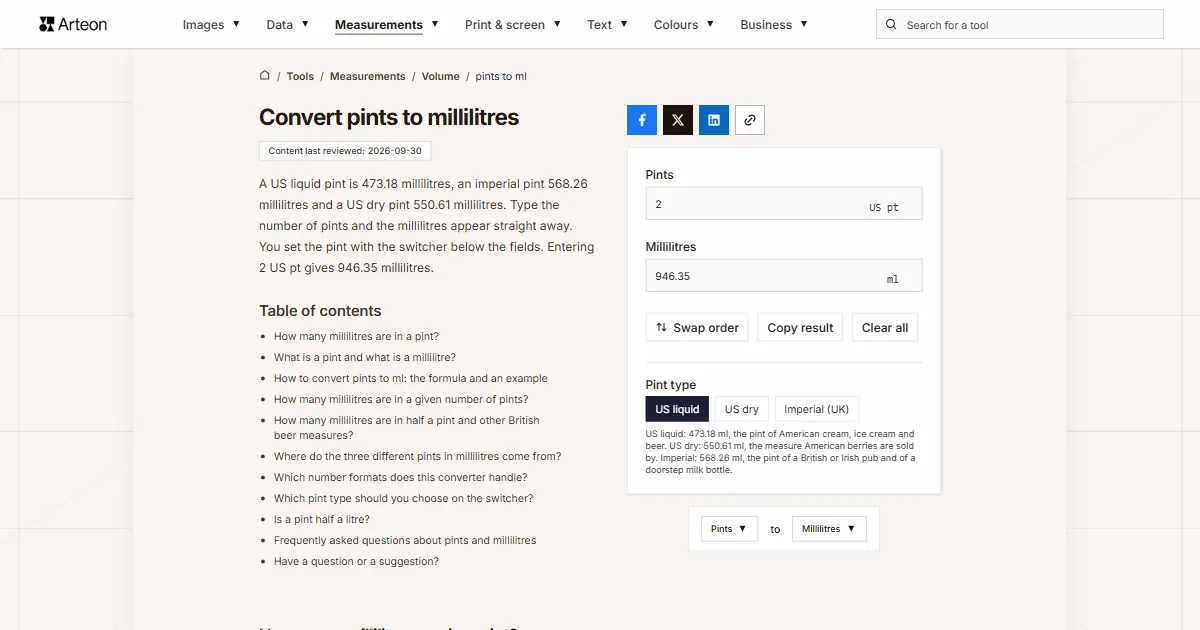
A US liquid pint is 473.18 millilitres, an imperial pint 568.26 millilitres and a US dry pint 550.61 millilitres. Type the number of pints and the millilitres appear straight away. You set the pint with the switcher below the fields. Entering 2 US pt gives 946.35 millilitres.
How many millilitres are in a pint?
One US liquid pint is 473.18 millilitres[1]. Multiply the number of pints by 473.176473: millilitres = pints × 473.176473.
That multiplier gives four values that come in handy with an American recipe. Half a pint is 236.59 millilitres, the same as one cup. One and a half pints is 709.76 millilitres. Two pints make 946.35 millilitres and add up to one quart[1]. Eight pints form a US gallon of 3,785.41 millilitres.
A pint from the United Kingdom is larger. The imperial pint holds 568.26 millilitres[2]. That is 95.08 millilitres more than the US pint. The third measure, the US dry pint, holds 550.61 millilitres. You choose the measure with the Pint type switcher below the fields, and the multiplier changes with it.
The millilitres to pints converter handles the reverse calculation, and the pints to cups converter shows the same pint in cups.
What is a pint and what is a millilitre?
A pint is one eighth of a gallon. The US liquid gallon is 231 cubic inches, so a pint takes up 28.875 cubic inches and divides into 16 fluid ounces[1]. Converting those cubic inches to cubic centimetres gives 473.176473 millilitres[2].
The British imperial system also splits the gallon into eight pints, and its gallon holds 160 fluid ounces. One imperial pint is therefore 20 British fluid ounces[1] and 568.26125 millilitres[2].
The US dry pint belongs to a separate series of dry measures, in which two pints make a dry quart of 67.2006 cubic inches[1]. In millilitres the dry pint comes to 550.6104713575[2].
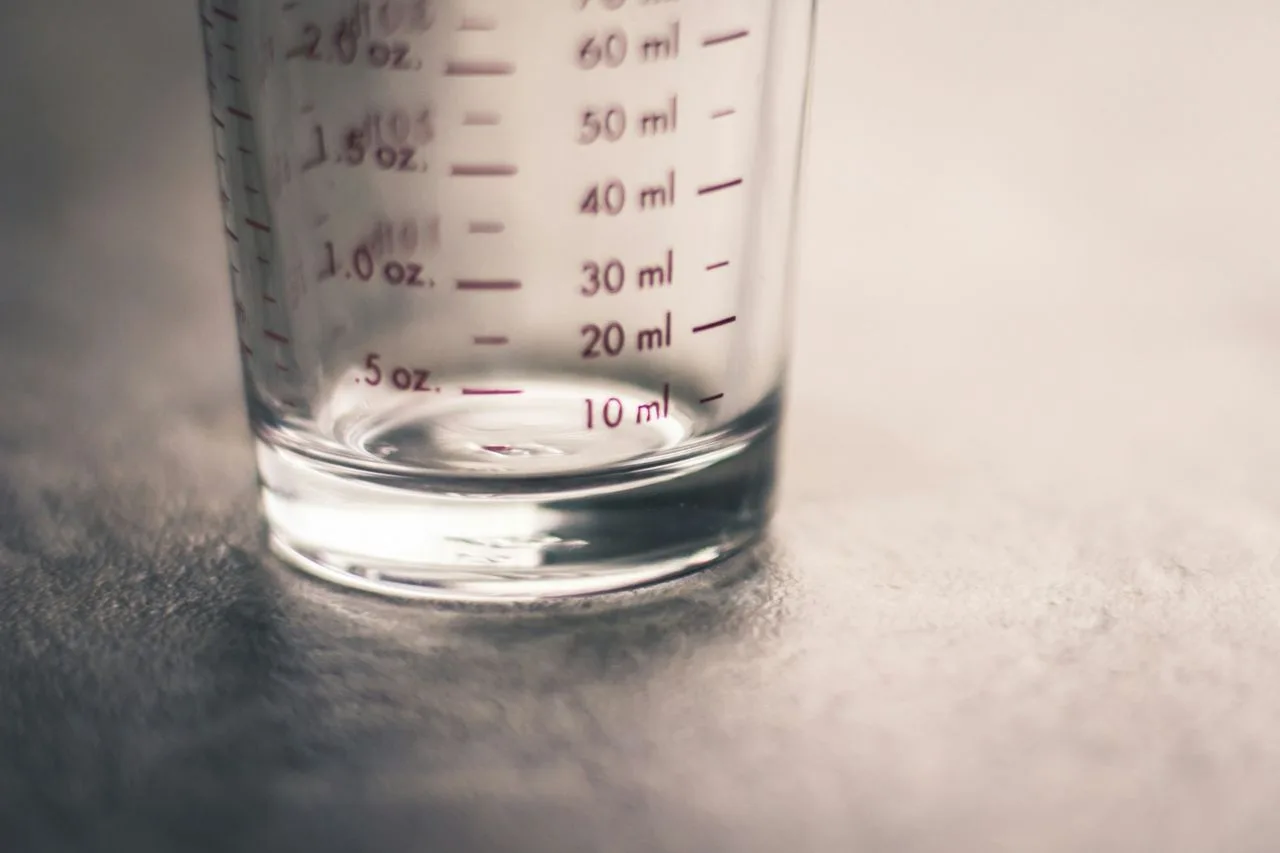
A millilitre is a thousandth of a litre. In 1964 the General Conference on Weights and Measures declared that the word litre may be used as a special name for the cubic decimetre[3], so one millilitre has the volume of a cube with sides of one centimetre.
How to convert pints to ml: the formula and an example
One multiplication is enough. Multiply the number of pints by 473.176473 and the answer comes out in millilitres.
Take an American ice cream recipe that calls for one and a half pints of cream. One and a half pints times 473.176473 gives 709.76 millilitres. With 500-millilitre cartons you need two of them. The first gives 500 millilitres, and you measure the remaining 209.76 millilitres from the second.
Writing the units out shows why the answer comes out in millilitres: 1.5 pt × (473.176473 ml ÷ 1 pt) = 709.76 ml. The pint appears once above the line and once below it, so it cancels and millilitres are left.
The Pint type switcher puts the right multiplier in for you and recalculates the result when you change the measure after typing a number.
The pints to quarts converter shows the same number of pints in quarts.
How many millilitres are in a given number of pints?
| Pints | US liquid pint | US dry pint | Imperial pint |
|---|---|---|---|
| 0.25 pt | 118.29 ml | 137.65 ml | 142.07 ml |
| 0.5 pt | 236.59 ml | 275.31 ml | 284.13 ml |
| 0.75 pt | 354.88 ml | 412.96 ml | 426.20 ml |
| 1 pt | 473.18 ml | 550.61 ml | 568.26 ml |
| 1.25 pt | 591.47 ml | 688.26 ml | 710.33 ml |
| 1.5 pt | 709.76 ml | 825.92 ml | 852.39 ml |
| 1.75 pt | 828.06 ml | 963.57 ml | 994.46 ml |
| 2 pt | 946.35 ml | 1,101.22 ml | 1,136.52 ml |
| 2.25 pt | 1,064.65 ml | 1,238.87 ml | 1,278.59 ml |
| 2.5 pt | 1,182.94 ml | 1,376.53 ml | 1,420.65 ml |
| 3 pt | 1,419.53 ml | 1,651.83 ml | 1,704.78 ml |
| 3.5 pt | 1,656.12 ml | 1,927.14 ml | 1,988.91 ml |
| 4 pt | 1,892.71 ml | 2,202.44 ml | 2,273.05 ml |
| 4.5 pt | 2,129.29 ml | 2,477.75 ml | 2,557.18 ml |
| 5 pt | 2,365.88 ml | 2,753.05 ml | 2,841.31 ml |
| 6 pt | 2,839.06 ml | 3,303.66 ml | 3,409.57 ml |
| 7 pt | 3,312.24 ml | 3,854.27 ml | 3,977.83 ml |
| 8 pt | 3,785.41 ml | 4,404.88 ml | 4,546.09 ml |
| 10 pt | 4,731.76 ml | 5,506.10 ml | 5,682.61 ml |
| 20 pt | 9,463.53 ml | 11,012.21 ml | 11,365.23 ml |
How many millilitres are in half a pint and other British beer measures?
| Quantity | Millilitres | Legislation |
|---|---|---|
| 1/3 pint | 189.42 ml | 1988 Order |
| 1/2 pint | 284.13 ml | 1988 Order |
| 2/3 pint | 378.84 ml | 2011 Order |
| 1 pint | 568.26 ml | 1988 Order, as a multiple of half a pint |
| 2 pints | 1,136.52 ml | 1988 Order, as a multiple of half a pint |
Where do the three different pints in millilitres come from?
| Pint type | Millilitres | Cubic inches | Division it comes from | Switcher option |
|---|---|---|---|---|
| US liquid | 473.176473 ml | 28.875 | One eighth of the 231-cubic-inch US gallon | US liquid |
| US dry | 550.6104713575 ml | 33.6003 | Half of the US dry quart | US dry |
| Imperial | 568.26125 ml | 34.6774 | One eighth of the imperial gallon of 160 fluid ounces | Imperial (UK) |
Which number formats does this converter handle?
| What you type | What the converter shows | How we read it |
|---|---|---|
| 2.5 | 1182.94 ml | The point is the decimal separator, so this is two and a half pints. |
| 2,5 | 1182.94 ml | A comma followed by one digit is a European decimal comma, so we read it as two and a half. |
| 1,500 | 709764.71 ml | Three digits after the comma mark a thousands separator, so we count one thousand five hundred pints. A note under the field shows the other possible reading, 1.5. |
| 1 500 | 709764.71 ml | A space between the thousands is skipped, so this is one thousand five hundred pints as well. |
| 3/4 | 354.88 ml | We convert a fraction with a slash directly, so it doesn’t need to become 0.75 first. |
| 1½ | 709.76 ml | A ½ character copied from a recipe or a label is added to the number in front of it. |
| 2 pints | 946.35 ml | A unit pasted along with the number doesn’t get in the way, so we count two pints. |
| 1 UK pt | 568.26 ml | The field reads UK pt as the British imperial pint and counts it as 568.26 millilitres. |
Which pint type should you choose on the switcher?
The pint type depends on where the number comes from. Each step describes one source of a value and the option that matches it.
A recipe or a liquid label from the United States
Choose US liquid. In the American system liquids are measured by the pint of 473.18 millilitres. With this option two pints from a recipe give 946.35 millilitres.Beer, cider or milk from the United Kingdom
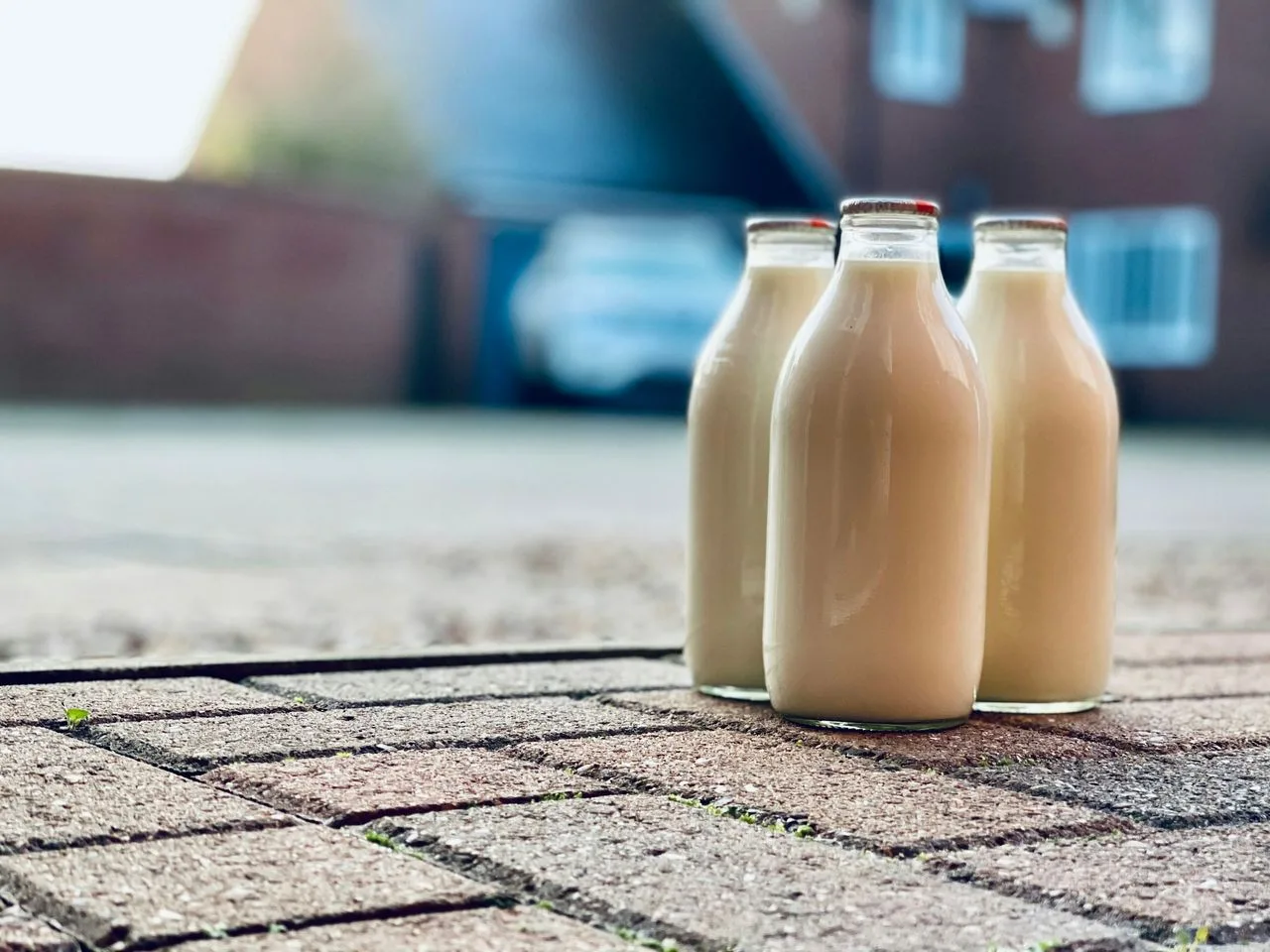
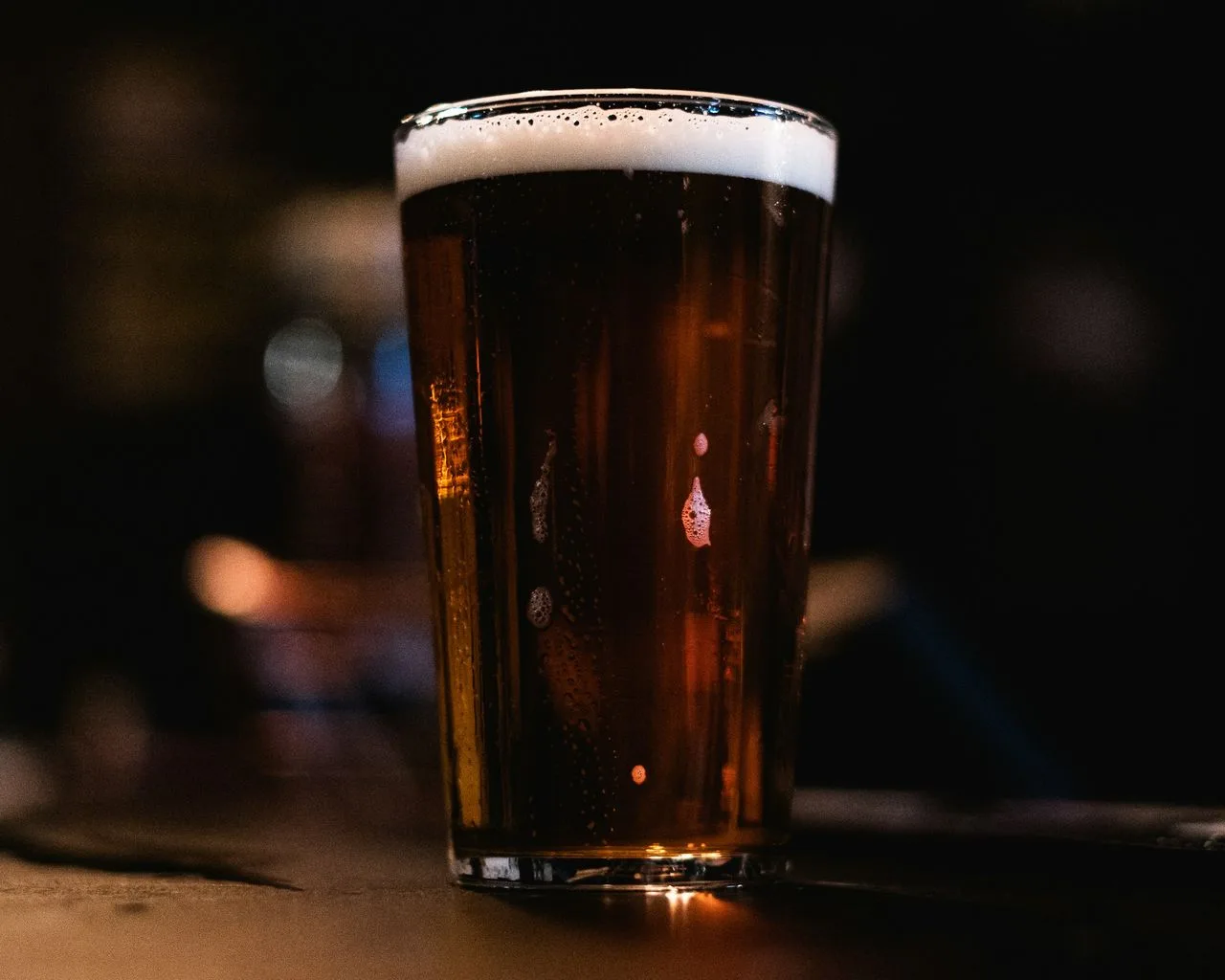
Choose Imperial (UK). British law has kept the pint for draught beer and cider and for milk in returnable containers[6], and one imperial pint holds 568.26 millilitres.A basket of berries from an American store
Choose US dry. A US act of 1916 fixed the capacity of pint containers for small fruits and vegetables as a dry pint[7], and that pint holds 550.61 millilitres.Draught beer in Canada
Choose Imperial (UK). Measurement Canada allows draught beer to be sold by the imperial pint of 568 millilitres[8].Use the result elsewhere
The Copy result button puts the number on the clipboard. The Swap order button takes you to the millilitres to pints converter, and the Clear all button empties both fields.
Is a pint half a litre?
Half a litre, or 500 millilitres, is between the sizes of the three pints. The US liquid pint is 26.82 millilitres smaller. The US dry pint is 50.61 millilitres larger. The imperial pint exceeds half a litre by 68.26 millilitres.
The gap grows with the number of pints. Four imperial pints hold 2,273.05 millilitres. Four half-litre bottles give 2,000 millilitres, so they fall 273.05 millilitres short of the same amount.
In Australia and New Zealand a glass called a pint has its own sizes. Outside South Australia, the pint glass in Australian pubs holds 570 millilitres, close to the imperial pint. In South Australia a pint of beer is 425 millilitres[2]. In New Zealand the largest glass, which is called a pint, usually holds 425 millilitres[2].
The pints to liters converter gives the same pints in litres.
Convert other units to Millilitres
Convert Pints to other units
Sources
- Handbook 44 – 2026, Appendix C. General Tables of Units of Measurement — National Institute of Standards and Technology
- Pint — Wikipedia
- Resolution 6 of the 12th CGPM (1964) on the litre — Bureau International des Poids et Mesures
- The Weights and Measures (Intoxicating Liquor) Order 1988 — legislation.gov.uk
- The Weights and Measures (Specified Quantities) (Unwrapped Bread and Intoxicating Liquor) Order 2011 — legislation.gov.uk
- The Units of Measurement Regulations 1995 — legislation.gov.uk
- Standard Fruits and Vegetable Baskets and Containers Act of 1916 — Wikipedia
- Authorized units of measurement for selling draft beer — Measurement Canada
Every figure in the tables was computed from the unit definitions and checked arithmetically before publication. Historical values and the names of local units come from the sources listed above.
Content last reviewed: · written and checked by the Arteon team
Frequently asked questions about pints and millilitres
How many millilitres are in a pint of beer in Canada?
568 millilitres. Measurement Canada allows draught beer to be sold by the Canadian, or imperial, pint of 568 millilitres or 20 imperial fluid ounces, and also by the millilitre[8]. The US customary pint of 473 millilitres is on the list of units that cannot be used. In French the imperial pint is called a chopine.
How do I enter two and a quarter pints?
The field takes 2.25 as well as the fraction 2 1/4 with a space between the whole number and the fraction. Both give 1,064.65 millilitres for the US liquid pint.
What does pt next to the field mean?
pt is the abbreviation of pint. The field shows US pt for the US liquid pint, US dry pt for the dry pint and UK pt for the imperial pint, and the abbreviation changes with the option chosen on the switcher.
Have a question or a suggestion?
Write to us if the converter is missing a unit you need, or if any figure looks out of date.