Convert mph to km/h
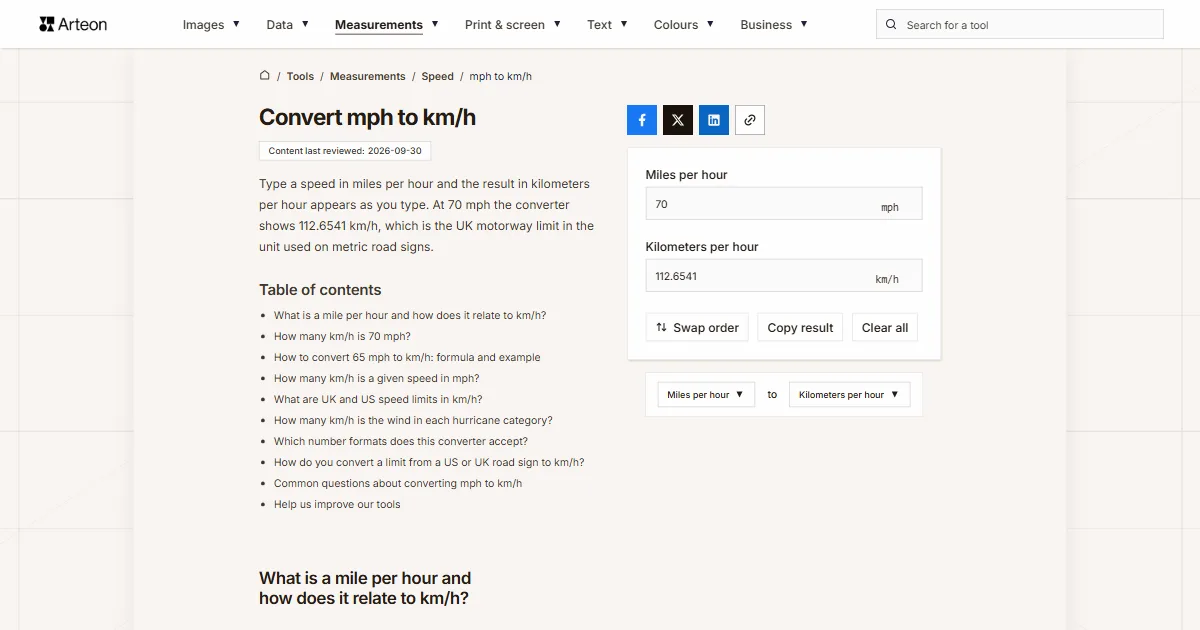
Type a speed in miles per hour and the result in kilometers per hour appears as you type. At 70 mph the converter shows 112.6541 km/h, which is the UK motorway limit in the unit used on metric road signs.
What is a mile per hour and how does it relate to km/h?
A mile per hour (mph) is a unit of speed in the British imperial system and in the United States customary system. It gives the number of miles traveled in one hour[1].
The mile in that name is the statute mile. It is 1,760 yards long and has measured exactly 1.609344 kilometers since 1 July 1959[2].
So one mile per hour is exactly 1.609344 km/h. In meters per second that is 0.44704 m/s[1].
Railways in the United States, Canada and Ireland give speeds in miles per hour[1]. In some countries the speed of the ball in cricket, tennis and baseball is given in mph as well[1].
How many km/h is 70 mph?
70 mph is 112.65 km/h. To convert mph to km/h, multiply the speed in miles per hour by 1.609344.
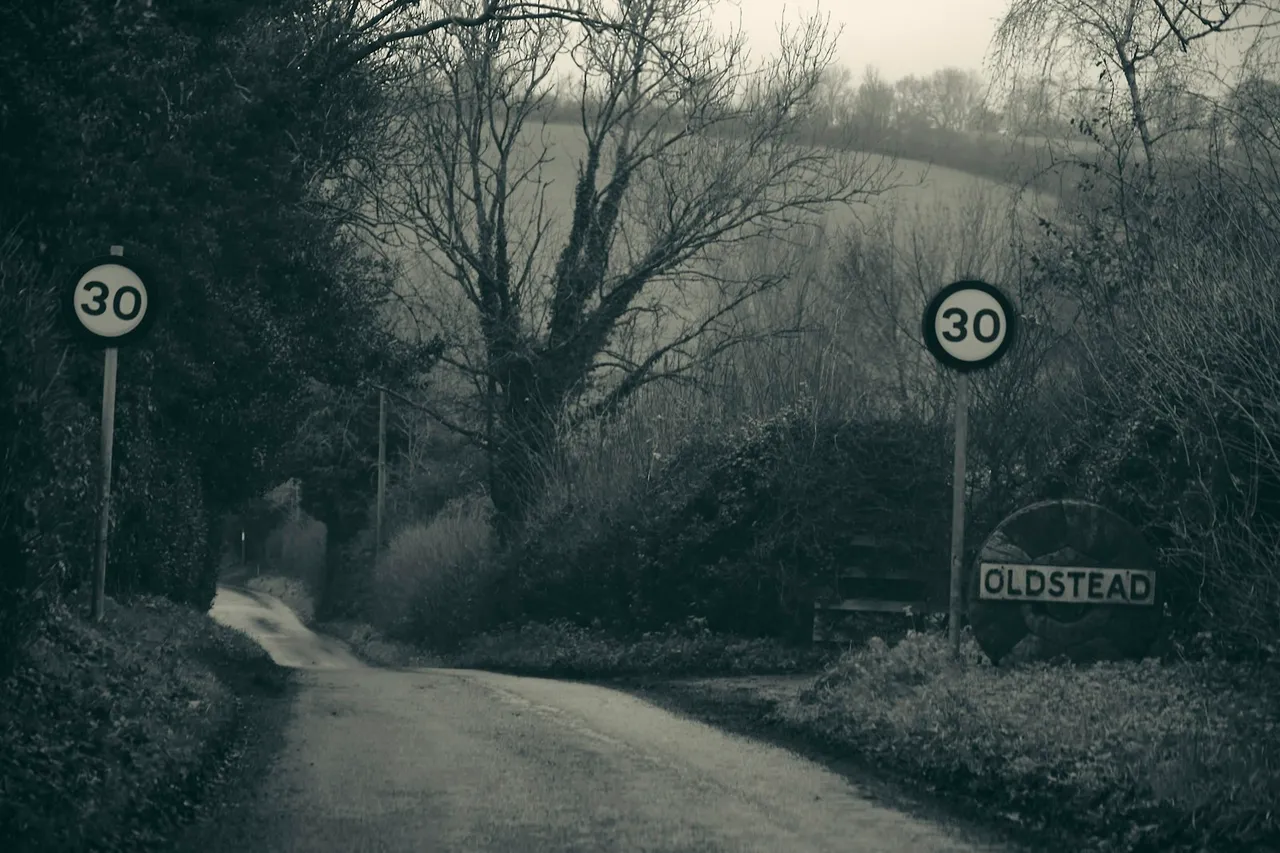
The same multiplication translates the limits on British road signs, which show speed in miles per hour[3]. In built-up areas of England, Scotland and Northern Ireland the limit is 30 mph. Converted, that is 48.28 km/h. On a single carriageway outside built-up areas you may drive at up to 60 mph. That gives 96.56 km/h. The 70 mph limit applies on dual carriageways and motorways.
In Wales the default limit in built-up areas is 20 mph. In kilometers per hour that is 32.19 km/h.
The sum helps when you explain a British or American limit to a visitor from a country where signs show km/h.
Formula: km/h = mph × 1.609344
The multiplier 1.609344 is exact, because it follows directly from the length of the mile. The result field shows four decimal places, while the tables round to hundredths.
How to convert 65 mph to km/h: formula and example
The conversion is a single multiplication: km/h = mph × 1.609344.
Take 65 mph, a limit found on highways along the Eastern Seaboard of the United States[4]. Multiplying it by 1.609344 gives 104.61 km/h.
A quick estimate comes from multiplying by 1.6. For 65 mph that gives 104 km/h, which is 0.61 km/h below the exact result.
The shortcut comes out about 0.6% low, because a mile is slightly longer than 1.6 kilometers. At the speeds on road signs the gap stays under one kilometer per hour.
The km/h to mph converter handles the reverse conversion. A distance from an American map converts with the miles to km converter.
How many km/h is a given speed in mph?
| Miles per hour | Kilometers per hour (km/h) | Meters per second (m/s) |
|---|---|---|
| 1 mph | 1.61 km/h | 0.45 m/s |
| 2 mph | 3.22 km/h | 0.89 m/s |
| 3 mph | 4.83 km/h | 1.34 m/s |
| 5 mph | 8.05 km/h | 2.24 m/s |
| 10 mph | 16.09 km/h | 4.47 m/s |
| 15 mph | 24.14 km/h | 6.71 m/s |
| 20 mph | 32.19 km/h | 8.94 m/s |
| 25 mph | 40.23 km/h | 11.18 m/s |
| 30 mph | 48.28 km/h | 13.41 m/s |
| 35 mph | 56.33 km/h | 15.65 m/s |
| 40 mph | 64.37 km/h | 17.88 m/s |
| 45 mph | 72.42 km/h | 20.12 m/s |
| 50 mph | 80.47 km/h | 22.35 m/s |
| 55 mph | 88.51 km/h | 24.59 m/s |
| 60 mph | 96.56 km/h | 26.82 m/s |
| 65 mph | 104.61 km/h | 29.06 m/s |
| 70 mph | 112.65 km/h | 31.29 m/s |
| 75 mph | 120.7 km/h | 33.53 m/s |
| 80 mph | 128.75 km/h | 35.76 m/s |
| 85 mph | 136.79 km/h | 38 m/s |
| 90 mph | 144.84 km/h | 40.23 m/s |
| 95 mph | 152.89 km/h | 42.47 m/s |
| 100 mph | 160.93 km/h | 44.7 m/s |
| 110 mph | 177.03 km/h | 49.17 m/s |
| 120 mph | 193.12 km/h | 53.64 m/s |
| 125 mph | 201.17 km/h | 55.88 m/s |
| 130 mph | 209.21 km/h | 58.12 m/s |
| 140 mph | 225.31 km/h | 62.59 m/s |
| 150 mph | 241.4 km/h | 67.06 m/s |
| 155 mph | 249.45 km/h | 69.29 m/s |
| 160 mph | 257.5 km/h | 71.53 m/s |
| 170 mph | 273.59 km/h | 76 m/s |
| 180 mph | 289.68 km/h | 80.47 m/s |
| 190 mph | 305.78 km/h | 84.94 m/s |
| 200 mph | 321.87 km/h | 89.41 m/s |
| 220 mph | 354.06 km/h | 98.35 m/s |
| 230 mph | 370.15 km/h | 102.82 m/s |
| 240 mph | 386.24 km/h | 107.29 m/s |
| 250 mph | 402.34 km/h | 111.76 m/s |
| 300 mph | 482.8 km/h | 134.11 m/s |
| 400 mph | 643.74 km/h | 178.82 m/s |
| 500 mph | 804.67 km/h | 223.52 m/s |
What are UK and US speed limits in km/h?
| Where it applies | Limit in mph | Limit in km/h |
|---|---|---|
| Wales: default limit in built-up areas since 17 September 2023 | 20 mph | 32.19 km/h |
| England, Scotland and Northern Ireland: built-up areas | 30 mph | 48.28 km/h |
| United Kingdom: single carriageway outside built-up areas | 60 mph | 96.56 km/h |
| United Kingdom: dual carriageway and motorway | 70 mph | 112.65 km/h |
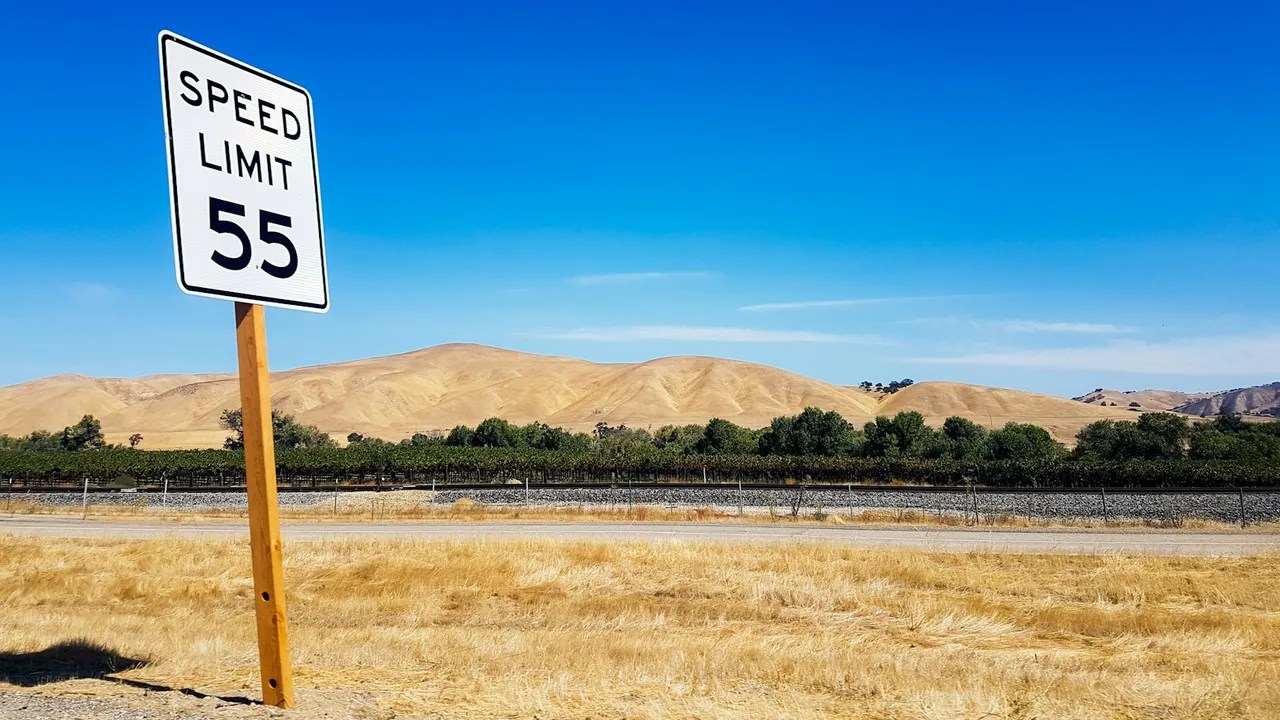
| United States: upper limit tied to federal highway funds, 1974 to 1987 | 55 mph | 88.51 km/h |
| United States: Texas State Highway 130, the highest limit in the country | 85 mph | 136.79 km/h |
How many km/h is the wind in each hurricane category?
| Hurricane category | Wind in mph | Wind in km/h |
|---|---|---|
| Category 1 | 74–95 mph | 119–153 km/h |
| Category 2 | 96–110 mph | 154–177 km/h |
| Category 3 | 111–129 mph | 178–208 km/h |
| Category 4 | 130–156 mph | 209–251 km/h |
| Category 5 | 157 mph or higher | 252 km/h or higher |
Which number formats does this converter accept?
| What you type | What the converter shows | How we read it |
|---|---|---|
| 70 | 112.6541 km/h | A number on its own is read as miles per hour, because that is the unit on the field. |
| 70mph | 112.6541 km/h | The mph symbol pasted with the number, with or without a space and in capitals as on US signs, is skipped. |
| 62.5 | 100.584 km/h | The decimal point separates the fraction, exactly as you would expect. |
| 62,5 | 100.584 km/h | A comma followed by one or two digits can only be a decimal comma, so the result is the same. |
| 1,500 | 2,414.016 km/h | A comma before three digits groups thousands in English, so this is fifteen hundred miles per hour. A note under the field shows the other possible reading, 1.5. |
| 1.500 | 2.414 km/h | A single point is always read as a decimal point, so the field counts one and a half miles per hour. A note under the field shows the other possible reading, 1500. |
| 1 500 | 2,414.016 km/h | A space between the thousands, as written in much of Europe and in SI style, gives the same result as 1,500. |
| 100 km/h | 100 km/h | Kilometres per hour are converted to miles per hour, with a line under the field saying so, so the result comes back to 100 km/h. |
How do you convert a limit from a US or UK road sign to km/h?
Four steps let you compare a limit posted in miles per hour with a speed in kilometers per hour.
Type the number from the sign
In the Miles per hour field, type the limit from the sign, for example 55.Read the result in km/h
The converter shows 88.5139 km/h. That is the value to find on a scale in kilometers per hour.Save the result
The Copy result button puts the number on your clipboard, for example for a note with your route plan.Clear the fields before the next limit
The Clear all button empties both fields, so you type the next value from a sign from the start.
Sources
- Miles per hour — Wikipedia
- Mile — Wikipedia
- Speed limits in the United Kingdom — Wikipedia
- Speed limits in the United States — Wikipedia
- Saffir-Simpson Hurricane Wind Scale — National Hurricane Center (NOAA)
- Speed limits in Ireland — Wikipedia
- Puerto Rican units of measurement — Wikipedia
Every figure in the tables was computed from the unit definitions and checked arithmetically before publication. Historical values and the names of local units come from the sources listed above.
Content last reviewed: · written and checked by the Arteon team
Common questions about converting mph to km/h
Which is faster, 1 mph or 1 km/h?
A mile per hour is faster, because a mile is longer than a kilometer. With the same number on the sign, a speed in mph is about 61% higher than a speed in km/h.
Why are speed limits in km/h in Ireland but in mph in Northern Ireland?
Is a mile per hour the same in the UK and the US?
Yes. The 1959 international yard and pound agreement gave the United States, the United Kingdom, Canada, Australia, New Zealand and South Africa the same mile[2]. The converter result is therefore correct for a speed from either country.
Help us improve our tools
Have an idea for a new feature, spotted a bug or want to suggest another tool? Write to us.