Convert grams to tons
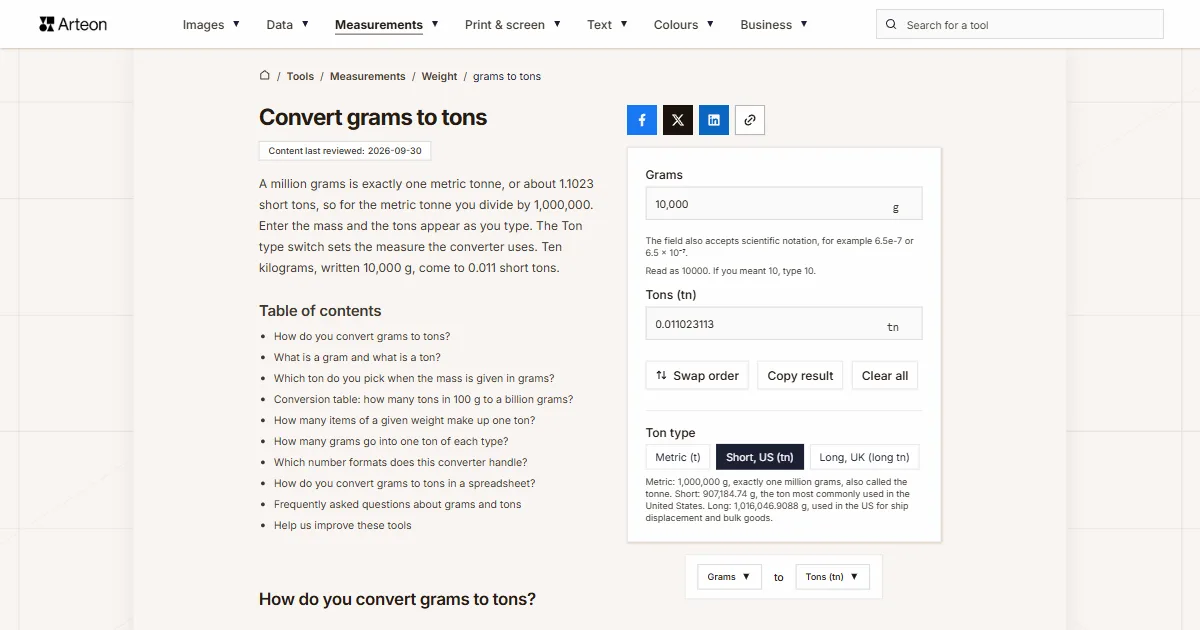
A million grams is exactly one metric tonne, or about 1.1023 short tons, so for the metric tonne you divide by 1,000,000. Enter the mass and the tons appear as you type. The Ton type switch sets the measure the converter uses. Ten kilograms, written 10,000 g, come to 0.011 short tons.
The field also accepts scientific notation, for example 6.5e-7 or 6.5 × 10⁻⁷.
How do you convert grams to tons?
For the metric tonne you divide the number of grams by a million: tons = grams ÷ 1,000,000. A million grams comes to exactly one metric tonne. Ten thousand grams give 0.01 t and 250 g give 0.00025 t. The decimal point moves six places to the left, which is enough for a sum in your head.
The divisor comes from the name of the unit. A metric tonne is the same thing as a megagram, and the prefix mega means a million — the SI Brochure writes it out as 1 t = 1 Mg = 10³ kg[1]. The million in the denominator is built into the name itself.
The short ton and the long ton carry their own divisors, because the pound of 453.59237 g defines them. For the short ton you divide by 907,184.74 and for the long ton by 1,016,046.9088[2]. Both figures are exact, because the mass of the pound is exact. The Ton type switch sets which of the three divisors the converter uses.
What is a gram and what is a ton?
A gram carries the symbol g and equals one thousandth of a kilogram. Before the SI arrived, physics worked in the CGS system, where the gram was the base unit of mass[3]. That older status still shows in the names: in 1967 the International Committee for Weights and Measures declared that multiples of the unit of mass are named by attaching a prefix to the word gram[1]. That is where kilogram, milligram and megagram all come from.
Further up that ladder, the megagram follows the kilogram at a million grams. The unit has a second name: the tonne, with the symbol t. The Bureau International des Poids et Mesures adopted that symbol in 1879 and accepts the tonne for use with the SI, while the system itself leaves the unit outside[4].
Between the gram and that unit sit the decagram (dag) of 10 grams, the hectogram (hg) of 100 grams and the kilogram[1]. The answer in kilograms comes from the grams to kilograms converter, and masses below a gram go through the grams to milligrams converter.
Which ton do you pick when the mass is given in grams?
Take the type of ton from the document the answer is going into. According to NIST, the ton most commonly used is the short ton in the United States and Canada, the long ton in Great Britain and the metric ton in countries using the metric system[5]. So a shipment quoted in American tons usually divides by 907,184.74.
For cargo in overseas traffic NIST records long tons or metric tons as the usual measure, with the short ton used only occasionally[5]. When you are turning the weight of one pack into the weight of a whole consignment, check the freight unit first and then set it in the switch.
A million grams is exactly 1 metric tonne. Rounded, the same mass is 1.1023 short tons or 0.9842 long tons. A long ton is exactly 12 percent heavier than a short ton, because 2,240 pounds is 1.12 times 2,000 pounds. The route in the other direction runs through the tons to grams converter, and the step through kilograms through the kilograms to tons converter.

Conversion table: how many tons in 100 g to a billion grams?
| Grams | Metric tonne | Short ton (US) | Long ton (UK) |
|---|---|---|---|
| 100 g | 0.0001 t | 0.000110231 t | 0.000098421 t |
| 150 g | 0.00015 t | 0.000165347 t | 0.000147631 t |
| 200 g | 0.0002 t | 0.000220462 t | 0.000196841 t |
| 250 g | 0.00025 t | 0.000275578 t | 0.000246052 t |
| 300 g | 0.0003 t | 0.000330693 t | 0.000295262 t |
| 400 g | 0.0004 t | 0.000440925 t | 0.000393683 t |
| 500 g | 0.0005 t | 0.000551156 t | 0.000492103 t |
| 700 g | 0.0007 t | 0.000771618 t | 0.000688945 t |
| 1,000 g | 0.001 t | 0.001102311 t | 0.000984207 t |
| 1,500 g | 0.0015 t | 0.001653467 t | 0.00147631 t |
| 2,000 g | 0.002 t | 0.002204623 t | 0.001968413 t |
| 2,500 g | 0.0025 t | 0.002755778 t | 0.002460516 t |
| 3,000 g | 0.003 t | 0.003306934 t | 0.00295262 t |
| 5,000 g | 0.005 t | 0.005511557 t | 0.004921033 t |
| 8,800 g | 0.0088 t | 0.00970034 t | 0.008661017 t |
| 10,000 g | 0.01 t | 0.011023113 t | 0.009842065 t |
| 15,000 g | 0.015 t | 0.01653467 t | 0.014763098 t |
| 20,000 g | 0.02 t | 0.022046226 t | 0.019684131 t |
| 25,000 g | 0.025 t | 0.027557783 t | 0.024605163 t |
| 50,000 g | 0.05 t | 0.055115566 t | 0.049210326 t |
| 100,000 g | 0.1 t | 0.110231131 t | 0.098420653 t |
| 150,000 g | 0.15 t | 0.165346697 t | 0.147630979 t |
| 250,000 g | 0.25 t | 0.275577828 t | 0.246051632 t |
| 500,000 g | 0.5 t | 0.551155655 t | 0.492103264 t |
| 1,000,000 g | 1 t | 1.1023 t | 0.9842 t |
| 1,500,000 g | 1.5 t | 1.6535 t | 1.4763 t |
| 2,000,000 g | 2 t | 2.2046 t | 1.9684 t |
| 4,000,000 g | 4 t | 4.4092 t | 3.9368 t |
| 5,000,000 g | 5 t | 5.5116 t | 4.921 t |
| 10,000,000 g | 10 t | 11.0231 t | 9.8421 t |
| 20,000,000 g | 20 t | 22.0462 t | 19.6841 t |
| 31,000,000 g | 31 t | 34.1717 t | 30.5104 t |
| 50,000,000 g | 50 t | 55.1156 t | 49.2103 t |
| 100,000,000 g | 100 t | 110.2311 t | 98.4207 t |
| 500,000,000 g | 500 t | 551.1557 t | 492.1033 t |
| 1,000,000,000 g | 1,000 t | 1,102.3113 t | 984.2065 t |
How many items of a given weight make up one ton?
| Weight of one item | Items per metric tonne | Items per short ton |
|---|---|---|
| 5 g | 200,000 | 181,436 |
| 10 g | 100,000 | 90,718 |
| 20 g | 50,000 | 45,359 |
| 50 g | 20,000 | 18,143 |
| 100 g | 10,000 | 9,071 |
| 250 g | 4,000 | 3,628 |
| 500 g | 2,000 | 1,814 |
| 1,000 g | 1,000 | 907 |
How many grams go into one ton of each type?
| Type of ton | Grams in one ton | What to do with the gram figure |
|---|---|---|
| Metric tonne (t) | 1,000,000 g | divide by 1,000,000 |
| Short ton (tn) | 907,184.74 g | divide by 907,184.74 |
| Long ton (long tn) | 1,016,046.9088 g | divide by 1,016,046.9088 |
Which number formats does this converter handle?
| What you type | What the converter shows | How we read it |
|---|---|---|
| 2500.5 | 0.0025005 t | The decimal point from the numeric keypad, written the way English writes it |
| 2500,5 | 0.0025005 t | A comma pasted from a market that writes decimals that way is read as a decimal point, so the result is the same |
| 1,500 | 0.0015 t | Three digits follow the comma, so we read it as a thousands separator: the field holds one thousand five hundred. A note under the field shows the other possible reading, 1.5. |
| 2 500 | 0.0025 t | A space between thousands, the way a spreadsheet pastes it, does not split the number in two |
| 3/4 | 0.00000075 t | We work the fraction out ourselves, so there is no need to turn it into a decimal first |
| 900½ | 0.0009005 t | The ½ character copied from a recipe or a label is added to the number in front of it |
| 2500.5 g | 0.0025005 t | A unit symbol pasted along with the number is no trouble: we take the number and leave the symbol out |
| 2.6e-3 | 0.0000000026 t | Scientific notation, the way a spreadsheet shows very small numbers, is read as it stands |
How do you convert grams to tons in a spreadsheet?
A spreadsheet handles this with one function, though the answer is often so small that the cell shows zeros. The steps therefore cover the number format as well.
Write the CONVERT function with a unit code
In Excel the function is CONVERT and it takes three arguments: CONVERT(number,from_unit,to_unit)[6]. The formula =CONVERT(A1,"g","Mg") converts grams to metric tonnes, because the code "Mg" means megagram and the prefix M multiplies a metric unit by a million.Change the code for the short and the long ton
The formula =CONVERT(A1,"g","ton") gives short tons and =CONVERT(A1,"g","uk_ton") gives long tons. With 1000000 in cell A1 the three results come to 1, 1.1023113 and 0.9842065, so three formulas side by side show the difference between the tons at once.Set scientific format for very small results
Two hundred grams is 0.0002 tons and two grams is 0.000002 tons. A cell rounded to two decimal places shows 0.00 for values like these, so open the cell format window and pick the Scientific category; Microsoft describes the path in Excel Help[7]. The cell then reads 2.00E-06.Add the grams up before converting a consignment
Build the weight of the consignment in grams with SUM, then convert once, on the finished total. Converting each line on its own adds a rounding step to every line, while one division at the end leaves one result with one rounding.
Convert other units to Tons (tn)
Convert Grams to other units
Sources
- The International System of Units (SI), 9th edition – Table 8 and the 1967 CIPM declaration on prefixes for the unit of mass — Bureau International des Poids et Mesures
- Handbook 44 – 2026, Appendix C. General Tables of Units of Measurement — National Institute of Standards and Technology
- Gram — Wikipedia
- NIST SP 330, Section 4 – units accepted for use with the SI — National Institute of Standards and Technology
- Handbook 44 – 2026, Appendix B. Units and Systems of Measurement — National Institute of Standards and Technology
- CONVERT function — Microsoft
- Display numbers in scientific (exponential) notation — Microsoft
Every figure in the tables was computed from the unit definitions and checked arithmetically before publication. Historical values and the names of local units come from the sources listed above.
Content last reviewed: · written and checked by the Arteon team
Frequently asked questions about grams and tons
How many tons is a million grams?
A million grams is 1.1023 short tons. The same mass is exactly one metric tonne and 0.9842 long tons.
How many tons is 10,000 grams?
Ten thousand grams is 0.011023113 short tons, which is ten kilograms. In metric tonnes it comes to 0.01 t and in long tons to 0.009842065 t.
How many tons is one gram?
One gram is 0.000001 metric tonnes, a millionth of a tonne. For values like these the result field adds a line reading 1 × 10⁻⁶ t, because six zeros after the decimal point are hard to count by eye.
How many tons is 100,000 grams?
A hundred thousand grams is 0.1 metric tonnes, which is 100 kilograms. In short tons the same mass gives 0.110231131 t and in long tons 0.098420653 t.
How do you convert grams to tonnes in your head?
Move the decimal point six places to the left. 2,500,000 g becomes 2.5 t and 45,000 g becomes 0.045 t. The short ton and the long ton need actual division by the numbers given above.
How many 100 gram items make a ton?
Ten thousand items of 100 g make exactly one metric tonne. A short ton takes 9,071 such items, and the remainder is then 84.74 g, below the weight of one more item.
How many metric tonnes are a short ton and a long ton?
A short ton is 907,184.74 g, which is 0.90718474 metric tonnes[2]. A long ton is 1,016,046.9088 g, which is 1.0160469088 metric tonnes.
Why does the result field show nine decimal places?
Dividing by a million takes six places straight away, so a shorter display would drop any mass under a kilogram to zero. Nine places still show a thousandth of a gram, and smaller values gain extra significant digits.
How do you write the result more compactly for a table?
Use the line under the result field, which gives the same mass as 4.5 × 10⁻⁵ t. A spreadsheet writes that value as 4.5E-05 once the scientific format is set, so both spellings describe one number in two conventions.
Help us improve these tools
Have an idea for a new feature, found a bug or want to suggest another tool? Write to us.