Convert kiloliters to liters
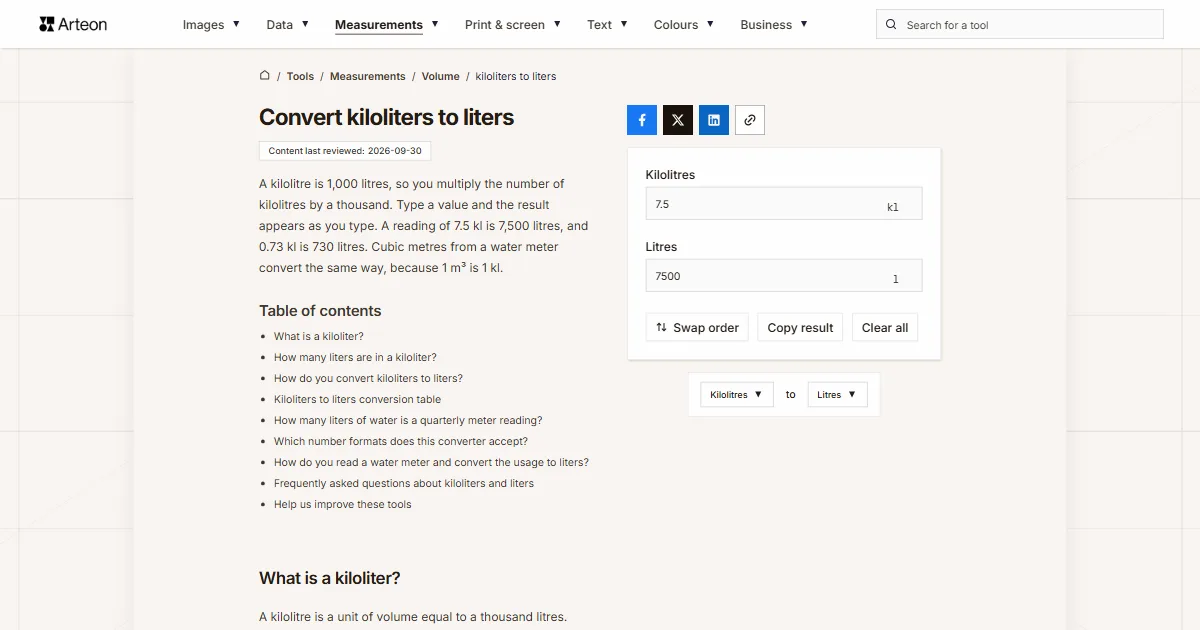
A kilolitre is 1,000 litres, so you multiply the number of kilolitres by a thousand. Type a value and the result appears as you type. A reading of 7.5 kl is 7,500 litres, and 0.73 kl is 730 litres. Cubic metres from a water meter convert the same way, because 1 m³ is 1 kl.
What is a kiloliter?
A kilolitre is a unit of volume equal to a thousand litres. The name joins the litre with the prefix kilo, which means a thousand and has the symbol k,[1] so the kilolitre is written kl.
A thousand litres is the volume of a cube one metre on each side. The kilolitre and the cubic metre therefore describe the same amount, and the table of litre multiples lists them in one row.[2] When a water utility bills in cubic metres, each cubic metre on the bill is one kilolitre.
The symbol can also be written kL, because the litre is accepted with both a lower-case l and a capital L.[3]
How many liters are in a kiloliter?
One kilolitre is 1,000 litres. The conversion comes down to multiplying the number of kilolitres by a thousand. The result is exact, because the prefix kilo has the same value throughout the metric system. The kilolitre is a unit a thousand times larger, so the figure in litres comes out a thousand times larger. In the other direction you divide the number of litres by a thousand.
That multiplication gives round figures. Two kilolitres are 2,000 litres. Half a kilolitre gives 500 litres. A reading of 7.5 kilolitres is 7,500 litres, which fills thirty thousand glasses of 250 millilitres. Ten kilolitres are already 10,000 litres.
Values below one kilolitre come out as fewer than a thousand litres. A reading of 0.73 kl means 730 litres. In the same way, 0.779 kl gives 779 litres. Cubic metres convert exactly like kilolitres, so 0.73 m³ is also 730 litres. Each further cubic metre on a water meter therefore means another thousand litres of water.
How do you convert kiloliters to liters?
The formula has one step: liters = kiloliters × 1000. Multiplying by a thousand moves the decimal point three places to the right, so 2.83 kilolitres is 2,830 litres.
When fewer than three digits follow the decimal point, you fill the missing places with zeros at the end of the number. For 34.6 kilolitres you add two zeros and get 34,600 litres. For 5 kilolitres you add three zeros, which gives 5,000 litres.
The opposite direction is covered by the liters to kiloliters converter. Litres from the result convert to smaller measures in the liters to ml converter.
Kiloliters to liters conversion table
| Kiloliters | Liters | Milliliters |
|---|---|---|
| 0.001 kl | 1 l | 1,000 ml |
| 0.005 kl | 5 l | 5,000 ml |
| 0.01 kl | 10 l | 10,000 ml |
| 0.1 kl | 100 l | 100,000 ml |
| 0.2 kl | 200 l | 200,000 ml |
| 0.25 kl | 250 l | 250,000 ml |
| 0.5 kl | 500 l | 500,000 ml |
| 0.73 kl | 730 l | 730,000 ml |
| 0.779 kl | 779 l | 779,000 ml |
| 1 kl | 1,000 l | 1,000,000 ml |
| 1.5 kl | 1,500 l | 1,500,000 ml |
| 2 kl | 2,000 l | 2,000,000 ml |
| 2.83 kl | 2,830 l | 2,830,000 ml |
| 3 kl | 3,000 l | 3,000,000 ml |
| 4 kl | 4,000 l | 4,000,000 ml |
| 5 kl | 5,000 l | 5,000,000 ml |
| 6 kl | 6,000 l | 6,000,000 ml |
| 7 kl | 7,000 l | 7,000,000 ml |
| 7.5 kl | 7,500 l | 7,500,000 ml |
| 8 kl | 8,000 l | 8,000,000 ml |
| 9 kl | 9,000 l | 9,000,000 ml |
| 10 kl | 10,000 l | 10,000,000 ml |
| 23 kl | 23,000 l | 23,000,000 ml |
| 34.6 kl | 34,600 l | 34,600,000 ml |
| 45.7 kl | 45,700 l | 45,700,000 ml |
| 70 kl | 70,000 l | 70,000,000 ml |
| 100 kl | 100,000 l | 100,000,000 ml |
| 104.3 kl | 104,300 l | 104,300,000 ml |
How many liters of water is a quarterly meter reading?
| Usage | Liters | Average per day over 90 days |
|---|---|---|
| 10 kl | 10,000 l | 111.1 l per day |
| 20 kl | 20,000 l | 222.2 l per day |
| 30 kl | 30,000 l | 333.3 l per day |
| 40 kl | 40,000 l | 444.4 l per day |
| 50 kl | 50,000 l | 555.6 l per day |
| 60 kl | 60,000 l | 666.7 l per day |
| 75 kl | 75,000 l | 833.3 l per day |
| 90 kl | 90,000 l | 1,000 l per day |
| 100 kl | 100,000 l | 1,111.1 l per day |
Which number formats does this converter accept?
| What you type | What the converter shows | How we read it |
|---|---|---|
| 7.5 | 7,500 l | A number on its own is read as kilolitres, because that is the unit on the field. |
| 7.5kl | 7,500 l | The kl symbol pasted with the number, with or without a space, is skipped, and so is the word kilolitres. |
| 0.73 | 730 l | The decimal point separates the fraction, exactly as you would expect. |
| 0,73 | 730 l | A comma followed by one or two digits can only be a decimal comma, so the result is the same. |
| 1,500 | 1,500,000 l | A comma before three digits groups thousands in English, so this is fifteen hundred kilolitres. A note under the field shows the other possible reading, 1.5. |
| 1.500 | 1,500 l | A single point is always read as a decimal point, so the field counts one and a half kilolitres. A note under the field shows the other possible reading, 1500. |
| 1 500 | 1,500,000 l | A space between the thousands, as written in much of Europe and in SI style, gives the same result as 1,500. |
| 3/4 | 750 l | We work out a fraction with a slash for you, so three quarters of a kilolitre needs no conversion to 0.75 first. |
| 2½ | 2,500 l | A ½ sign copied from a label or a recipe is added to the number in front of it. |
| 50.5 m³ | 50,500 l | Cubic metres from a meter are converted to kilolitres: the field enters 50.5 and says so in a line under it. |
How do you read a water meter and convert the usage to liters?
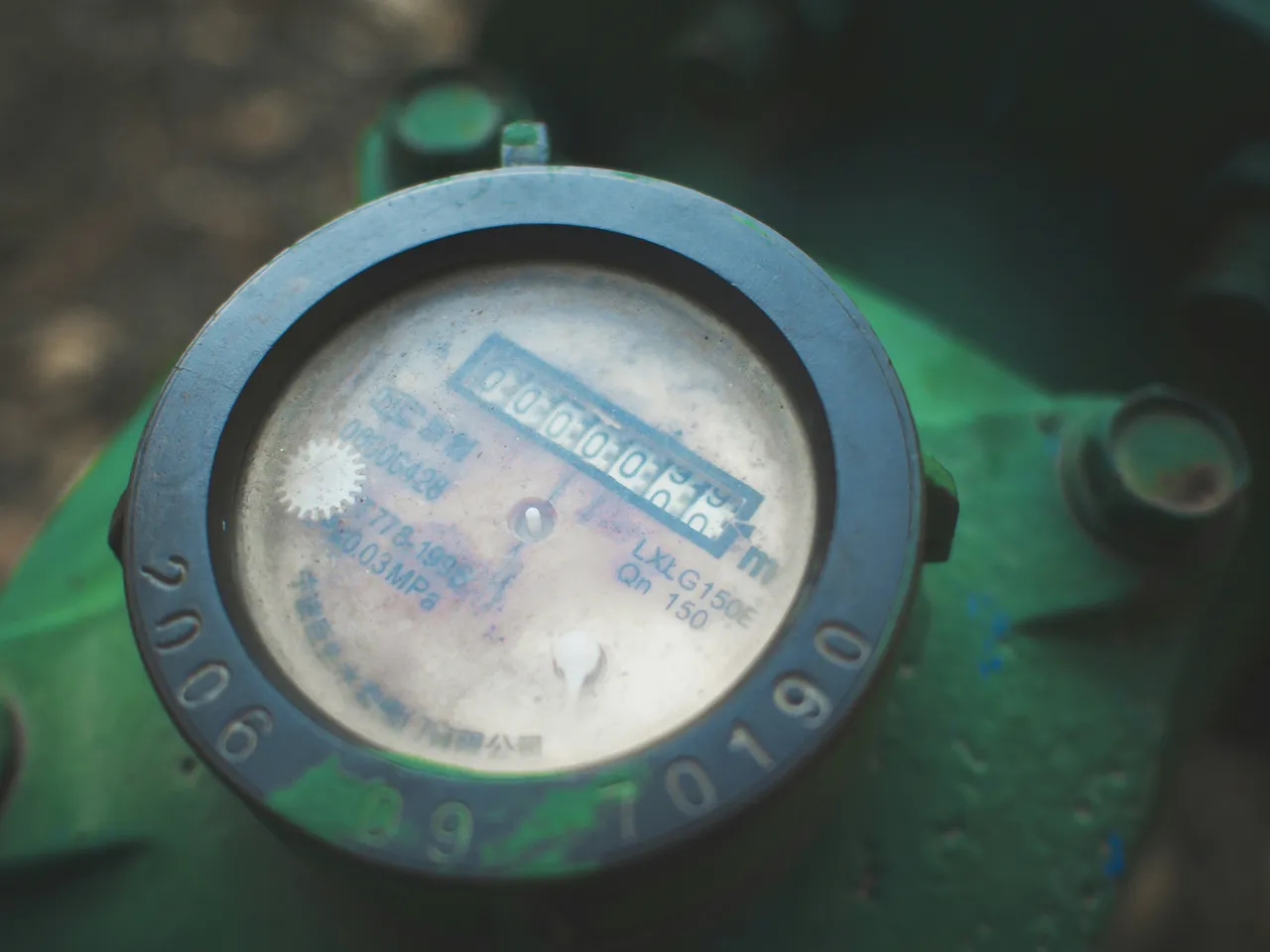
A standard mechanical meter shows the reading in kilolitres on a white and black dial. These four steps take you from the meter to a number of litres.
Write down the reading on the white and black dial
The white and black dial shows the meter reading in kilolitres (kL). That is the number Sydney Water asks for, and the red numbers are not needed for it.[4]Read the red digits for litres
The red numbers or pointers show litres.[4] A meter with 204 on the black dial and 701 in red therefore shows 204 kilolitres and 701 litres.Subtract the previous reading
Usage for the period is the difference between the current reading and the previous one. Readings of 204.701 and 154.201 give 50.5 kilolitres.Convert the result to litres
Type the difference into the field above as kilolitres. 50.5 kl gives 50,500 litres. Over a 90-day quarter that is an average of 561.1 litres a day.
Convert other units to Litres
Sources
- Metric (SI) prefixes — National Institute of Standards and Technology
- Litre — Wikipedia
- NIST Special Publication 330, section 4 — non-SI units accepted for use with the SI — National Institute of Standards and Technology
- Meter readings — Sydney Water
- Residential pricing — Sydney Water
- How do I access free basic municipal services? — South African Government
- CONVERT function — Microsoft
Every figure in the tables was computed from the unit definitions and checked arithmetically before publication. Historical values and the names of local units come from the sources listed above.
Content last reviewed: · written and checked by the Arteon team
Frequently asked questions about kiloliters and liters
How much does a liter of water cost when you know the price per kiloliter?
Divide the price per kilolitre by 1,000. From 1 July 2026 Sydney Water charges $3.41 a kilolitre for drinking water, so one litre costs 0.341 cents. The wastewater charge appears as a separate line in the same price list.[5]
How many liters is free basic water in South Africa?
Free basic water in South Africa is at least 6 kl, or 6,000 litres, per household per month.[6] Over a 30-day month that averages 200 litres a day. The exact amount can differ between municipalities.
How do you convert kiloliters to liters in Excel?
Type =CONVERT(A1,"kl","l") or =A1*1000. The function recognises the code "kl", because the documentation allows the prefix kilo in front of the litre code.[7] Unit names are case-sensitive, so the k stays lower-case.
What is 0.00784 kL in liters?
0.00784 kilolitres is 7.84 litres. The decimal point moves three places to the right and lands after the digit 7, so rounded to two decimal places the result still reads 7.84 l.
How many liters are in 105.75 kL?
105.75 kilolitres is 105,750 litres. Moving the decimal point three places to the right leaves one place empty, so you add one zero at the end.
What is 0.2598 kL in liters?
0.2598 kilolitres is 259.8 litres, just under 260 litres. After the decimal point moves three places to the right, one digit remains after it.
How many liters of water does a 12 m³ pool hold?
12 cubic metres are 12 kilolitres, which is 12,000 litres. The number of thousands of litres equals the volume given in cubic metres.
Help us improve these tools
Have an idea for a feature, spotted a mistake or want to suggest another tool? Write to us.