Roman Numerals to Numbers – Converter and How to Read Them
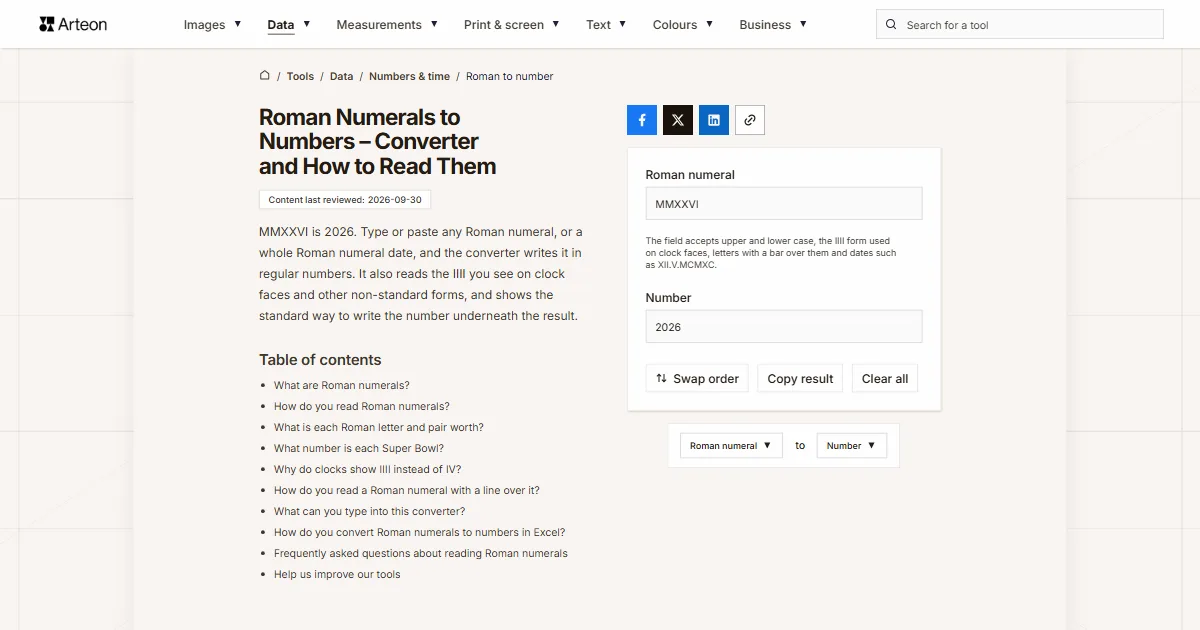
MMXXVI is 2026. Type or paste any Roman numeral, or a whole Roman numeral date, and the converter writes it in regular numbers. It also reads the IIII you see on clock faces and other non-standard forms, and shows the standard way to write the number underneath the result.
The field accepts upper and lower case, the IIII form used on clock faces, letters with a bar over them and dates such as XII.V.MCMXC.
What are Roman numerals?
Roman numerals are written with seven letters: I is 1, V is 5, X is 10, L is 50, C is 100, D is 500 and M is 1,000. Each letter always has the same value, and you add them up to get the number[1]. There is no letter for zero.
The digits we use every day, often called Arabic numerals, work differently. They are positional: the same 2 means two, twenty or two hundred depending on where it stands, and 0 holds the empty places. Binary works the same way with only two digits, which you can see in the decimal to binary converter. Because Roman letters never change their value, a Roman numeral can get long: 1888 is MDCCCLXXXVIII.
Today you meet them in names of monarchs and popes, such as Elizabeth II or Pope Leo XIV, on clock faces, on building fronts and in the copyright year at the end of film and TV credits[1]. In the United States they also appear after names shared across generations, such as William Howard Taft IV.
How do you read Roman numerals?
Read from left to right and add the letters up. There is one exception: a smaller letter placed right before a larger one is subtracted from it. Modern usage has only six of these pairs: IV is 4, IX is 9, XL is 40, XC is 90, CD is 400 and CM is 900[1].
Take MCMXC. M is 1,000. CM is 1,000 minus 100, which is 900. XC is 90. Together they make 1990.
MMXXVI is simpler because there is no subtractive pair in it: MM is 2,000, XX is 20 and VI is 6, so the year is 2026.
A numeral after a name is read as an ordinal: Elizabeth II is Elizabeth the Second[1]. The converter gives you the plain number, 2, and you add the ordinal ending yourself.
What is each Roman letter and pair worth?
| Roman numeral | Number | Example |
|---|---|---|
| I | 1 | III is 3 |
| V | 5 | VII is 7 |
| X | 10 | XXX is 30 |
| L | 50 | LX is 60 |
| C | 100 | CCC is 300 |
| D | 500 | DC is 600 |
| M | 1000 | MM is 2,000 |
| IV | 4 | XIV is 14 |
| IX | 9 | XIX is 19 |
| XL | 40 | XLV is 45 |
| XC | 90 | XCIX is 99 |
| CD | 400 | CDL is 450 |
| CM | 900 | MCM is 1,900 |
What number is each Super Bowl?
| Super Bowl | Number |
|---|---|
| LI | 51 |
| LII | 52 |
| LIII | 53 |
| LIV | 54 |
| LV | 55 |
| LVI | 56 |
| LVII | 57 |
| LVIII | 58 |
| LIX | 59 |
| LX | 60 |
Why do clocks show IIII instead of IV?
Clock faces with Roman numerals very often show four o'clock as IIII and nine o'clock as IX. The habit goes back to very early clocks such as the Wells Cathedral clock of the late 14th century. It is not universal, though: the clock on Elizabeth Tower at the Palace of Westminster uses IV[1].
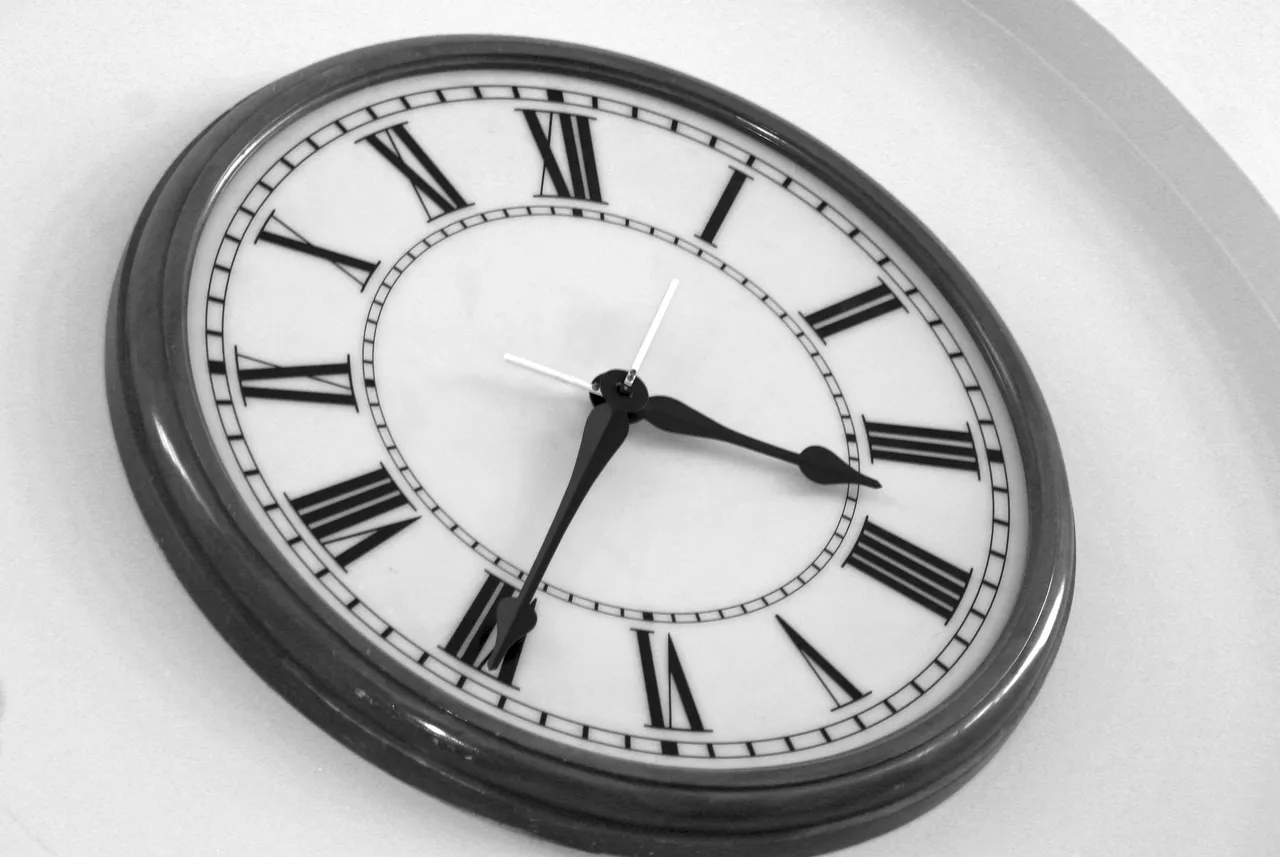
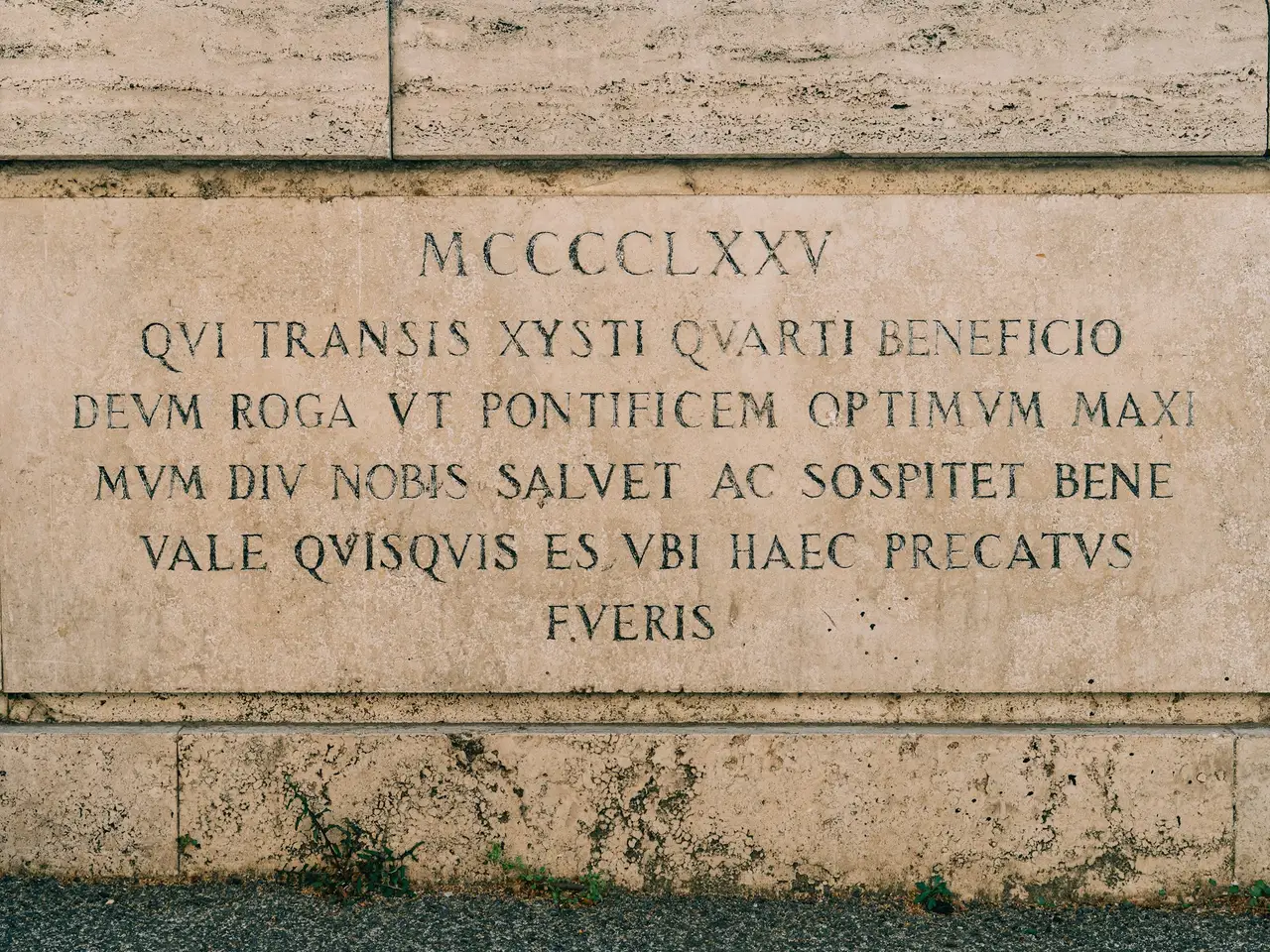
Additive forms like IIII, XXXX and CCCC were in use long before clocks and kept appearing for centuries. The two styles could even be mixed in one document or in one numeral[1].
The converter reads these forms the same way as any other numeral: a smaller letter before a larger one is subtracted and the rest is added. Excel's ARABIC function also accepts a non-standard form and reads mxmvii as 1997[3]. So you get a result for IIII, MDCCCCX or IC, and the Standard form line under it shows the modern spelling: IV, MCMX and XCIX. A run of equal letters before a larger one is subtracted as a whole, so the old XIIX used by the 18th Roman legion comes out as 18[1].
How do you read a Roman numeral with a line over it?
A bar over a letter, called a vinculum, multiplies its value by 1,000[1]. V with a bar is 5,000, X with a bar is 10,000 and M with a bar is 1,000,000. Letters without a bar keep their usual value, so X̅V is 10,005.
The bar has to sit over every letter it applies to. If the field holds IV̅, with the bar over the V only, the converter subtracts I from 5,000 and gives 4,999, and the Standard form line shows I̅V̅CMXCIX. Four thousand is I̅V̅, with a bar over both letters.
The field accepts the bar pasted as a combining overline or as a macron, for example from text where someone typed Ī. It reads numbers up to 3,999,999.
What can you type into this converter?
| What you type | What the converter shows | Note |
|---|---|---|
| MMXXVI | 2026 | This is a plain year in capitals, the way it appears in film credits. |
| mmxxvi | 2026 | Lower case letters are read the same as capitals, so you do not need Caps Lock. |
| Ⅻ | 12 | The ready-made twelve character from Word or a symbol table is split into the letters XII. |
| VII/IV/MDCCLXXVI | 7/4/1776 | A Roman numeral date is converted part by part, and the slashes stay where they were. |
| XIV.VII.MDCCLXXXIX | 14.7.1789 | Dots between the parts are kept too, which suits dates written in day, month, year order. |
| IIII | 4 | The clock-face form is read, and IV appears under the result as the standard form. |
| MCCCCLXXV | 1475 | Four Cs in a row are added up, and MCDLXXV appears under the result as the standard form. |
| I̅V̅ | 4000 | A bar over a letter multiplies it by 1,000, so IV with a bar is four thousand. |
| LX | 60 | A Super Bowl number is read like any other numeral. |
How do you convert Roman numerals to numbers in Excel?
For one numeral the field above is faster. For a whole column, Excel's ARABIC function does the job when you drag it down.
Enter the ARABIC formula
Put the Roman numeral in cell A1 and the formula =ARABIC(A1) in cell B1. You can also type the text straight into the formula: =ARABIC("LVII") returns 57[3].Ignore upper and lower case
The function ignores case, so "mcmxii" and "MCMXII" both return 1912. Spaces before and after the numeral are ignored too[3].Check cells that show #VALUE!
Excel returns #VALUE! when a cell holds a number, a date or text that is not a valid Roman numeral, and an empty text "" returns 0[3]. The function does not split a Roman numeral date into parts, so convert dates in the field above.Keep to the length limit
The text can be at most 255 characters long, so the largest result ARABIC can return is 255,000, which is 255 Ms[3]. It does not read numerals with a bar over them.
Sources
- Roman numerals — Wikipedia
- Niners' Levi's Stadium approved as site for Super Bowl LX in 2026 — NFL.com
- ARABIC function — Microsoft
Every figure in the tables was computed from the unit definitions and checked arithmetically before publication. Historical values and the names of local units come from the sources listed above.
Content last reviewed: · written and checked by the Arteon team
Frequently asked questions about reading Roman numerals
Is there a Roman numeral for zero?
No. The Romans had no numeral for zero. In medieval times the Latin word nulla was used for it, and around the year 725 Bede or a colleague used the letter N in a table of Roman numerals[1]. The field does not accept N, because it is not part of the standard system.
What is the largest Roman numeral?
Without a bar, the largest number is 3,999, written MMMCMXCIX, because the standard form never repeats a letter four times. With a bar over the letters, the converter reads numbers up to 3,999,999.
Why does a film show the wrong year in Roman numerals?
Because the numeral in the credits was written wrong. The 1954 film The Last Time I Saw Paris carries MCMXLIV, which is 1944, in its copyright notice[1]. Paste the year from the credits into the field to check it.
What should I do when the converter says the field contains a regular number?
It means the field for Roman numerals holds digits, for example 2026. Click Swap order to open the numbers to Roman numerals converter, where you can type the number and get its Roman form.
Help us improve our tools
Have an idea, found a bug, or want to suggest another tool? Drop us a message.