Convert psi to atmospheres
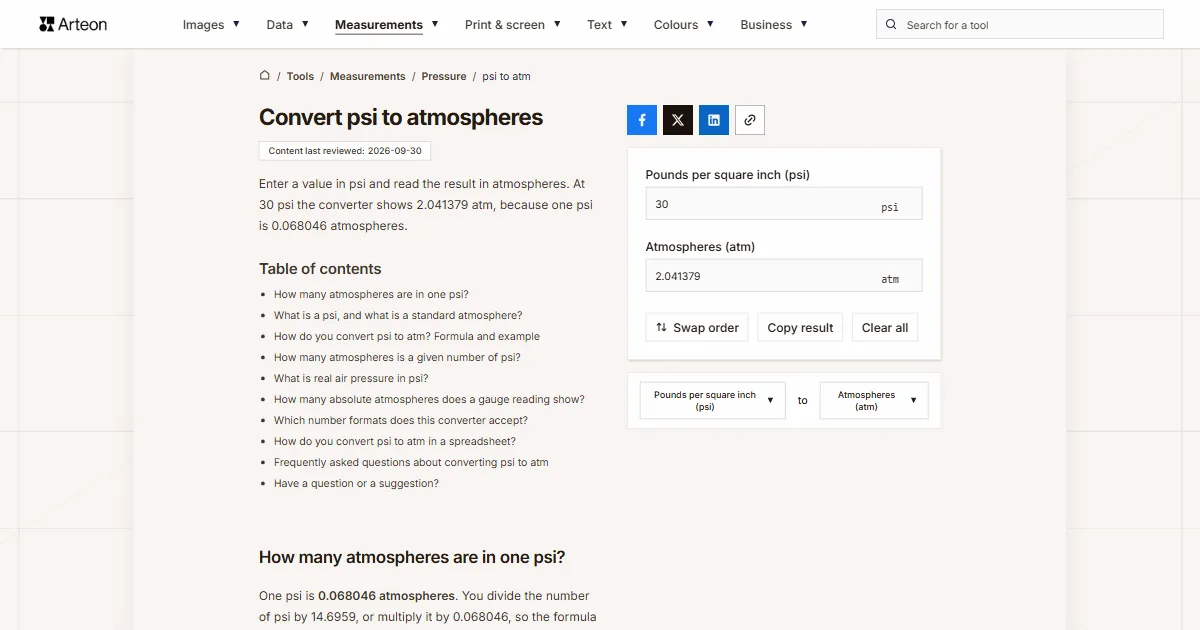
Enter a value in psi and read the result in atmospheres. At 30 psi the converter shows 2.041379 atm, because one psi is 0.068046 atmospheres.
How many atmospheres are in one psi?
One psi is 0.068046 atmospheres. You divide the number of psi by 14.6959, or multiply it by 0.068046, so the formula reads atm = psi ÷ 14.6959.
Both numbers are the ratio of the two definitions, rounded. A psi is 6,894.757 pascals and an atmosphere is 101,325 pascals[1], so the quotient is 0.068 046 0 and the IUPAC pressure conversion table prints the same value[2].
Because the atmosphere is more than fourteen times the larger unit, one psi lands below a tenth of an atmosphere. Thirty psi give 2.041379 atmospheres and a hundred psi give 6.804596. The converter shows six decimal places so that neighbouring gauge readings stay apart.
The same divisor covers the whole range. A reading of 14.7 psi comes to 1.000276 atmospheres, just over unity. Three thousand psi give 204.137892 atmospheres.
What is a psi, and what is a standard atmosphere?
A psi comes from one pound-force spread over one square inch[3]. That definition ties the unit to the customary system, and its value in SI units is 6,894.757 pascals[1].
The standard atmosphere describes air pressure at sea level and is exactly 101,325 pascals[1]. It is sometimes used as a reference pressure and carries the symbol atm[4].
One unit therefore comes from force and area, and the other out of the weight of the air itself. That is why the factor between them carries four decimal places.
How do you convert psi to atm? Formula and example
The arithmetic comes down to one division. Three gauge readings follow, each worked out in full.
Thirty psi give 2.041379 atmospheres. Fifty psi come to 3.402298 atmospheres. Three thousand psi work out to 204.137892 atmospheres.
The atm to psi converter runs the calculation the other way. For the units printed on European gauges, the same reading goes through the psi to bar converter or the psi to kPa converter.
How many atmospheres is a given number of psi?
| Psi | Atmospheres | Bar |
|---|---|---|
| 1 psi | 0.068046 atm | 0.0689 bar |
| 2 psi | 0.136092 atm | 0.1379 bar |
| 5 psi | 0.34023 atm | 0.3447 bar |
| 7 psi | 0.476322 atm | 0.4826 bar |
| 8 psi | 0.544368 atm | 0.5516 bar |
| 10 psi | 0.68046 atm | 0.6895 bar |
| 12 psi | 0.816552 atm | 0.8274 bar |
| 14 psi | 0.952643 atm | 0.9653 bar |
| 14.7 psi | 1.000276 atm | 1.0135 bar |
| 15 psi | 1.020689 atm | 1.0342 bar |
| 20 psi | 1.360919 atm | 1.379 bar |
| 25 psi | 1.701149 atm | 1.7237 bar |
| 29 psi | 1.973333 atm | 1.9995 bar |
| 30 psi | 2.041379 atm | 2.0684 bar |
| 32 psi | 2.177471 atm | 2.2063 bar |
| 35 psi | 2.381609 atm | 2.4132 bar |
| 36 psi | 2.449655 atm | 2.4821 bar |
| 40 psi | 2.721839 atm | 2.7579 bar |
| 45 psi | 3.062068 atm | 3.1026 bar |
| 50 psi | 3.402298 atm | 3.4474 bar |
| 55 psi | 3.742528 atm | 3.7921 bar |
| 60 psi | 4.082758 atm | 4.1369 bar |
| 65 psi | 4.422988 atm | 4.4816 bar |
| 70 psi | 4.763217 atm | 4.8263 bar |
| 75 psi | 5.103447 atm | 5.1711 bar |
| 80 psi | 5.443677 atm | 5.5158 bar |
| 85 psi | 5.783907 atm | 5.8605 bar |
| 90 psi | 6.124137 atm | 6.2053 bar |
| 100 psi | 6.804596 atm | 6.8948 bar |
| 110 psi | 7.485056 atm | 7.5842 bar |
| 120 psi | 8.165516 atm | 8.2737 bar |
| 130 psi | 8.845975 atm | 8.9632 bar |
| 145 psi | 9.866665 atm | 9.9974 bar |
| 150 psi | 10.206895 atm | 10.3421 bar |
| 175 psi | 11.908044 atm | 12.0658 bar |
| 200 psi | 13.609193 atm | 13.7895 bar |
| 250 psi | 17.011491 atm | 17.2369 bar |
| 300 psi | 20.413789 atm | 20.6843 bar |
| 400 psi | 27.218386 atm | 27.579 bar |
| 500 psi | 34.022982 atm | 34.4738 bar |
| 750 psi | 51.034473 atm | 51.7107 bar |
| 1,000 psi | 68.045964 atm | 68.9476 bar |
| 1,500 psi | 102.068946 atm | 103.4214 bar |
| 2,000 psi | 136.091928 atm | 137.8951 bar |
| 3,000 psi | 204.137892 atm | 206.8427 bar |
| 4,500 psi | 306.206838 atm | 310.2641 bar |
| 5,000 psi | 340.22982 atm | 344.7379 bar |
| 10,000 psi | 680.459639 atm | 689.4757 bar |
What is real air pressure in psi?
| Measured pressure | Where and when | Atmospheres | Psi |
|---|---|---|---|
| 1,089.1 hPa | Record above 750 m: Tosontsengel, Mongolia, 30 December 2004 | 1.0749 atm | 15.7961 psi |
| 1,083.8 hPa | Record below 750 m: Agata, Russian Federation, 31 December 1968 | 1.0696 atm | 15.7192 psi |
| 1,053.6 hPa | UK record: Aberdeen Observatory, 31 January 1902 | 1.0398 atm | 15.2812 psi |
| 1,013.25 hPa | Standard atmosphere, the agreed value | 1 atm | 14.6959 psi |
| 870 hPa | Lowest at sea level: the eye of Typhoon Tip, 12 October 1979 | 0.8586 atm | 12.6183 psi |
How many absolute atmospheres does a gauge reading show?
| Gauge reading | Absolute pressure | Absolute atmospheres |
|---|---|---|
| 0 psi | 14.6959 psi | 1 atm |
| 15 psi | 29.6959 psi | 2.0207 atm |
| 30 psi | 44.6959 psi | 3.0414 atm |
| 32 psi | 46.6959 psi | 3.1775 atm |
| 50 psi | 64.6959 psi | 4.4023 atm |
| 100 psi | 114.6959 psi | 7.8046 atm |
| 200 psi | 214.6959 psi | 14.6092 atm |
| 3,000 psi | 3,014.6959 psi | 205.1379 atm |
Which number formats does this converter accept?
| What you type | What the converter shows | Note |
|---|---|---|
| 30 | 2.041379 atm | A plain number is read as psi, because that’s what the field is labeled. |
| 30 psi | 2.041379 atm | The psi symbol pasted along with the number is skipped, in capitals too. |
| 30 psig | 2.041379 atm | The psig suffix marks a gauge reading. The field skips it, and the result stays gauge pressure, only in atmospheres. |
| 14.7 psia | 1.000276 atm | The psia suffix marks absolute pressure. The field skips it, so the result is in absolute atmospheres. |
| 2.5 | 0.170115 atm | The period is your decimal point, and that’s exactly how we read it. |
| 2,5 | 0.170115 atm | A comma with fewer than three digits after it is a decimal comma from a European document, so we read two and a half psi. |
| 1.500 | 0.102069 atm | A single period is always read as a decimal point, so the field takes one and a half psi. A note under the field says: Read as 1.5. If you meant 1500, type 1500. |
| 1,500 | 102.068946 atm | A comma followed by three digits groups thousands, so the field reads fifteen hundred psi. A note under the field says: Read as 1500. If you meant 1.5, type 1.5. |
| 1/2 | 0.034023 atm | A fraction with a slash is worked out for you, so half a psi doesn’t need to become 0.5 first. |
| -5 | -0.34023 atm | A minus sign is accepted, so a vacuum gauge reading in psi converts too. |
| -80 kPa | -0.789539 atm | A pressure in another unit is converted by the field itself, minus sign included, as long as the minus sits right against the number. |
| - 80 kPa | The result field stays empty. | A minus separated by a space isn’t joined to the number, so nothing is calculated. Type the minus right before the digit. |
How do you convert psi to atm in a spreadsheet?
Excel carries a built-in function for pressure units, so it supplies the factor itself.
Type the gauge reading in psi
Put the number of psi in a cell, for example 30 in cell A2.Call the CONVERT function
In the next cell type =CONVERT(A2,"psi","atm"). The function takes number, from_unit and to_unit[7].Show more decimal places
Excel rounds the displayed result to the column width, so on the Home tab click Increase Decimal until six decimal places appear.Drag the formula down
Grab the bottom right corner of the result cell and drag it along the column to convert a whole list of readings at once.
Convert Pounds per square inch (psi) to other units
Sources
- NIST Guide to the SI, Appendix B.9: Factors for Units Listed by Kind of Quantity or Field of Science — National Institute of Standards and Technology
- Quantities, Units and Symbols in Physical Chemistry (Green Book), 3rd edition, p. 233 — International Union of Pure and Applied Chemistry
- Pound per square inch — Wikipedia
- Standard atmosphere (unit) — Wikipedia
- Global Weather & Climate Extremes Archive, table of records — World Meteorological Organization
- National Meteorological Library and Archive Factsheet 9: Weather extremes — Met Office
- CONVERT function — Microsoft
Every figure in the tables was computed from the unit definitions and checked arithmetically before publication. Historical values and the names of local units come from the sources listed above.
Content last reviewed: · written and checked by the Arteon team
Frequently asked questions about converting psi to atm
How many atm is 30 psi?
Thirty psi come to 2.041379 atmospheres, or 2.0684 bar. That is the reading on a tire gauge set to 30 psi.
How many atm is 50 psi?
Fifty psi give 3.402298 atmospheres. In bar the same reading is 3.4474.
How many atm is 60 psi?
Sixty psi come to 4.082758 atmospheres, or 4.1369 bar. The relation is linear, so twice the psi gives twice the atmospheres.
How many atm is 100 psi?
A hundred psi come to 6.804596 atmospheres. In bar the same reading is 6.8948, close to seven times the air pressure at sea level.
How many atm is 3000 psi?
Three thousand psi come to 204.137892 atmospheres. In bar the same reading is 206.8427.
How many atm is 1 psi?
One psi is 0.068046 atmospheres. One atmosphere therefore comes to just under fifteen psi, or 14.695 948 8 to seven decimal places.
Is 14.7 psi one atmosphere?
A reading of 14.7 psi gives 1.000276 atmospheres. The full value is 14.695 948 8 psi, so rounding to 14.7 lifts the result by just under three ten-thousandths of an atmosphere.
Why does a gauge read zero when one atmosphere surrounds it?
A gauge measures pressure above its surroundings, so with the same pressure on both sides it points at zero. You get absolute pressure by adding 14.6959 psi to the reading.
How many atmospheres are in a tire inflated to 32 psi?
A reading of 32 psi answers to 2.177471 atmospheres of gauge pressure. The air inside is at 3.1775 atmospheres absolute, because the surrounding atmosphere adds to the reading.
What are the records for sea-level air pressure?
The World Meteorological Organization lists 1,089.1 hPa at Tosontsengel in Mongolia as the highest sea-level air pressure and 870 hPa in the eye of Typhoon Tip as the lowest. In psi that spans 12.6183 to 15.7961.
Have a question or a suggestion?
Write to us if you need another pressure unit converted, or if you spot a value in the tables worth correcting.