Numbers to Roman Numerals – Converter for Numbers and Dates
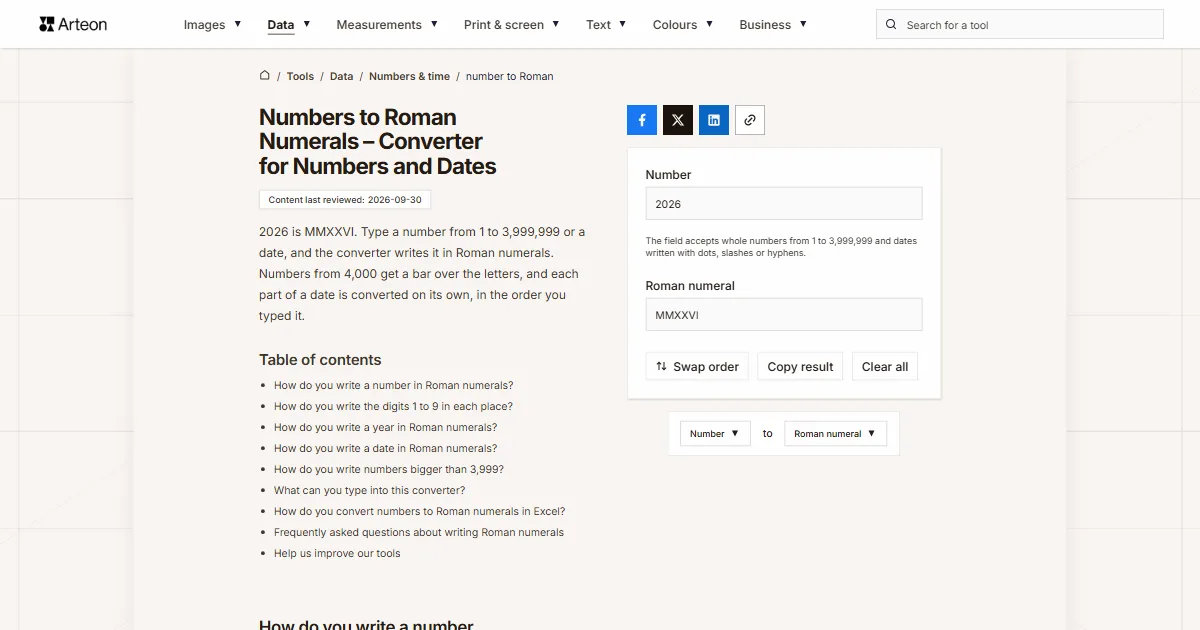
2026 is MMXXVI. Type a number from 1 to 3,999,999 or a date, and the converter writes it in Roman numerals. Numbers from 4,000 get a bar over the letters, and each part of a date is converted on its own, in the order you typed it.
The field accepts whole numbers from 1 to 3,999,999 and dates written with dots, slashes or hyphens.
How do you write a number in Roman numerals?
Split the number into thousands, hundreds, tens and ones, write each part on its own and put them side by side from largest to smallest[1]. Any zero is simply left out, because Roman numerals have no symbol for it.
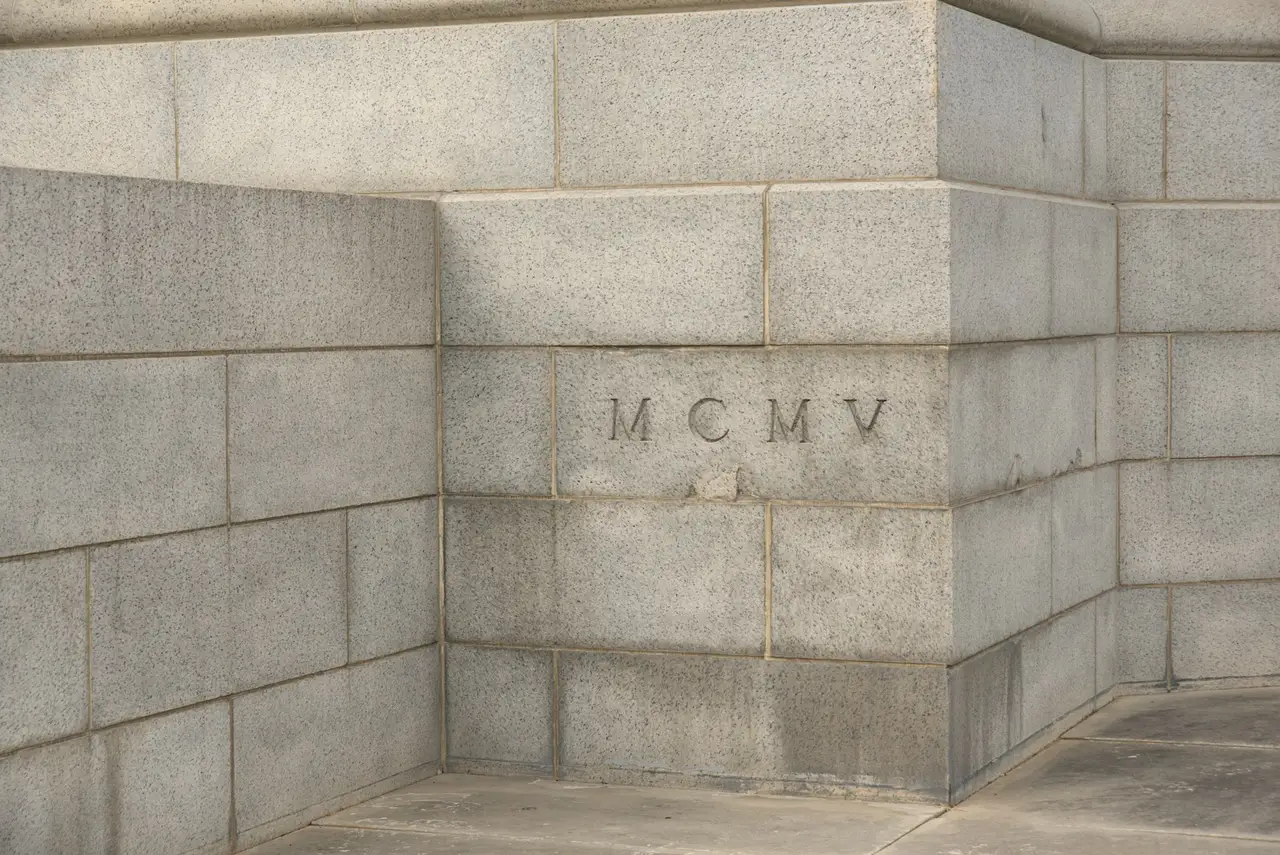
Take 1944. One thousand is M, nine hundred is CM, forty is XL and four is IV, so the whole number is MCMXLIV. 2026 is shorter: two thousand is MM, twenty is XX and six is VI, which gives MMXXVI.
Fours and nines are written by subtraction, with the smaller letter in front of the larger one. Modern usage keeps to six pairs: IV, IX, XL, XC, CD and CM[1]. That is why 49 is XLIX, forty plus nine.
How do you write the digits 1 to 9 in each place?
| Digit | Ones | Tens | Hundreds | Thousands |
|---|---|---|---|---|
| 1 | I | X | C | M |
| 2 | II | XX | CC | MM |
| 3 | III | XXX | CCC | MMM |
| 4 | IV | XL | CD | I̅V̅ |
| 5 | V | L | D | V̅ |
| 6 | VI | LX | DC | V̅I̅ |
| 7 | VII | LXX | DCC | V̅I̅I̅ |
| 8 | VIII | LXXX | DCCC | V̅I̅I̅I̅ |
| 9 | IX | XC | CM | I̅X̅ |
How do you write a year in Roman numerals?
| Year | Roman numeral |
|---|---|
| 1970 | MCMLXX |
| 1971 | MCMLXXI |
| 1972 | MCMLXXII |
| 1973 | MCMLXXIII |
| 1974 | MCMLXXIV |
| 1975 | MCMLXXV |
| 1976 | MCMLXXVI |
| 1977 | MCMLXXVII |
| 1978 | MCMLXXVIII |
| 1979 | MCMLXXIX |
| 1980 | MCMLXXX |
| 1981 | MCMLXXXI |
| 1982 | MCMLXXXII |
| 1983 | MCMLXXXIII |
| 1984 | MCMLXXXIV |
| 1985 | MCMLXXXV |
| 1986 | MCMLXXXVI |
| 1987 | MCMLXXXVII |
| 1988 | MCMLXXXVIII |
| 1989 | MCMLXXXIX |
| 1990 | MCMXC |
| 1991 | MCMXCI |
| 1992 | MCMXCII |
| 1993 | MCMXCIII |
| 1994 | MCMXCIV |
| 1995 | MCMXCV |
| 1996 | MCMXCVI |
| 1997 | MCMXCVII |
| 1998 | MCMXCVIII |
| 1999 | MCMXCIX |
| 2000 | MM |
| 2001 | MMI |
| 2002 | MMII |
| 2003 | MMIII |
| 2004 | MMIV |
| 2005 | MMV |
| 2006 | MMVI |
| 2007 | MMVII |
| 2008 | MMVIII |
| 2009 | MMIX |
| 2010 | MMX |
| 2011 | MMXI |
| 2012 | MMXII |
| 2013 | MMXIII |
| 2014 | MMXIV |
| 2015 | MMXV |
| 2016 | MMXVI |
| 2017 | MMXVII |
| 2018 | MMXVIII |
| 2019 | MMXIX |
| 2020 | MMXX |
| 2021 | MMXXI |
| 2022 | MMXXII |
| 2023 | MMXXIII |
| 2024 | MMXXIV |
| 2025 | MMXXV |
| 2026 | MMXXVI |
| 2027 | MMXXVII |
| 2028 | MMXXVIII |
| 2029 | MMXXIX |
| 2030 | MMXXX |
How do you write a date in Roman numerals?
Type the date the way you normally write it and the converter turns the day, the month and the year into Roman numerals separately, keeping the separators in place. It never reorders the parts, so the result follows your own date format.
In the United States the month comes first, so July 4, 1776 typed as 7/4/1776 becomes VII/IV/MDCCLXXVI. In the United Kingdom and Australia the day comes first, so 4 July 1776 typed as 4/7/1776 becomes IV/VII/MDCCLXXVI. Both results are correct, but they are not interchangeable, so for a tattoo or an engraving check the order before you copy.
A leading zero disappears, because a Roman numeral has no zero: 05 becomes V. If you want a middle dot between the parts, for example for an engraving, type the date with it, for example 12·05·1990, and the converter keeps it: XII·V·MCMXC. To read a Roman numeral date back, use the Roman numerals to numbers converter.
How do you write numbers bigger than 3,999?
Plain Roman numerals stop at 3,999, which is MMMCMXCIX. For bigger numbers the Romans used, among other methods, a bar over the letters called a vinculum, which multiplies the value by 1,000[1].
The converter uses it from 4,000 up: it writes the thousands with a bar over every letter and the rest without one. 4,000 is I̅V̅, 10,000 is X̅, 25,000 is X̅X̅V̅ and 1,000,000 is M̅. When the result has a bar, a line under it explains what the bar means.
The bar is a separate combining character that sits right after its letter. The Copy result button copies each letter with its bar, so you can paste the result into a document without retyping it. The largest number the converter writes is 3,999,999.
What can you type into this converter?
| What you type | What the converter shows | Note |
|---|---|---|
| 2026 | MMXXVI | A plain number, such as this year, goes in as it is. |
| 1,000,000 | M̅ | Commas between the thousands are ignored, and a million comes out as M with a bar. |
| 7/4/1776 | VII/IV/MDCCLXXVI | A US date in month, day, year order is converted part by part, and the order stays. |
| 04/07/1776 | IV/VII/MDCCLXXVI | A UK or Australian date in day, month, year order works the same way, and the leading zeros disappear. |
| 12·05·1990 | XII·V·MCMXC | A middle dot, for example for an engraving, stays in the result. |
| 1990–2026 | MCMXC–MMXXVI | A range of years is converted on both sides, and the dash stays. |
| 1 500 | MD | A space between the thousands, common in European text, is read the same as a comma. |
| 5. | V. | The dot after a list number stays after the result. |
How do you convert numbers to Roman numerals in Excel?
For one number the field above is faster. For a whole column, Excel's ROMAN function does the job when you drag it down.
Enter the ROMAN formula
Put the number in cell A1 and the formula =ROMAN(A1) in cell B1. For 2026 you get MMXXVI. The function returns the numeral as text[2].Stay within the range
ROMAN returns #VALUE! for a negative number and for any number greater than 3,999[2]. Numbers with a bar over the letters are only available in the field above.Leave the form argument out unless you need it
The optional second argument picks a style from 0 to 4. Zero, or no argument, gives the classic numeral, and higher values shorten it with unusual subtraction: for 499 the function returns CDXCIX, LDVLIV, XDIX, VDIV and ID in turn[2]. Only the first one is the standard form.
Sources
- Roman numerals — Wikipedia
- ROMAN function — Microsoft
Every figure in the tables was computed from the unit definitions and checked arithmetically before publication. Historical values and the names of local units come from the sources listed above.
Content last reviewed: · written and checked by the Arteon team
Frequently asked questions about writing Roman numerals
Why is 4,000 not written MMMM?
Because the standard form never repeats a letter four times. From 4,000 up the converter uses a bar over the letters and writes 4,000 as I̅V̅, which is IV times 1,000.
Can you write a fraction or a negative number in Roman numerals?
Not with the letters I to M, so the converter shows a message for both. The Romans did have a sign for one half, S, and counted smaller fractions in twelfths rather than tenths[1].
Which separator should I use in a date for a tattoo or an engraving?
Any one you like: a dot, a slash, a hyphen, a middle dot or a space. The converter keeps whatever separator you typed, so you see straight away how the date will look.
Can I paste the result into Word or Google Docs?
Yes. Click Copy result and paste it wherever you need it. A result with a bar carries the bar as a separate character after each letter.
Help us improve our tools
Have an idea, found a bug, or want to suggest another tool? Drop us a message.