Convert kilograms to micrograms
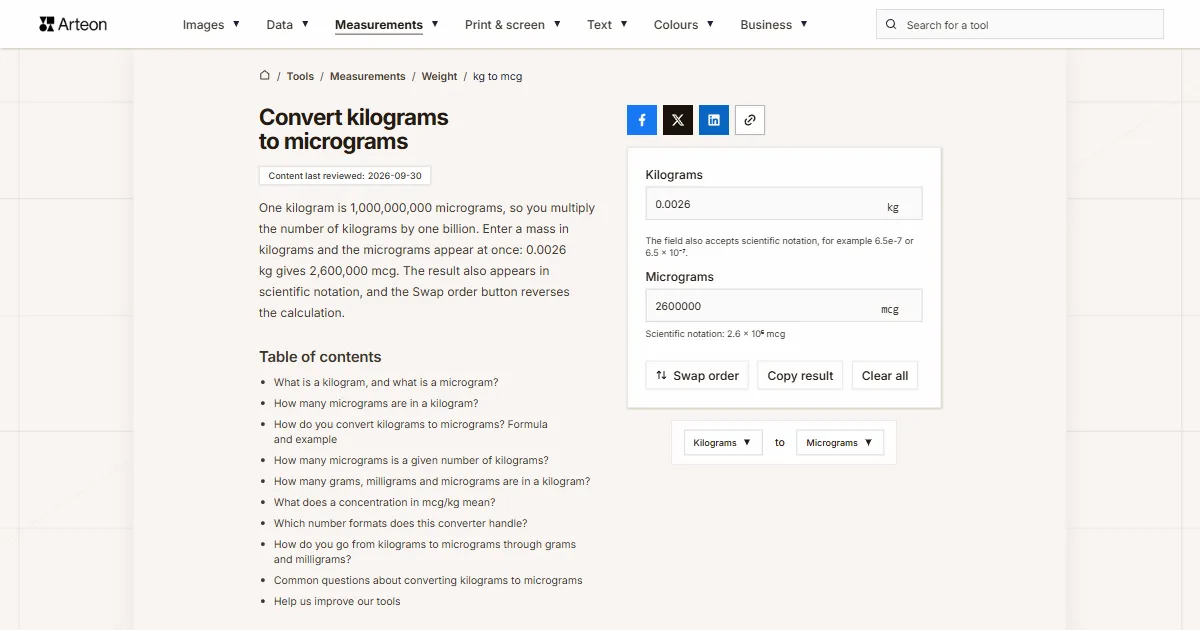
One kilogram is 1,000,000,000 micrograms, so you multiply the number of kilograms by one billion. Enter a mass in kilograms and the micrograms appear at once: 0.0026 kg gives 2,600,000 mcg. The result also appears in scientific notation, and the Swap order button reverses the calculation.
The field also accepts scientific notation, for example 6.5e-7 or 6.5 × 10⁻⁷.
What is a kilogram, and what is a microgram?
The kilogram is the SI base unit of mass. NIST lists it among the seven SI base units and gives it the symbol kg[1]. For historical reasons its name already contains a prefix, kilo, and this has a practical effect on this page. Prefixes for mass attach to the name “gram” and to the symbol “g”, as the NIST rule on prefixes and the kilogram states[2].
A microgram is a gram combined with the prefix micro. The NIST table of SI prefixes gives micro the factor 10⁻⁶[1], so one microgram is one millionth of a gram. The same guide describes how every prefix works: a prefix name attaches directly to the name of a unit, and a prefix symbol attaches directly to its symbol[1].
The two units are nine orders of magnitude apart. The Wikipedia entries on the kilogram and the microgram describe both units in more detail. The table of prefixes on this page sets out the same ladder, and you can convert micrograms to milligrams with the mcg to mg converter.
How many micrograms are in a kilogram?
One kilogram is 1,000,000,000 micrograms, or one billion. As a power of ten that is 10⁹, the same factor that the table of SI prefixes assigns to giga[1]. Converting kilograms to micrograms moves the decimal point nine places to the right.
The number comes from two steps. One kilogram is one thousand grams. One gram is one million micrograms, because the prefix micro means one millionth[1]. One thousand multiplied by one million gives one billion.
The same multiplier applies to every value in between. A quarter of a kilogram is 250,000,000 mcg. One thousandth of a kilogram, which is one gram, gives 1,000,000 mcg.
In the other direction the number looks like this: one microgram is 0.000000001 kilograms, or 10⁻⁹ kg.
For that reason both fields of the converter accept scientific notation, and a line with the power of ten appears under the result field. A body mass of 70 kg is 70,000,000,000 mcg, and that line shows it as 7 × 10¹⁰.
How do you convert kilograms to micrograms? Formula and example
The formula has one factor: mcg = kg × 1,000,000,000. Take a mass of 0.0026 kg, for example a value copied from a label into a spreadsheet. Multiply it by one billion and you get 2,600,000 mcg.
The formula gives three results for round fractions of a kilogram. Half a kilogram is 500,000,000 mcg. One tenth of a kilogram gives 100,000,000 mcg. One hundredth of a kilogram, which is ten grams, is 10,000,000 mcg.
Powers of ten make numbers of this length easier to read. The value 2,600,000 mcg is 2.6 × 10⁶, and 70,000,000,000 mcg is 7 × 10¹⁰. The converter gives both forms at once: the number in the result field and the power of ten in the Scientific notation line under it.
You can turn a mass in micrograms into kilograms with the mcg to kg converter, and the grams to mcg converter covers the step through the gram.
How many micrograms is a given number of kilograms?
| Mass in kilograms | Mass in micrograms | Scientific notation |
|---|---|---|
| 0.000001 kg | 1,000 mcg | 1 × 10³ |
| 0.00001 kg | 10,000 mcg | 1 × 10⁴ |
| 0.0001 kg | 100,000 mcg | 1 × 10⁵ |
| 0.001 kg | 1,000,000 mcg | 1 × 10⁶ |
| 0.0026 kg | 2,600,000 mcg | 2.6 × 10⁶ |
| 0.005 kg | 5,000,000 mcg | 5 × 10⁶ |
| 0.01 kg | 10,000,000 mcg | 1 × 10⁷ |
| 0.02 kg | 20,000,000 mcg | 2 × 10⁷ |
| 0.05 kg | 50,000,000 mcg | 5 × 10⁷ |
| 0.1 kg | 100,000,000 mcg | 1 × 10⁸ |
| 0.2 kg | 200,000,000 mcg | 2 × 10⁸ |
| 0.25 kg | 250,000,000 mcg | 2.5 × 10⁸ |
| 0.5 kg | 500,000,000 mcg | 5 × 10⁸ |
| 0.75 kg | 750,000,000 mcg | 7.5 × 10⁸ |
| 1 kg | 1,000,000,000 mcg | 1 × 10⁹ |
| 1.5 kg | 1,500,000,000 mcg | 1.5 × 10⁹ |
| 2 kg | 2,000,000,000 mcg | 2 × 10⁹ |
| 2.5 kg | 2,500,000,000 mcg | 2.5 × 10⁹ |
| 5 kg | 5,000,000,000 mcg | 5 × 10⁹ |
| 10 kg | 10,000,000,000 mcg | 1 × 10¹⁰ |
| 20 kg | 20,000,000,000 mcg | 2 × 10¹⁰ |
| 50 kg | 50,000,000,000 mcg | 5 × 10¹⁰ |
| 70 kg | 70,000,000,000 mcg | 7 × 10¹⁰ |
| 100 kg | 100,000,000,000 mcg | 1 × 10¹¹ |
How many grams, milligrams and micrograms are in a kilogram?
| Unit | How many in a kilogram | Power of ten | Prefix |
|---|---|---|---|
| kilogram (kg) | 1 | 10⁰ | kilo, 10³ grams |
| gram (g) | 1,000 | 10³ | no prefix |
| milligram (mg) | 1,000,000 | 10⁶ | milli, 10⁻³ of a gram |
| microgram (µg, mcg) | 1,000,000,000 | 10⁹ | micro, 10⁻⁶ of a gram |
| nanogram (ng) | 1,000,000,000,000 | 10¹² | nano, 10⁻⁹ of a gram |
What does a concentration in mcg/kg mean?
| Concentration | Parts per billion (ppb) | Substance in 1 kg | Substance in 100 g |
|---|---|---|---|
| 1 mcg/kg | 1 | 1 mcg | 0.1 mcg |
| 5 mcg/kg | 5 | 5 mcg | 0.5 mcg |
| 10 mcg/kg | 10 | 10 mcg | 1 mcg |
| 20 mcg/kg | 20 | 20 mcg | 2 mcg |
| 100 mcg/kg | 100 | 100 mcg | 10 mcg |
| 1 mg/kg | 1,000 | 1,000 mcg | 100 mcg |
Which number formats does this converter handle?
| What you type | What the converter shows | How we read it |
|---|---|---|
| 0.25 | 250000000 mcg | The decimal point from the numeric keypad, written the way English writes it |
| 0,25 | 250000000 mcg | A comma pasted from a market that writes decimals that way is read as a decimal point, so the result is the same |
| 1,500 | 1500000000000 mcg | Three digits follow the comma, so we read it as a thousands separator: the field holds one thousand five hundred. A note under the field shows the other possible reading, 1.5. |
| 3/4 | 750000000 mcg | We work the fraction out ourselves, so there is no need to turn it into a decimal first |
| 2½ | 2500000000 mcg | The ½ character copied from a recipe or a label is added to the number in front of it |
| 0.25 kg | 250000000 mcg | A unit symbol pasted along with the number is no trouble: we take the number and leave the symbol out |
| 2.6e-3 | 2600000 mcg | Scientific notation, the way a spreadsheet shows very small numbers, is read as it stands |
How do you go from kilograms to micrograms through grams and milligrams?
A single multiplication gives the same result, and working through the steps shows where the billion comes from. The steps convert a mass of 0.25 kg.
Convert kilograms to grams
Multiply by one thousand. 0.25 kg gives 250 g.Convert grams to milligrams
Multiply by one thousand again. 250 g gives 250,000 mg.Convert milligrams to micrograms
Multiply by one thousand a third time and you have 250,000,000 mcg. Three multiplications by one thousand give one billion in total, the multiplier from the conversion formula.Check the result as a power of ten
The value 250,000,000 mcg is 2.5 × 10⁸. The converter shows this form in the Scientific notation line under the result field, so you have both forms side by side.
Convert other units to Micrograms
Convert Kilograms to other units
Sources
- NIST Guide to the SI, Chapter 4: Table 1 (SI base units) and Table 5 (SI prefixes) — National Institute of Standards and Technology
- NIST Guide to the SI, Chapter 6, Section 6.2.7: Prefixes and the kilogram — National Institute of Standards and Technology
- NIST Guide to the SI, Chapter 7, Section 7.10.3: ppm, ppb and ppt — National Institute of Standards and Technology
- Compliance Policy Guide Sec. 555.400: Aflatoxins in Human Food — U.S. Food and Drug Administration
Every figure in the tables was computed from the unit definitions and checked arithmetically before publication. Historical values and the names of local units come from the sources listed above.
Content last reviewed: · written and checked by the Arteon team
Common questions about converting kilograms to micrograms
How many micrograms are in one kilogram?
One kilogram is 1,000,000,000 micrograms, or 10⁹. A kilogram is one thousand grams, and a gram is one million micrograms, because the prefix micro means one millionth[1]. One thousand multiplied by one million is one billion.
Are µg and mcg the same unit?
Yes, they are two ways of writing one unit. The SI symbol is µg, with the Greek letter mu, while mcg uses Latin letters only. The conversion result is identical for both. A comparison of the spellings, with the places where each one applies, is on the mcg to kg converter page.
How many mcg is 0.5 kg?
Half a kilogram is 500,000,000 mcg, or 5 × 10⁸. The same mass is 500 g in grams and 500,000 mg in milligrams.
What does mcg/kg mean on a lab report or in a food standard?
It is a concentration: the number of micrograms of a substance in each kilogram of a product. One microgram per kilogram corresponds to one part per billion. NIST uses unit ratios such as ng/kg in place of ppb, partly because the names of numbers from 10⁹ upwards differ between countries[3].
Does the field accept scientific notation copied from a spreadsheet?
Yes. The field accepts 2.6e-3 and 2.6 × 10⁻³, as well as a decimal point or comma. A result from one thousand upwards gets a Scientific notation line under the field. The field skips letters as you type. If the entry cannot be read as a number, for example an unfinished power of ten such as 2.6 × 10, the message “This number cannot be converted” appears under the field with an example of a valid entry.
Why is a millionth of a kilogram called a milligram?
For historical reasons the name of the SI base unit of mass already contains the prefix kilo, so further prefixes are formed from the gram[2]. NIST gives exactly this example: 10⁻⁶ kg is written as 1 mg, one milligram.
Help us improve our tools
Have an idea for a feature, found a bug, or want to suggest another tool? Write to us.