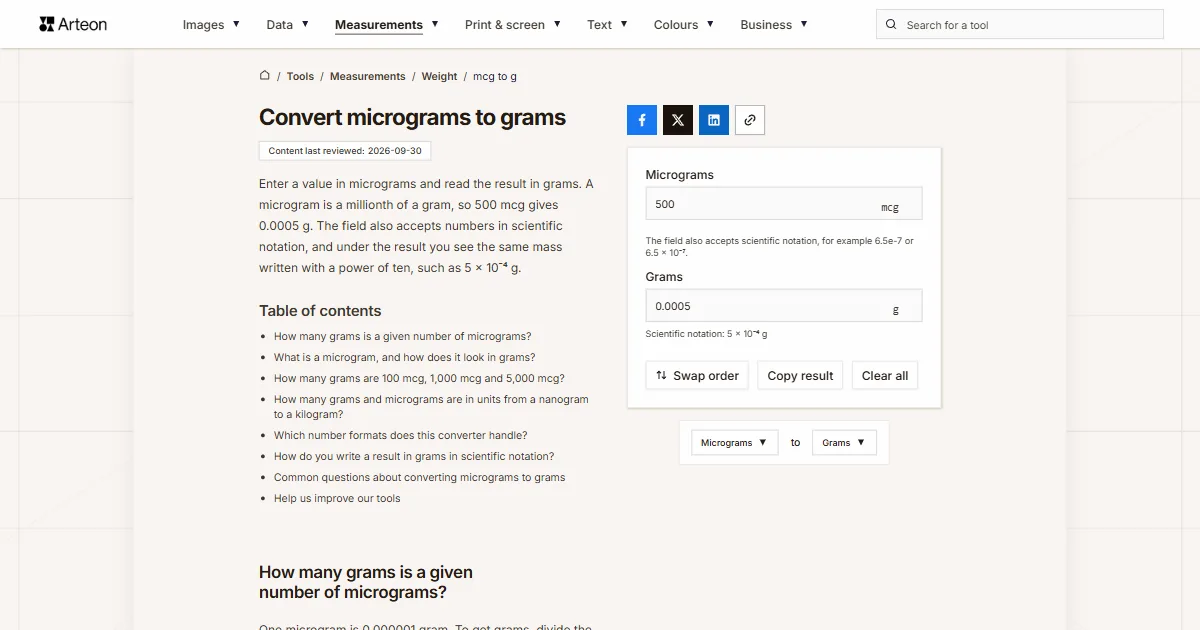
Convert micrograms to grams
Enter a value in micrograms and read the result in grams. A microgram is a millionth of a gram, so 500 mcg gives 0.0005 g. The field also accepts numbers in scientific notation, and under the result you see the same mass written with a power of ten, such as 5 × 10⁻⁴ g.
The field also accepts scientific notation, for example 6.5e-7 or 6.5 × 10⁻⁷.
How many grams is a given number of micrograms?
One microgram is 0.000001 gram. To get grams, divide the number of micrograms by one million. A value of 500 mcg therefore gives 0.0005 g.
Formula: grams = micrograms ÷ 1,000,000
By hand, you move the decimal point six places to the left. In this way, 2,500 mcg becomes 0.0025 g. A value of 50 mcg gives 0.00005 g. Any value below one million gives less than one gram, so the result starts with a zero and a decimal point.
A gram has a million micrograms, because the SI prefix micro means one millionth[1].
The converter shows even a thousandth of a microgram, which is 0.000000001 g. Under the result field, the same number appears in scientific notation. For 500 mcg, that is 5 × 10⁻⁴ g. The input field also accepts a value copied from a spreadsheet, for example 2.5E+03 for 2,500 mcg.
To convert grams to micrograms, use the grams to micrograms converter. The intermediate result in milligrams comes from the micrograms to milligrams converter.
What is a microgram, and how does it look in grams?
A microgram is one millionth of a gram, and its symbol is µg. In the SI, the Greek letter μ stands for the prefix micro, which means a factor of 10⁻⁶[1].
Written as a decimal, one microgram is 0.000001 g, with the digit 1 in the sixth decimal place. In scientific notation, the same mass is 1 × 10⁻⁶ g.
The US Institute for Safe Medication Practices and the FDA recommend the abbreviation mcg for medical information, because μ can be misread as m for milli[2].
How many grams are 100 mcg, 1,000 mcg and 5,000 mcg?
| Micrograms | Grams | Scientific notation |
|---|---|---|
| 0.1 mcg | 0.0000001 g | 1 × 10⁻⁷ g |
| 0.5 mcg | 0.0000005 g | 5 × 10⁻⁷ g |
| 1 mcg | 0.000001 g | 1 × 10⁻⁶ g |
| 2 mcg | 0.000002 g | 2 × 10⁻⁶ g |
| 2.4 mcg | 0.0000024 g | 2.4 × 10⁻⁶ g |
| 3 mcg | 0.000003 g | 3 × 10⁻⁶ g |
| 4 mcg | 0.000004 g | 4 × 10⁻⁶ g |
| 5 mcg | 0.000005 g | 5 × 10⁻⁶ g |
| 10 mcg | 0.00001 g | 1 × 10⁻⁵ g |
| 20 mcg | 0.00002 g | 2 × 10⁻⁵ g |
| 25 mcg | 0.000025 g | 2.5 × 10⁻⁵ g |
| 30 mcg | 0.00003 g | 3 × 10⁻⁵ g |
| 40 mcg | 0.00004 g | 4 × 10⁻⁵ g |
| 50 mcg | 0.00005 g | 5 × 10⁻⁵ g |
| 60 mcg | 0.00006 g | 6 × 10⁻⁵ g |
| 75 mcg | 0.000075 g | 7.5 × 10⁻⁵ g |
| 90 mcg | 0.00009 g | 9 × 10⁻⁵ g |
| 100 mcg | 0.0001 g | 1 × 10⁻⁴ g |
| 150 mcg | 0.00015 g | 1.5 × 10⁻⁴ g |
| 200 mcg | 0.0002 g | 2 × 10⁻⁴ g |
| 250 mcg | 0.00025 g | 2.5 × 10⁻⁴ g |
| 300 mcg | 0.0003 g | 3 × 10⁻⁴ g |
| 400 mcg | 0.0004 g | 4 × 10⁻⁴ g |
| 450 mcg | 0.00045 g | 4.5 × 10⁻⁴ g |
| 500 mcg | 0.0005 g | 5 × 10⁻⁴ g |
| 600 mcg | 0.0006 g | 6 × 10⁻⁴ g |
| 750 mcg | 0.00075 g | 7.5 × 10⁻⁴ g |
| 800 mcg | 0.0008 g | 8 × 10⁻⁴ g |
| 900 mcg | 0.0009 g | 9 × 10⁻⁴ g |
| 1,000 mcg | 0.001 g | 1 × 10⁻³ g |
| 1,200 mcg | 0.0012 g | 1.2 × 10⁻³ g |
| 1,500 mcg | 0.0015 g | 1.5 × 10⁻³ g |
| 2,000 mcg | 0.002 g | 2 × 10⁻³ g |
| 2,500 mcg | 0.0025 g | 2.5 × 10⁻³ g |
| 3,000 mcg | 0.003 g | 3 × 10⁻³ g |
| 4,000 mcg | 0.004 g | 4 × 10⁻³ g |
| 5,000 mcg | 0.005 g | 5 × 10⁻³ g |
| 6,000 mcg | 0.006 g | 6 × 10⁻³ g |
| 7,500 mcg | 0.0075 g | 7.5 × 10⁻³ g |
| 10,000 mcg | 0.01 g | 1 × 10⁻² g |
| 25,000 mcg | 0.025 g | 2.5 × 10⁻² g |
| 50,000 mcg | 0.05 g | 5 × 10⁻² g |
| 100,000 mcg | 0.1 g | 1 × 10⁻¹ g |
| 250,000 mcg | 0.25 g | 2.5 × 10⁻¹ g |
| 500,000 mcg | 0.5 g | 5 × 10⁻¹ g |
| 1,000,000 mcg | 1 g | 1 × 10⁰ g |
How many grams and micrograms are in units from a nanogram to a kilogram?
| Unit | Symbol | In grams | In micrograms | In words |
|---|---|---|---|---|
| Nanogram | ng | 1 × 10⁻⁹ g | 0.001 mcg | one thousandth of a microgram |
| Microgram | mcg | 1 × 10⁻⁶ g | 1 mcg | one microgram |
| Milligram | mg | 1 × 10⁻³ g | 1,000 mcg | one thousand micrograms |
| Gram | g | 1 × 10⁰ g | 1,000,000 mcg | one million micrograms |
| Kilogram | kg | 1 × 10³ g | 1,000,000,000 mcg | one billion micrograms |
Which number formats does this converter handle?
| What you type | What the converter shows | How we read it |
|---|---|---|
| 250.5 | 0.0002505 g | The decimal point from the numeric keypad, written the way English writes it |
| 250,5 | 0.0002505 g | A comma pasted from a market that writes decimals that way is read as a decimal point, so the result is the same |
| 1,500 | 0.0015 g | Three digits follow the comma, so we read it as a thousands separator: the field holds one thousand five hundred. A note under the field shows the other possible reading, 1.5. |
| 1 000 | 0.001 g | A space between thousands, the way a spreadsheet pastes it, does not split the number in two |
| 3/4 | 0.00000075 g | We work the fraction out ourselves, so there is no need to turn it into a decimal first |
| 500½ | 0.0005005 g | The ½ character copied from a recipe or a label is added to the number in front of it |
| 250.5 µg | 0.0002505 g | A unit symbol pasted along with the number is no trouble: we take the number and leave the symbol out |
| 2.6e-3 | 0.0000000026 g | Scientific notation, the way a spreadsheet shows very small numbers, is read as it stands |
How do you write a result in grams in scientific notation?
Scientific notation writes a number as a significand multiplied by a power of ten. In normalized form, the significand is at least 1 and less than 10[3]. The steps show this for 250 mcg.
Divide micrograms by one million
A value of 250 mcg gives 0.00025 g.Move the decimal point after the first nonzero digit
In this way, 0.00025 becomes 2.5. The decimal point has moved four places to the right.Turn the number of moves into the exponent
Four moves to the right give an exponent of minus four, so the result is 2.5 × 10⁻⁴ g. Calculators and computer programs often write the power of ten with the letter E[3]. There, the same mass appears as 2.5E-4.Check the result in the converter
Enter 250 in the micrograms field. The result field shows 0.00025 g, and the line under it shows 2.5 × 10⁻⁴ g.
Convert other units to Grams
Convert Micrograms to other units
Sources
- Metric (SI) Prefixes — National Institute of Standards and Technology
- Microgram — Wikipedia
- Scientific notation — Wikipedia
Every figure in the tables was computed from the unit definitions and checked arithmetically before publication. Historical values and the names of local units come from the sources listed above.
Content last reviewed: · written and checked by the Arteon team
Common questions about converting micrograms to grams
Is 1,000 mcg equal to 1 gram?
One thousand micrograms make one milligram, which is 0.001 g. A gram is a thousand times larger than a milligram and is made up of a million micrograms.
How do you paste a spreadsheet value written as 2.5E+03?
Paste it straight into the micrograms field. The field reads 2.5E+03 as 2,500 mcg and shows the result of 0.0025 g right away. The notation 2.5 × 10³ works the same way.
Does the result depend on whether the label says µg or mcg?
The result is the same, because µg and mcg are two ways of writing one microgram. Enter just the number from the label, and the converter divides it by one million.
Help us improve our tools
Have an idea for a feature, found a bug, or want to suggest another tool? Write to us.