Convert liters to pints
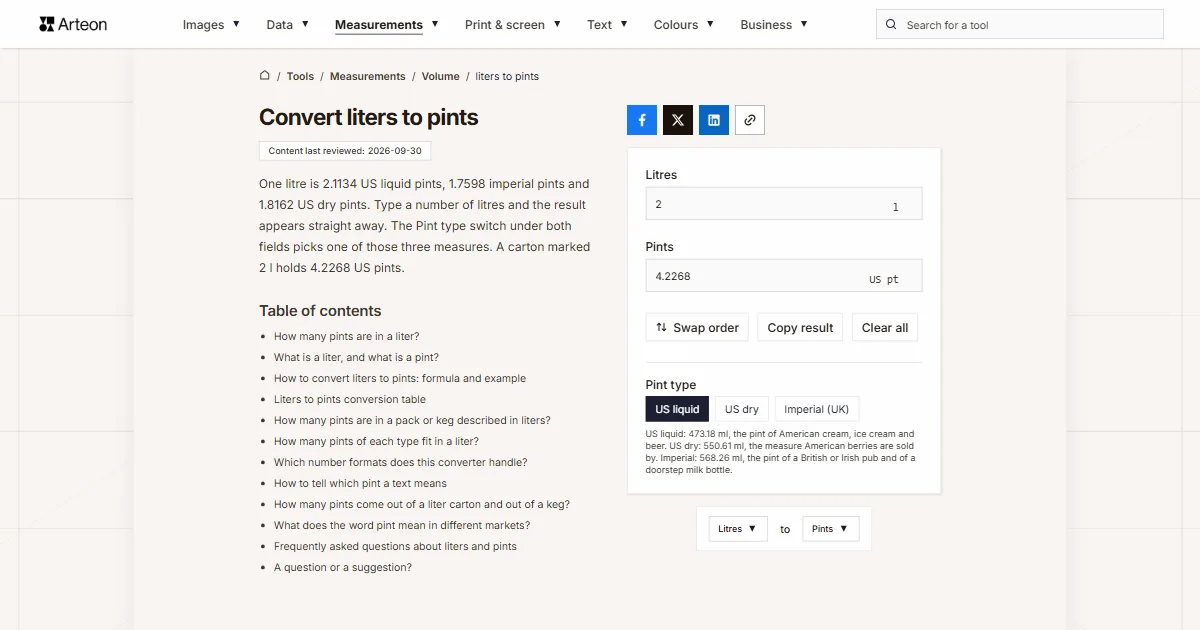
One litre is 2.1134 US liquid pints, 1.7598 imperial pints and 1.8162 US dry pints. Type a number of litres and the result appears straight away. The Pint type switch under both fields picks one of those three measures. A carton marked 2 l holds 4.2268 US pints.
How many pints are in a liter?
One litre is 2.1134 US liquid pints[1]. You divide the number of litres by 0.473176473 and the answer comes out in pints.
That divisor gives four values you meet on drink labels. Half a litre gives 1.0567 pints. A bottle of 0.75 litres gives 1.5850 pints. Two litres give 4.2268 pints. A five-litre keg gives 10.5669 pints.
With the imperial pint the same litre gives fewer servings. One litre is 1.7598 imperial pints, because that pint holds 0.56826125 litres[2]. The third measure, the US dry pint, gives 1.8162 pints to the litre[1]. That series covers dry goods in the United States, so for a drink you stay with the liquid pint.
You pick the measure with the Pint type switch under the fields, and the divisor changes with it. The figure you type may be a fraction, because the field takes both a decimal point and a slash. The result field gives pints to four decimal places.
What is a liter, and what is a pint?
The pint is a measure the United Kingdom kept in trade alongside the metric system. The rules allow draught beer and cider to be dispensed by the pint and milk to be sold by the pint in returnable containers[3], and the weights and measures act fixes its capacity at 0.56826125 cubic decimetres[2].
The US pint is smaller, because it comes from a smaller gallon. The US liquid gallon measures 231 cubic inches, so an eighth of it holds 0.4732 litres[1]. Alongside that, the US series of dry measures has a pint of its own holding 0.5506 litres[1].
The litre has a geometric definition. It is the volume of a cube one decimetre on a side[1], so it descends from no gallon and carries one value in every market.
That is why the converter’s switch applies only to the pint. The same litre in millilitres is shown by the liters to ml converter.
How to convert liters to pints: formula and example
One division does the whole job. You divide the number of litres by 0.473176473 and the answer comes out in US pints.
Take a five-litre keg of beer and a British menu that lists servings in pints. Five litres divided by 0.56826125 gives 8.7988 imperial pints. That keg pours eight full pints, and the ninth falls about a fifth short.
Writing the units out shows why the answer lands in pints: 5 l ÷ (0.56826125 l ÷ 1 pt) = 8.7988 pt. The litre cancels against the litre and the pint is what remains.
For the US liquid pint the divisor is 0.473176473, and for the US dry pint it is 0.5506104713575. The Pint type switch substitutes the right figure on its own, and it recalculates even when you change the measure after typing the number.
The pints to liters converter does the sum the other way round, and capacities written in millilitres go through the ml to pints converter.
Liters to pints conversion table
| Litres | US liquid | US dry | Imperial |
|---|---|---|---|
| 0.25 l | 0.5283 pt | 0.4540 pt | 0.4399 pt |
| 0.33 l | 0.6974 pt | 0.5993 pt | 0.5807 pt |
| 0.5 l | 1.0567 pt | 0.9081 pt | 0.8799 pt |
| 0.75 l | 1.5850 pt | 1.3621 pt | 1.3198 pt |
| 1 l | 2.1134 pt | 1.8162 pt | 1.7598 pt |
| 1.25 l | 2.6417 pt | 2.2702 pt | 2.1997 pt |
| 1.5 l | 3.1701 pt | 2.7242 pt | 2.6396 pt |
| 1.75 l | 3.6984 pt | 3.1783 pt | 3.0796 pt |
| 2 l | 4.2268 pt | 3.6323 pt | 3.5195 pt |
| 2.5 l | 5.2834 pt | 4.5404 pt | 4.3994 pt |
| 3 l | 6.3401 pt | 5.4485 pt | 5.2793 pt |
| 3.7 l | 7.8195 pt | 6.7198 pt | 6.5111 pt |
| 4 l | 8.4535 pt | 7.2647 pt | 7.0390 pt |
| 5 l | 10.5669 pt | 9.0808 pt | 8.7988 pt |
| 6 l | 12.6803 pt | 10.8970 pt | 10.5585 pt |
| 8 l | 16.9070 pt | 14.5293 pt | 14.0780 pt |
| 9 l | 19.0204 pt | 16.3455 pt | 15.8378 pt |
| 10 l | 21.1338 pt | 18.1617 pt | 17.5975 pt |
| 15 l | 31.7006 pt | 27.2425 pt | 26.3963 pt |
| 20 l | 42.2675 pt | 36.3233 pt | 35.1951 pt |
| 30 l | 63.4013 pt | 54.4850 pt | 52.7926 pt |
| 50 l | 105.6688 pt | 90.8083 pt | 87.9877 pt |
How many pints are in a pack or keg described in liters?
| Capacity | US pints | Imperial pints |
|---|---|---|
| Can 0.33 l | 0.6974 pt | 0.5807 pt |
| Bottle 0.5 l | 1.0567 pt | 0.8799 pt |
| Wine bottle 0.75 l | 1.5850 pt | 1.3198 pt |
| Carton 1 l | 2.1134 pt | 1.7598 pt |
| Bottle 1.5 l | 3.1701 pt | 2.6396 pt |
| Bottle 2 l | 4.2268 pt | 3.5195 pt |
| Keg 5 l | 10.5669 pt | 8.7988 pt |
| Keg 20 l | 42.2675 pt | 35.1951 pt |
| Keg 30 l | 63.4013 pt | 52.7926 pt |
| Keg 50 l | 105.6688 pt | 87.9877 pt |
How many pints of each type fit in a liter?
| Pint type | Capacity in litres | Pints in one litre | Switch option |
|---|---|---|---|
| US liquid | 0.473176473 l | 2.1134 pt | US liquid |
| US dry | 0.5506104713575 l | 1.8162 pt | US dry |
| Imperial | 0.56826125 l | 1.7598 pt | Imperial (UK) |
Which number formats does this converter handle?
| What you type | What the converter shows | How we read it |
|---|---|---|
| 2.5 | 5.2834 US pt | The point is the decimal separator, so this is two and a half litres. |
| 2,5 | 5.2834 US pt | A comma followed by one digit is a European decimal comma, so we read it as two and a half. |
| 1,500 | 3170.0646 US pt | Three digits after the comma mark a thousands separator, so we count one thousand five hundred litres. A note under the field says: Read as 1500. If you meant 1.5, type 1.5. |
| 1 500 | 3170.0646 US pt | A space between the thousands is skipped, so this is one thousand five hundred litres as well. |
| 3/4 | 1.585 US pt | We convert a fraction with a slash directly, so it doesn’t need to become 0.75 first. |
| 1½ | 3.1701 US pt | A ½ character copied from a recipe or a label is added to the number in front of it. |
| 2 l | 4.2268 US pt | A unit pasted along with the number is ignored, and we convert the value alone. |
How to tell which pint a text means
The pint has three real capacities, so the answer depends on where the text you found it in comes from. The steps below run from the source of the figure to the option in the switch.
Check the country the text comes from
A pub menu from the United Kingdom or Ireland describes the imperial pint, the measure both countries kept for draught beer and cider[4], and so does a British milk bottle sold in a returnable container[3]. A recipe, a drink label and an ice cream tub from the United States describe the US liquid pint.For a British text pick Imperial (UK)
A litre then gives 1.7598 pints and half a litre 0.8799 pints. The same choice covers Canadian documents: Measurement Canada authorises the Canadian (imperial) pint of 568 mL for selling draft beer and lists the US pint of 473 mL as not authorised[5].For a US text pick US liquid
A litre then gives 2.1134 pints and half a litre 1.0567 pints. This option is the default, so an American recipe needs no change to the switch.For US dry goods pick US dry
That series of measures covers dry goods in the United States, and two pints make a dry quart in it[1]. A litre gives 1.8162 pints in it. The line under the switch gives the capacity of each of the three pints, so you can see the choice before you type a number.Type the litres and take the result further
The result appears as you type. The Copy result button puts the figure on the clipboard, Swap order turns the page round to converting pints into litres, and Clear all empties both fields.
How many pints come out of a liter carton and out of a keg?
A one-litre carton is 1.7598 imperial pints. British milk in returnable containers is sold by the pint[3], so a litre falls between one and two of those bottles.
At larger capacities the same sum gives a serving count. A keg of 30 litres gives 52.7926 imperial pints, which is 52 full servings and four fifths of the next one. A fifty-litre keg gives 87.9877 pints, just short of 88.
What does the word pint mean in different markets?
In English the word already carries two capacities. A British or Irish pint is 0.5683 litres, a US pint 0.4732 litres, and the gap between them is 95.08 millilitres. The US dry pint of 0.5506 litres makes a third, which is why the switch on this page carries three options.
In Quebec the same word describes another volume again. The language authority of the province records pinte as 946 millilitres, the US quart, and puts the pint of the imperial system there at 1,136 millilitres[6]. Half of that pinte is called a chopine and holds 473 millilitres. A litre therefore gives 1.0567 Quebec pintes.
Czech goes further still. The Czech pinta stood at 1.938 litres for liquids from the sixteenth century and was the same measure as one máz[7]. One of those is 3.4104 imperial pints.
Convert other units to Pints
Convert Litres to other units
Sources
- Handbook 44 – 2026, Appendix C. General Tables of Units of Measurement — National Institute of Standards and Technology
- Weights and Measures Act 1985, Schedule 1 — legislation.gov.uk
- The Units of Measurement Regulations 1995 — legislation.gov.uk
- Pint — Wikipedia
- Units of measurement used to sell draft beer — Measurement Canada
- pinte — Office québécois de la langue française
- Pinta — Wikipedia
Every figure in the tables was computed from the unit definitions and checked arithmetically before publication. Historical values and the names of local units come from the sources listed above.
Content last reviewed: · written and checked by the Arteon team
Frequently asked questions about liters and pints
Is 1.76 pints a correct rounding of a liter?
Yes, for the imperial pint. The exact figure is 1.7598 pints, so 1.76 differs from it by two ten-thousandths of a pint. Rounding to 1.8 pints is already 0.0402 pints away, which is over 22 millilitres.
Is the dry pint used for liquids?
A question or a suggestion?
Write to us if the converter is missing a unit you need, or if one of the numbers here looks out of date.