Update of 30 September 2026: transfer speed, pressure and 111 new converters
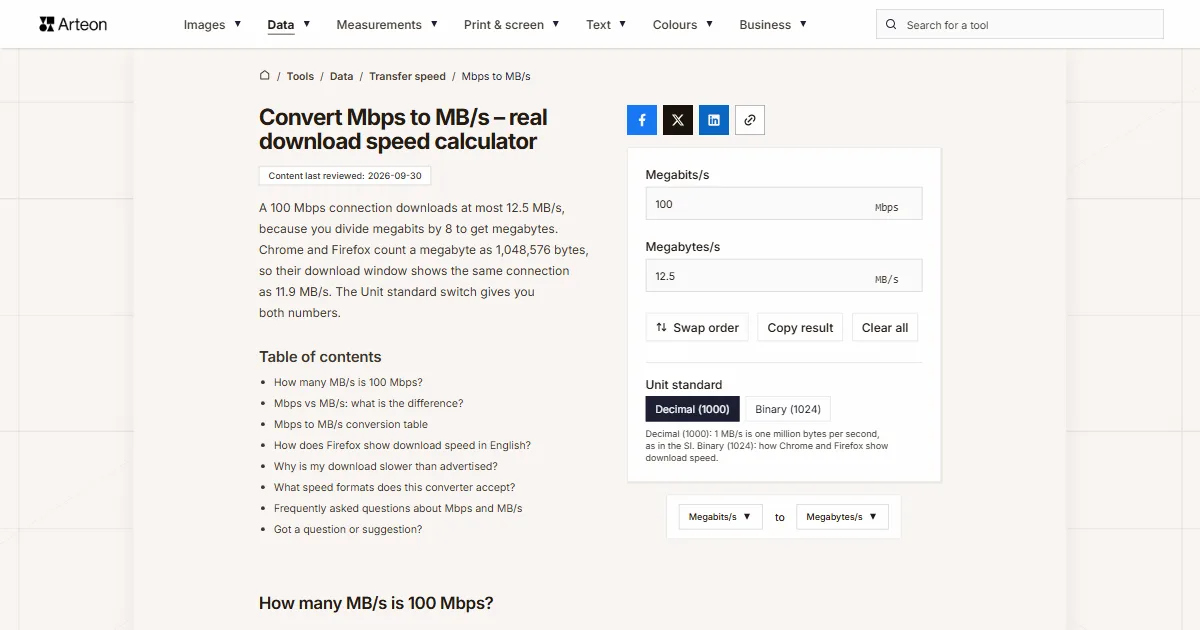
This release adds 111 converters, 53 of them in all eight languages. Data gets a Transfer speed subcategory with 11 converters for bits and bytes per second, Measurements gets Pressure, Data size grows by 18 converters and Volume by 48. Converter fields now read far more of what people paste, from 5 ft 3 in to 56k and 400GE, and a long list of entries that used to give a wrong number without a word now gets a clear message. See the details of the 30 September 2026 update.
New tools: 111 converters
This release adds 111 new converters, 53 of them in all eight languages, and gives one existing tool a new home. Data gets a new subcategory, Transfer speed, with 11 converters for bits and bytes per second. Measurements gets a new subcategory, Pressure, and Data size grows by 18 converters for units from the bit to the yottabyte. Volume gains 48 converters for metric, kitchen, American and British measures and drops. Every new page has tables, answers to the questions people ask about the conversion, a list of sources and facts that differ from market to market. Below you will find all the new tools and what waits on their pages.
Transfer speed
Data has a new subcategory, Transfer speed, with 11 converters. They convert between units of bits per second, used for links, ports and internet plans, and between megabits and megabytes per second, the unit that download windows and drives show. Every converter that involves bytes has a Unit standard switch with Decimal (1000) and Binary (1024) options, so a figure from a browser or a program that counts by 1,024 converts correctly. The Mbps to MB/s converter has moved here from Numbers & time, and its old address redirects to the new one. Depending on the converter, the field also reads speeds written the way spec sheets and programs write them, such as 400GE, 10G, 56k, 9600 baud or 1 gig.
Bits per second
- The kbps to Mbps converter puts Spotify music, a Zoom call and a YouTube video in one table and shows how to do the conversion in Excel.
- The Mbps to kbps converter gives the value for the Video Bitrate box in OBS Studio for eight resolution and frame rate settings that YouTube recommends for live streams.
- The Mbps to Gbps converter converts GPON and XGS-PON fibre lines and shows step by step how to check whether a speed test matches your plan.
- The Gbps to Mbps converter covers Ethernet ports, USB connectors, SATA drives and Wi-Fi in an 18-row table and explains why a speed test on a 1 Gbps connection shows about 940 Mbps.
- The Gbps to Tbps converter lists the Ethernet rates from a gigabit to a terabit with the IEEE standard and year of each, and adds up how many gigabits a single optical fibre carries.
- The Tbps to Gbps converter starts from the 10.841 Tbps peak LINX reported for 2024 and works out how many 100, 400 or 800 Gbit/s ports add up to a given capacity.
- The Tbps to Pbps converter shows how much of a petabit the Internet2 and Janet research networks carry.
- The Pbps to Tbps converter converts the 2025 record of 1.02 Pbps and compares a lab record with a real network.
Bits and bytes per second
- The Mbps to MB/s converter shows how Firefox writes download speed in English and has a table of what a download over TCP reaches on five ports.
- The MB/s to Mbps converter shows how to switch Steam from MB/s to Mbps and which port is enough for a given download speed.
Data size
The Data size subcategory gains 18 converters for units from the bit to the yottabyte. The converter on the subcategory page now lists 25 units in three groups, Bits, Bytes and Binary bytes, which make 600 pairs. On some of the new pages a Unit standard switch with the options Binary (1024) and Decimal (1000) lets you count the way Windows does or the way drive makers do.
Bits and bytes
- The bytes to bits converter shows how many bytes a character takes in UTF-8, using the word résumé as an example, and where the words bit and byte come from.
- The bits to bytes converter lists data sizes that are usually given in bits, such as IPv4 and IPv6 addresses, and explains how the 8-bit byte became the standard.
Binary units: GiB and TiB
- The gigabytes to gibibytes converter explains why a 1 TB drive shows up as 931 GB in Windows, and a table tells you where GB means gigabytes and where it means gibibytes.
- The gibibytes to gigabytes converter covers RAM, where 16 GB on the label means 16 GiB, or 17.18 GB, with the RAM options of the Raspberry Pi 5 as an example.
- The terabytes to tebibytes converter explains why a 4 TB drive can show only 2 TB, and a table gives the TiB a Synology NAS reports for common RAID setups.
- The tebibytes to terabytes converter reads sizes written as 3.7T in df -h output and shows that a 10 TiB cloud quota is almost 11 TB.
Large units: TB, PB, EB, ZB and YB
- The petabytes to terabytes converter reads a line such as Raw capacity: 1.2 PB from a storage array quote and lists the units after the petabyte with the year each prefix entered the SI.
- The terabytes to petabytes converter counts how many drives and tapes make up a petabyte in each standard.
- The exabytes to zettabytes converter shows how much memory a 64-bit processor can address: exactly 16 EiB.
- The zettabytes to exabytes converter converts the largest disk a GPT partition table can address, 8 ZiB with 512-byte sectors, and explains the German Trilliarde and the French trilliard.
Pressure
Measurements has a new Pressure subcategory with eight converters between bar, kilopascals, psi and standard atmospheres. The field on each page also takes a value pasted with another pressure unit, such as 36 psi or 1013 hPa, and converts it before it calculates.
- The atmospheres to psi converter has a table of diving depths in sea water and fresh water with their absolute pressure in psi. It also works out a hyperbaric chamber pressurised to 2.4 atmospheres absolute, which is 35.2703 psi.
- The psi to atmospheres converter shows six decimal places and turns gauge readings from 0 to 3,000 psi into absolute atmospheres. A second table puts records for sea-level air pressure into psi.
- The bar to kPa converter shows where the bar sits among the units of the pascal family and explains why a millibar in a weather forecast is the same as a hectopascal.
- The kPa to bar converter walks you through setting a tire pressure from a placard in kilopascals with a gauge that reads in bar, using 240 kPa as the example.
- The bar to psi converter gives the pressure in a tire, an espresso machine, a scuba cylinder and a hydrogen fill, from 2.3 to 700 bar, in psi. It also sets the bar, the standard atmosphere and the technical atmosphere side by side, because each gives a different number in psi.
- The psi to bar converter turns psig and psia into barg and bara in one table and shows what a 32 psi tire and a 3,000 psi scuba cylinder hold in bar.
- The kPa to psi converter has 76 ready conversions, the pressures at which the tire pressure warning light comes on, and MAP sensor readings turned into gauge pressure.
- The psi to kPa converter has 58 ready conversions and the warning threshold of the US standard FMVSS 138 for 16 recommended tire pressures. It also converts the pressure ranges from Trek’s chart for road and gravel bike tires.
Length
- The decimeters to millimeters converter explains why a decimeter holds 100 millimeters and not 10, and its table adds centimeters for homework on metric units.
- The millimeters to decimeters converter shows how rainfall in millimeters turns into decimeters of water and liters per square meter.
- The feet to kilometres converter gives mountain heights and flight levels in kilometres, starting with FL350 at 10.668 km. It also uses the International Standard Atmosphere to work out how cold it is at 35,000 feet.
- The kilometres to feet converter explains how China and Mongolia assign flight levels in metres and puts Ben Nevis, 1.345 km high, at 4,412.73 feet.
- The inches to yards converter adds a Yards and inches line under the result, so 100 inches reads as 2 yd 28 in. Its fabric table tells you how much to buy when a store sells by the eighth of a yard.
- The yards to inches converter takes a length typed as 2 yd 18 in, and its tables cover fractions of a yard down to 1/16 and the sizes of fat quarters and fat eighths.
- The kilometers to light-years converter keeps ten significant digits, so a million kilometers still shows as 0.0000001057000834 ly, and a Scientific notation line sits under the result. The field reads distances typed with a word, such as 25 billion.
- The light-years to kilometers converter writes the result in full and in scientific notation. It also explains why sources give different kilometer figures for a light-year, a gap that reaches 200 million kilometers.
Weight
- The decigrams to kilograms converter places the decigram among the metric mass units from the kilogram to the milligram and gives the sentence King Henry Died By Drinking Chocolate Milk for remembering their order.
- The kilograms to decigrams converter breaks a kilogram down into six smaller metric units and gives an avoirdupois pound as about 4,535.9 dg.
- The kilograms to ounces converter has an Ounce type switch with Avoirdupois (oz) and Troy (oz t), so a kilo bar of gold or silver comes out as 32.1507 troy ounces. A table turns a baby’s weight in kilograms into pounds and ounces.
- The ounces to kilograms converter has the same switch, and its bullion table gives weights in kilograms from a tenth of a troy ounce to a 1,000-ounce London silver bar.
Volume
The Volume subcategory gains 24 converters for the American and British measures: the barrel, the gallon, the quart, the pint and the recipe cup, together with millilitres and litres. Where a unit has more than one size, a switch under the fields picks it, so the Gallon type, Quart type, Pint type and Barrel type switches keep the US liquid, US dry and imperial measures apart.
Barrels
- The barrels to gallons converter has a Barrel type switch with the options Oil, US beer, US liquids and UK beer, and a table of five barrels, among them the 31-gallon US beer barrel, the 31.5-gallon barrel for liquids and the UK beer barrel of 36 imperial gallons. The field also reads Mbbl and MMbbl from oil reports, so 5 Mbbl counts as 5,000 barrels.
- The gallons to barrels converter shows that a 55-gallon drum holds 1.3095 barrels of oil, sets seven keg sizes against the US beer barrel and explains how to turn gallons per minute into barrels per day.
- The barrels to litres converter lists all four barrels from the switch side by side and has a refinery table with the litres of gasoline, diesel and jet fuel that one barrel of crude yields.
- The litres to barrels converter starts from 1000 l, which is 6.2898 bbl, and works out how many barrels of oil a tanker carries.
Gallons, quarts and pints
- The gallons to quarts converter needs no switch, because a gallon holds four quarts in the US liquid, imperial and US dry systems alike. Its container table shows that a 55-gallon drum holds 220 quarts.
- The quarts to gallons converter turns a tote marked 66 qt into 16.5 gallons and explains how the dry quart relates to the peck and the bushel.
- The gallons to pints converter has both the Gallon type and Pint type switches, so it also converts US gallons into imperial pints, and a table of 8 American and British keg and cask sizes.
- The pints to gallons converter gives every answer as a fraction of a gallon too and shows how to write a result in gallons and pints.
- The pints to quarts converter writes an odd number of pints as a recipe does, 5 pt as 2 1/2 quarts, and turns British pub servings into quarts and millilitres.
- The quarts to pints converter adds a half-pint column and a table of 11 American packages, from milk bottles to ice cream tubs and canning jars.
Cups, gallons and pints
- The cups to gallons converter shows that sixteen cups make one US gallon and sets out the US measures from the fluid ounce to the gallon across 7 rows.
- The gallons to cups converter gives the cup count for all three gallons on its Gallon type switch: 16 in a US gallon, 18.6184 in a dry gallon and 19.2152 in an imperial one.
- The cups to pints converter takes fractions such as 3/4 and mixed numbers such as 2 1/2 and adds the dry pint that berries are sold by to its Pint type switch.
- The pints to cups converter answers how many cups are in a pint of strawberries or blueberries and lists eight pints from different markets in millilitres and cups.
Millilitres and litres
- The gallons to millilitres converter puts the US, imperial and US dry gallon side by side and explains why the same drum is 55 gallons in the States and 44 in Britain.
- The millilitres to gallons converter turns a 750 ml wine bottle into 0.198129 of a US gallon and tells how that bottle replaced the fifth of a gallon.
- The litres to quarts converter turns a 5 l pack of oil into 5.28 US quarts and has a table of common bottle and canister sizes.
- The quarts to litres converter translates engine oil capacities that a car manual gives in quarts into litres and one-litre bottles.
- The millilitres to quarts converter explains why an American carton says 946 ml, which comes to 0.9996 quarts.
- The quarts to millilitres converter also gives the pint, cup, fluid ounce, tablespoon and teaspoon in millilitres and compares a quart with a metric measuring jug.
- The litres to pints converter turns ten packs and kegs described in litres into US and imperial pints and explains what the word pint means in different markets.
- The pints to litres converter answers whether two pints make a litre and lists seven British measures built on the pint, from the gill to the quarter.
- The millilitres to pints converter explains why a 375 ml bottle is called a pint in the US and lists drink cans from different countries in US and imperial pints.
- The pints to millilitres converter gives the British beer and cider measures from a third of a pint to two pints and answers whether a pint is half a litre.
Metric volume units
- The centiliters to liters converter turns 25 standard US bottle sizes for spirits into centilitres and litres, and compares six metric units, from the millilitre to the hectolitre.
- The liters to centiliters converter shows the measures that UK law sets for pubs in centilitres: a 25 ml spirit measure is 2.5 cl and a 175 ml glass of wine is 17.5 cl.
- The centiliters to milliliters converter sets 14 bottle sizes from Directive 2007/45/EC against the wording on the label and gives four steps for reading the capacity off a European label.
- The milliliters to centiliters converter converts 18 American bottle capacities from 27 CFR 5.203 into centilitres and shows in four steps how to rewrite a recipe from millilitres into centilitres.
- The deciliters to liters converter turns 8 recipe amounts into millilitres and US cups, and gives four ways to read a decilitre off a household jug.
- The liters to deciliters converter gives 8 containers you meet on a shelf in decilitres and shows how to convert a whole spreadsheet column at once.
- The deciliters to ml converter takes a Swedish recipe with the measures dl, msk, tsk and krm through four steps, and turns 10 amounts into 15 ml tablespoons and 5 ml teaspoons.
- The milliliters to deciliters converter lists 8 packages in decilitres and shows how the nutrition on a label given per 100 ml scales to the serving you pour.
- The liters to cubic meters converter works out how many compost bags of 20 to 80 litres fill a cubic metre. It also explains why one litre of liquid propane makes about 0.27 m³ of gas.
- The cubic meters to liters converter explains a water meter reading, where the three digits after the decimal point are litres, so 123.456 m³ is 123,456 litres. The field also takes a number pasted with m³, m3, m^3 or CBM.
Cups, ounces and spoons
- The cups to liters converter has a Cup type switch for the US customary cup, the US legal cup from food labels and the metric cup. A separate table shows that a 12-cup coffee maker takes 1.77 litres of water, because each water mark on the carafe counts 5 US fluid ounces.
- The liters to cups converter explains why a rice cooker sold as 1.8 litres holds 10 cups: the maker counts in the 180 ml rice cup that comes in the box.
- The cups to fluid ounces converter gives nine cups, among them the Japanese 200 ml cup and the drip coffee maker cup, in US and imperial fluid ounces, and explains why a cup of water weighs about 8.35 ounces.
- The fluid ounces to cups converter separates five measures that share the name ounce, three of volume and two of mass, and lists eleven American capacities in cups.
- The millilitres to tablespoons converter has a Tablespoon type switch for the metric, US and Australian spoon. It also says what to measure a medicine dose with, based on FDA guidance from May 2011 and a study of cutlery from 25 households in Athens.
- The tablespoons to millilitres converter explains where the three tablespoons come from, including the US spoon of 14.78676478125 ml derived from the gallon, and why a level spoonful of flour and one of oil hold the same 15 ml but weigh differently.
- The millilitres to teaspoons converter has a Teaspoon type switch for the metric and US customary spoon, and a table writes 10 medicine doses, such as 1.25 ml and 3.75 ml, as fractions of a teaspoon with the spoons from a measuring set.
- The teaspoons to millilitres converter compares six kinds of teaspoon with their capacity and tells you which one to pick in the converter.
- The tablespoons to teaspoons converter compares five spoon sets by how many teaspoons go into a tablespoon and explains why the US spoon also divides into exactly three.
- The teaspoons to tablespoons converter splits 19 portions into whole tablespoons and the teaspoons left over, explains the lower-case t and capital T in recipes, and lists the names of both spoons in eight languages.
Drops and millilitres
- The drops to ml converter counts the metric pharmacy drop of 0.05 ml, so 20 drops make 1 ml, and the field reads entries such as 20 drops or 20 gtt. A table sets that drop against the US and British minims, which the 1809 London pharmacopoeia introduced as an alternative to the drop, and against IV drip sets of 10 to 60 drops per millilitre.
- The ml to drops converter explains why eye drops come out smaller than the metric drop: a 1986 study of 20 glaucoma medications measured an average drop of 39.0 µl, so a millilitre of such a medicine gives about 26 drops.
Centilitres and fluid ounces
- The cl to oz converter turns a label in centilitres into US or UK fluid ounces with the Ounce type switch, so 75 cl reads as 25.36 US fl oz or 26.4 UK fl oz. The page also gives UK pub measures of 25 ml and 35 ml in ounces and shows that a 70 cl bottle holds 28 single 25 ml measures.
- The oz to cl converter reads cocktail fractions such as 3/4, 1 1/2 and 1½ typed or pasted into the field, so 1 1/2 oz gives 4.44 cl. A table puts the US standard drink of 12 fl oz of beer, 5 fl oz of wine and 1.5 fl oz of spirits into centilitres.
Colour conversion
- The CMYK to HEX converter reads values pasted from a brand guide, with or without percent signs, with the channel letters C, M, Y and K, or in device-cmyk() notation. A table shows what seven CMYK values turn into after a round trip to hex and back, and explains why none of the 1,875,000 values we checked with all three color inks above zero came back unchanged.
- The HEX to CMYK converter compares the formula with the GRACoL 2013 and PSO Coated v3 press profiles for seven codes, and lists the CMYK values of the HM Government brand palette. It expands the three-character shorthand and ignores the transparency pair of an eight-character code.
- The HSV to RGB converter has an HSV notation switch for degrees and percent, the OpenCV scale and 0–1 fractions, and it reads a NumPy array or a colorsys tuple pasted from Python. A table shows how the whole numbers Figma gives can move an RGB channel by one step.
- The RGB to HSV converter gives twelve common colors in all three notations of the switch. A second table runs the GOV.UK Design System blues through it: the hue stays close to 208°, the lighter tints lose saturation and the darker shades lose value.
Typographic units
- The points to centimeters converter, like the other five new point converters, has a Point type selector for the PostScript (DTP), Printer's (TeX) and Didot points. Its tables give the height of a capital letter in Arial, Calibri, Times New Roman and Verdana for 17 sizes from 36 to 1,638 pt.
- The centimeters to points converter gives each length in its table both to two decimal places and rounded to the half-point steps Word accepts. It also gives the largest font size in Word, PowerPoint and Excel in centimeters.
- The points to millimeters converter turns line weights from 0.1 to 6 pt into millimeters and lists ten traditional English type size names, from agate to great primer.
- The millimeters to points converter converts technical pen widths from 0.1 to 2 mm and twelve paper, envelope and business card sizes into points. It also tells you which font size gives a capital letter of a set height, from 1.5 to 50 mm.
- The points to inches converter gives 19 font sizes together with the real height of a capital letter in Arial and Times New Roman, and turns page sizes read from a PDF file into inches.
- The inches to points converter reads fractions such as 3/4 and 8 1/2, and converts the trim sizes, margins and bleed that Kindle Direct Publishing gives for paperbacks.
- The em to rem converter has Parent font-size and Base font-size fields, and the second one also takes a percentage such as 62.5%. A table rewrites seven typical em declarations in rem.
- The rem to em converter lists rem and em support in nine email clients from Can I email tests, and explains why email templates are written in em: rem fails in every tested version of Outlook for Windows from 2003 to 2019.
Numbers & time
- The numbers to Roman numerals converter writes numbers up to 3,999,999, with a bar over the letters from 4,000, and converts each part of a date on its own, in the order you typed it. A table lists every year from 1970 to 2030.
- The Roman numerals to numbers converter reads non-standard forms such as the IIII on clock faces and shows the usual spelling on the Standard form line under the result. A table gives the Super Bowl numbers from LI to LX.
New features
Units typed into a converter field
- A value written with a unit of the same kind now converts to the unit of the field, and a line under the field shows what it became. Type 5 ft 3 in into the feet to meters converter and the line reads “The pasted value 5 ft 3 in is 5.25 ft in this field.”, with 1.6002 m as the result. 1.5 t in the tons to kg converter becomes 1.653467 short tons, which is 1,500 kg, and 2 kg 500 g in the kg to lb converter gives 5.51 lb.
- A unit of a different kind gives a message instead of a number. 8 km in the kg field answers “This field works in kg, and 8 km measures something else, so it can’t be converted.”
- All mass fields take a pasted metric unit, the decagram included: 20 dag in the kg field is 0.2 kg, which is 0.44 lb.
- A unit name with a word that picks one definition is read with that definition. 1 imperial gallon in the gallons to liters converter becomes 1.20095 US gallons and gives 4.5461 litres. 1 troy ounce in the fluid ounce field of the ounces to cups converter gets the message that it measures something else, because a troy ounce is a weight. On the Polish and Czech pages the fields also read every grammatical form of a unit name after a number.
- More fields read a number written with a word: 25 billion km in the km to light years converter gives 0.002642502085 ly.
- The point field of the pt to cm converter reads the size written as a word processor names it: 12-point gives 0.4233 cm.
- A single point is now a decimal point on all eight language versions, as it already was in English. On the German kg to pounds page 1.500 is 1.5 kg with the hint “Gelesen als 1,5…”, and the Swiss thousands apostrophe in 1'500 gives 1,500 kg.
Data size
- The main data size converter has 25 units in one list with three groups: bits, bytes from B to YB, and binary bytes from KiB to YiB. The Decimal (1000) and Binary (1024) switch appears for KB to YB. A value pasted with its unit sets the list for you: 4.7 GB gives the line “Your entry gives the unit as GB, so we set this field to GB.”
- Bits pasted into a byte field are converted to the unit of the field. The capital letters decide: 8Gb, written as on memory chip data sheets, means gigabits, so with Decimal (1000) the GB to MB converter shows “The pasted value 8 Gbit is 1 GB in this field.” and 1,000 MB, while 500gb stays 500 GB.
- A line copied from the Windows Properties window converts from the exact byte count in brackets: 2.34 MB (2,457,600 bytes) in the MB to KB converter becomes 2.4576 MB and gives 2,457.6 KB with Decimal (1000).
- The Kubernetes short forms Ki, Mi and Gi without a B are read as binary bytes, so 5 Ki is 5 KiB. A prefix letter on its own, as in 5 K, gives a message instead of a guess.
- Whole numbers keep every digit up to 9,007,199,254,740,992: that many bytes in the bytes to bits converter give 72,057,594,037,927,936 bits.
- On the French pages the octet symbols convert on every page, also in lowercase right after the number: “2 go” in the Mo field is 2,000 Mo, and “128 Go” in the Po field is 0.000128 Po.
Transfer speed
- Baud counts as bits per second, which is what it equals on a serial line: 9600 baud in the kbps to Mbps converter becomes 9.6 kbps and gives 0.0096 Mbps.
Volume
- On the Polish, German, Spanish, French, Portuguese, Italian and Czech cup pages, the word for an everyday kitchen cup or glass, such as “1 taza” or “1 hrnek”, now gives a note that such a vessel has no single capacity and that you should measure it and type the result with a unit.
Colours
- Changing the notation switch now always rewrites the entry in the new notation, also when the entry is valid in both. In the HSL to HEX converter, 120, 50, 50 becomes 85, 127, 128 when you move from CSS (0–360°, 0–100%) to Microsoft Office (0–255).
- Colour fields accept a decimal comma: rgba(59, 130, 246, 0,5) in the RGB to HEX converter gives #3B82F680, and 76,5% 47% 0% 4% in the CMYK to HEX converter gives the same #3A82F5 as 76.5%.
PDF to image
- The PDF to JPG, PDF to PNG and PDF to WebP converters run on version 6 of the PDF.js library.
- A page too large for the browser, such as an A0 poster on an iPhone, is saved at the largest size the browser can hold, with the note “We saved this page at a lower resolution (… × … px) because at full size it is too large for this browser.” A page measuring 14,400 points, which used to end with an error, now saves too.
- A browser too old for the library shows “This browser is too old to open PDF files in this tool. Update it to the latest version or open the page in another browser. On an iPhone or iPad, Safari updates together with the system.”
Swap order
- The Swap order button carries the exact value to the other page, so swapping back and forth returns the number you started with. In the TB to PB converter with Binary (1024), 500 TB is 0.488281 PB, and swapping twice brings back 500 TB.
Fixed bugs
Entries that gave a wrong number
- Ranges. “100–300” was read as 100300. A range now gives “This number cannot be converted. Enter a single number, for example 12.5.”, whether it is written 100–300 Mbps, 1~2, 10—20 kg or 2 to 3 TB. The point field treats 12-15pt the same way.
- A minus before a pasted unit. -80 kPa in the bar field of the bar to psi converter lost its minus and gave 0.8 bar. It now reads -0.8 bar and gives -11.6 psi.
- Cubic metres. 10 m³ was counted as 10 to the power of 3. In the cubic meters to liters converter it now gives 10,000 litres.
- Two speeds from a product page. A read and write pair such as 1050/1000 MB/s was read as a fraction and gave 8.4. It now gets the message asking for a single number. Fractions such as 1/2, 3/4 and 5/16 work as before.
- Other units in speed fields. 5600 MHz copied from a memory module or 8 kg gave a result a thousand times too large. Both now get the message asking for a single number.
- Baud. 9600 baud in the kbps field gave 9,600,000 bits per second, because the field did not know the word. It now gives 9.6 kbps.
- “1 gig”. In the Mbps field of the Mbps to MB/s converter it was read as 1 Mbps. It now reads as 1,000 Mbps and gives 125 MB/s.
- Units typed letter by letter. The speed fields removed every letter the moment you typed it, so a unit could only be pasted, never typed. Letters now stay in the field as you type, and the result comes once you pause: 9600 bps typed into the Mbps field gives 0.0096 Mbps, and 1 MB/s gives 8 Mbps.
- A qualified unit name on the Polish pages. A word after the unit that picks its definition was ignored, so “1 uncja trojańska” (a troy ounce) counted as an ordinary ounce. It now gives 31.103477 g.
- A hint with no reason. 125 Mbps pasted into the MB/s field showed a separator hint, although the number has no separator. It now shows only “The pasted value 125 Mbps is 15.625 MB/s in this field.”
- A value typed into the result field. In the kg to oz converter a number typed into the ounce field changed once the converter recalculated. 3.5 now stays 3.5, and the kg field shows 0.09922.
- A colour in the wrong notation. A cmyk() value pasted into an RGB field and an rgba() value pasted into a CMYK field gave a different colour without a word. cmyk(76%, 47%, 0%, 4%) in the RGB field now gives “This entry cannot be read as an RGB colour. Enter three numbers from 0 to 255, for example rgb(59, 130, 246).”
PDF to image
- Scans compressed for fax, with JBIG2 or with JPEG 2000 came out as blank pages. They now show the scanned page.
- One password-protected file stopped the whole selection. It now gets its own row with “This PDF is password-protected, so it cannot be opened. Save a copy without the password and add it again.”, and the other files convert.
- A PNG chosen together with a PDF was skipped without a word. The page now says “Add PDF files. Files in other formats were skipped.”
- The pages promised a limit of 100 MB per file, but the converter did not check it. A larger file now gets the row “File is too large (max 100 MB).”
Actions before the page has loaded
- In our tests, 12 of 15 actions made before the page had finished loading were lost: a number typed into the cm field of the cm to inches converter, a click on Swap order, a PDF file chosen for conversion, or a quality slider moved to 70, which the converter then ignored and used 90. Now each of them is applied as soon as the page is ready.
- In the image to Base64 converter, a format chosen from the list before the page had loaded showed CSS background (background-image), while the code came out as a data: URL. The choice now holds, and the same fix covers the image resizer, the email signature generator and the data size converter.
Links and pages
- 164 internal links on the volume and length pages led to pages that did not exist yet. A link to a page that is not published now shows as plain text.
- The Mbps to MB/s converter moved to the transfer speed section, and its old address redirects to the new one.
- The error page of the French site was in Spanish. It now uses French.
- A YAML file with merge keys (<<) could freeze the browser tab in the YAML to JSON converter. An update of the YAML library fixed it.
Content
- The home page answer to “Are the tools available in other languages?” gave a total count of languages, including ones that are not published yet. It now names the eight languages the site is in: English, Polish, German, Spanish, French, Portuguese, Italian and Czech.
- The contact forms no longer promise a reply within one working day, and the data size and transfer speed forms no longer say that we reply to every message.
- On the Polish, German, Spanish, French, Portuguese, Italian and Czech pages, numbers group thousands with a non-breaking space instead of a point. A number copied from a table therefore gives the same value in the field, and it no longer breaks across two lines. Results of the text tools, such as reading time, use the same spacing.
- Footnote numbers now follow the word directly, with no space before them, on all eight language versions.
- The PDF to image pages explain that a scan from a multifunction printer or a fax comes out as a complete page image, but its text stays part of the picture, so you cannot select or copy it. They give an A4 page as about 1190 × 1684 pixels, because the exact size depends on the program that made the PDF.
- Pages in other languages were checked against their sources and corrected:
- the French and Italian km to feet pages give Mont Blanc as 4,807.3 m, from the latest measurement;
- the Portuguese pt to px page no longer credits the Brazilian standards body ABNT with the size name “corpo 10”;
- the Portuguese cup pages give the xícara as 200 ml on food labels and 240 ml in recipes;
- the gallons to quarts pages describe the origin of the 42-gallon barrel as the source does;
- the Italian pt to mm page gives the Fournier point with a source and the American point as 0.35146 mm;
- claims about a single capacity of a glass or cup (szklanka, hrnek, Tasse, taza, tazza) that had no source or contradicted one were removed from the Polish, Czech, German, Spanish and Italian pages.
- The description of how we measured file sizes on 60 image converter pages no longer names the testing software.
More news
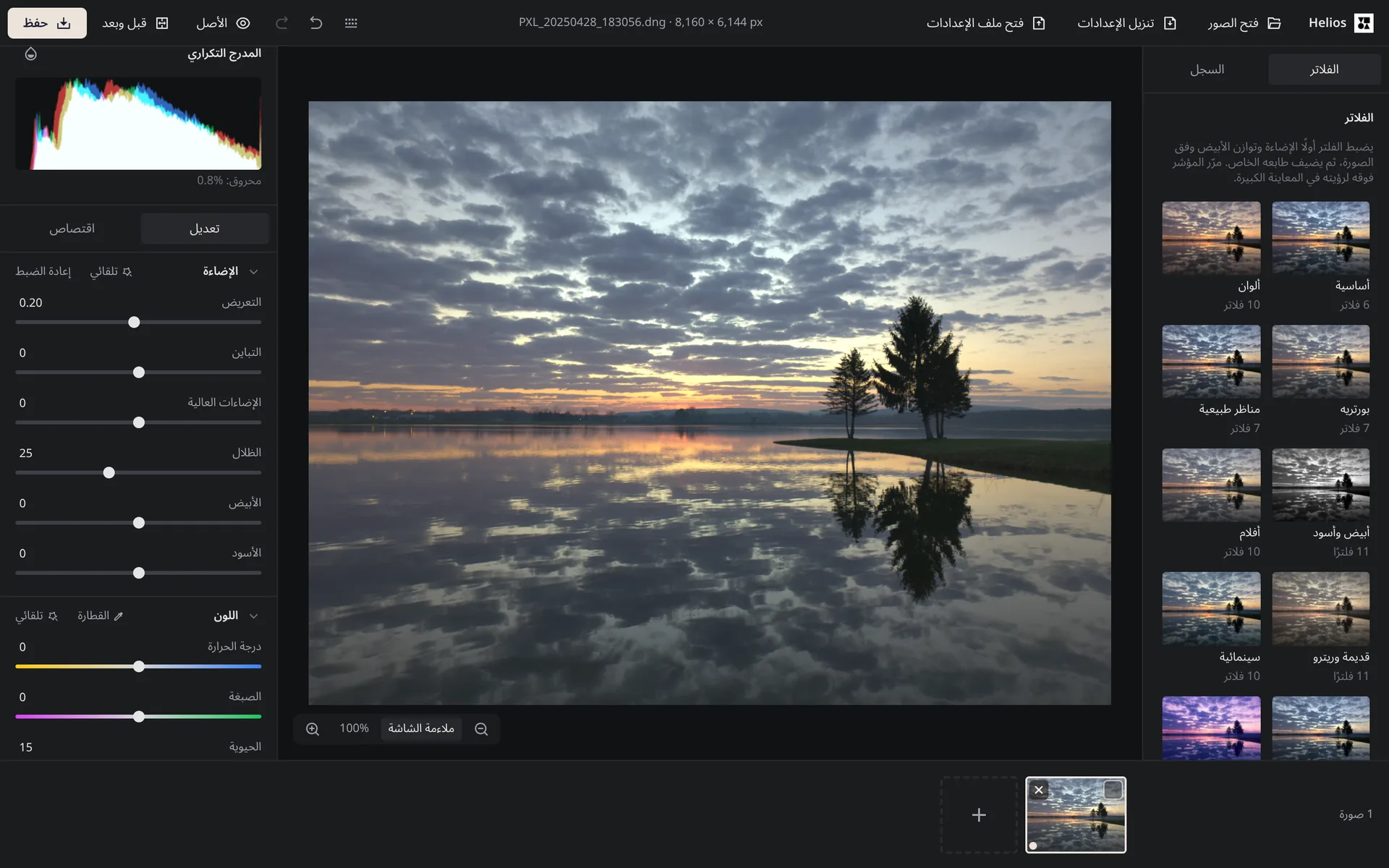
Update of 6 November 2026: ten new languages, Helios and print and screen converters
Published:
Arteon tools now work in 18 languages. This update adds Arabic, Indonesian, Turkish, Greek, Ukrainian, Romanian, Thai, Japanese, Vietnamese and Hindi, each with the Helios photo editor and part of the Print and screen category. The Helios guide now explains how your work is saved in the browser, and the privacy policy describes it in every language. See the details of the 6 November 2026 update.
Read the full post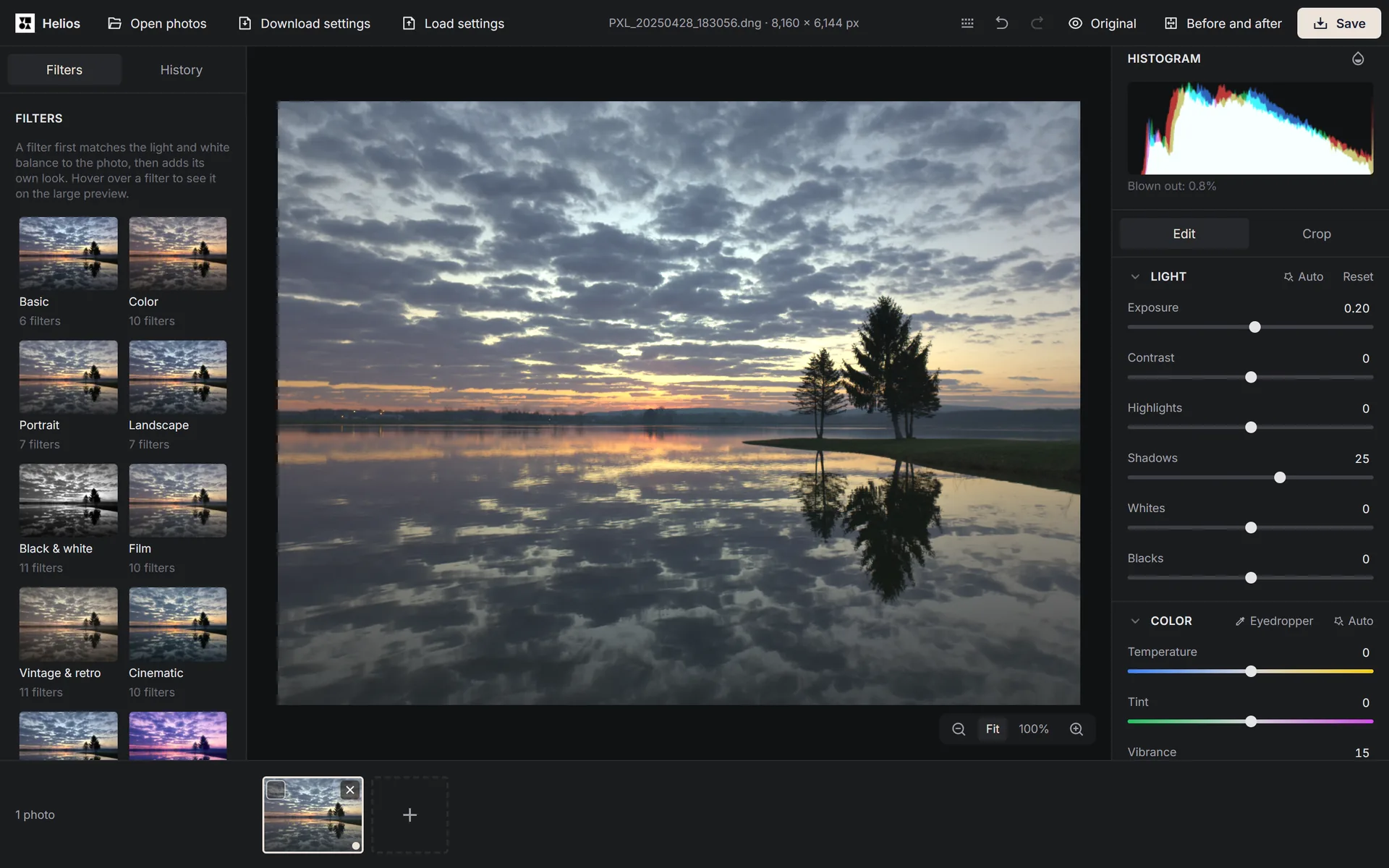
Update of 7 October 2026: Helios photo editor and ten unit converters
Published:
This release adds Helios, a free photo and RAW editor that works in your browser and never sends your photos to a server. Every subcategory with unit converters also gets its own converter on the subcategory page, from 16 units for pixels and DPI to 302 for length, in all eight languages. Converter fields now give a message instead of a wrong number for words they do not know. With the new subcategory converters, we removed 673 pages for unit pairs that get very little traffic in a given language. See the details of the 7 October 2026 update.
Read the full post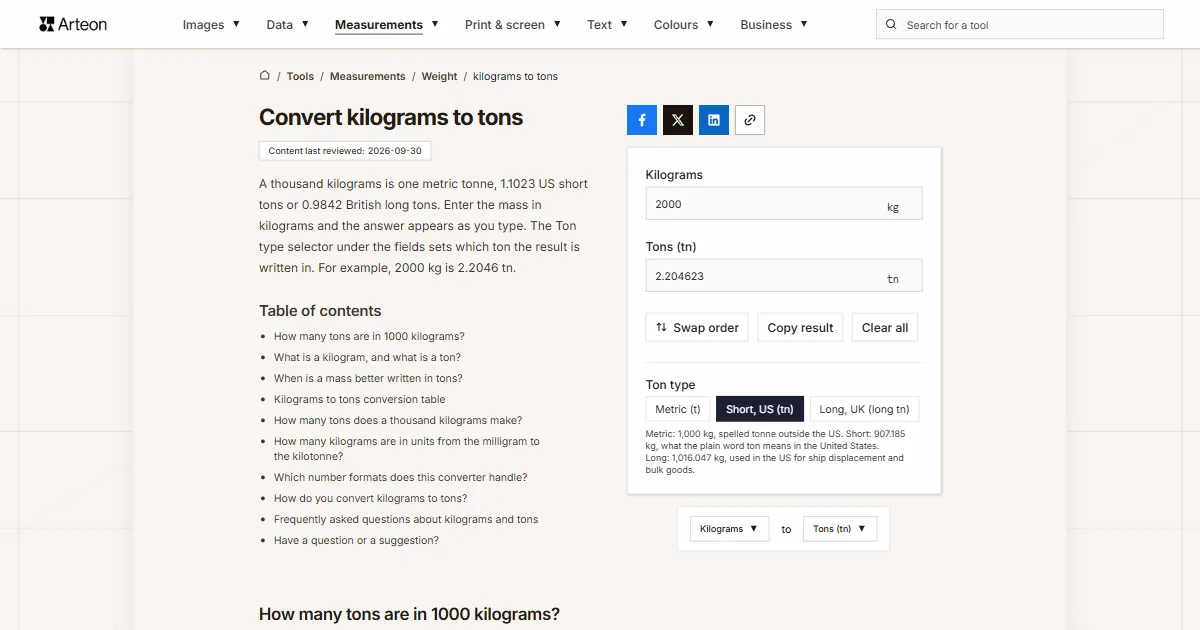
Update of 23 September 2026: 24 weight converters, HSL colour tools and new text calculators
Published:
This batch adds 24 weight converters in eight languages, four colour converters built around HSL and five tools for working with text. It also brings a rebuilt editor in the email signature generator, a privacy policy rewritten in seven languages, fixes for what the converter fields accept and much, much more. See the details of the 23 September 2026 update.
Read the full post